
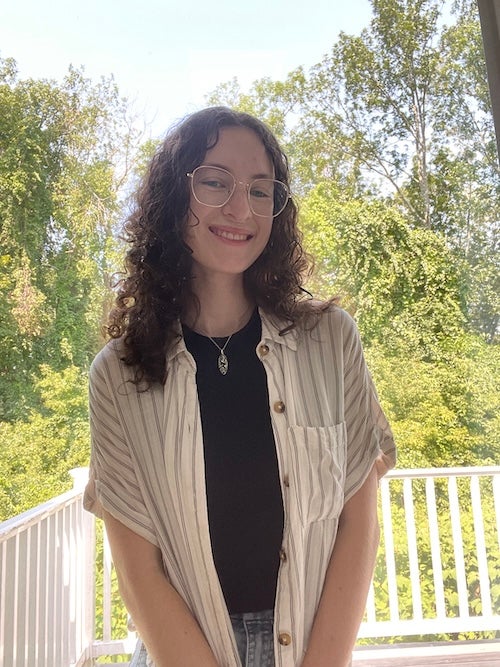
For URI marine biology and wildlife and conservation biology double major Faye Santaniello, this summer has been an opportunity to explore the evolutionary history of one of the ocean’s most fascinating animals: the horseshoe crab.
As a CELS Summer Research Fellow working in the Schwartz Lab with Dr. Rachel Schwartz, Santaniello used computational methods to study the evolutionary relationships between horseshoe crabs and other members of the subphylum Chelicerata, which includes arachnids. Her research is helping investigate a longstanding evolutionary question: Where exactly did horseshoe crabs diverge from the rest of the arachnid family tree?
Santaniello, who is from Warwick, Rhode Island, has analyzed archived genome sequences, aligning genes and using software to compare genetic differences among species. Here, she talks about her research, what she has learned and why horseshoe crabs have captured her attention.
Q. How would you explain your research to someone without a science background?
The ancestors of horseshoe crabs are very old, and they’re known as “living fossils” because they retain much of the same appearance as their ancestors from millions of years ago. Basically, they have gills that resemble the lungs in modern arachnids, so it would make sense that horseshoe crabs are related to all groups of arachnids.
However, genetic studies are contradicting this, finding evolutionary trees that show horseshoe crabs diverging between groups of arachnids rather than before arachnids. I’m running a similar study to find where horseshoe crabs diverge on the evolutionary tree of arachnids.
By downloading archived genome sequences, I can use programs to trim the data, align genes and compare the differences to map out evolutionary relationships.
What did your work involve on a typical day?
The majority of my day is spent using Unity, a terminal for inputting commands, and running code. After downloading genome sequences and aligning genes using software, I can build the tree of relationships between species using RStudio.
What has been the most interesting or surprising part of your research?
I’ve had to read through a lot of research papers to find the direction of my project. I’m amazed by the biology and history of horseshoe crabs and their relatives, like ancient sea scorpions!
What skills have you gained through this experience?
I was somewhat familiar with coding in R before this summer, but for this project I got to understand it in a lot more depth. Now, I can apply these skills to any large datasets I encounter in the future.
What has it been like working with Dr. Rachel Schwartz?
I’m super grateful to be working in her lab, since it’s the only reason I can operate software like this at all. After all, she has answered so many of my questions and helped me work through lots of errors.