
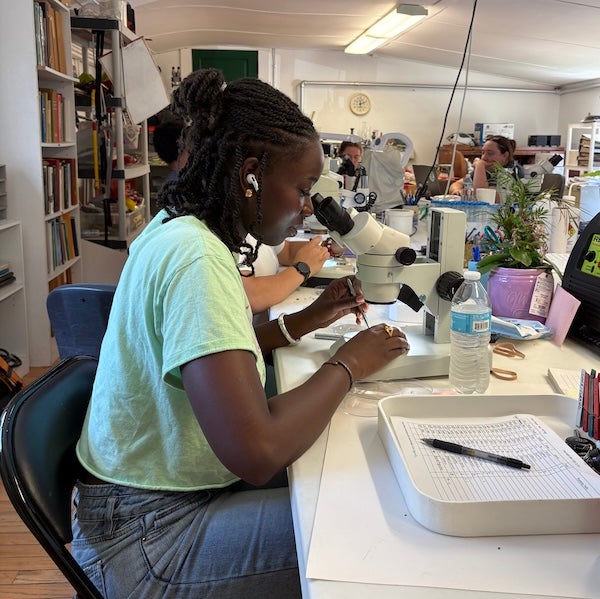
Biological Sciences major Mame Issa Ndoye, of Coventry, RI, spent her summer with the Rhode Island Department of Environmental Management’s (RIDEM) mosquito abatement program, working on vector-borne disease surveillance. As a CELS Summer Research Fellow, her work combined field work and lab work: twice a week, she and her team travel around the state setting up and collecting mosquito traps, each working their own separate routes. The rest of the week, they identify them by species and prepare them to be sent as samples to be tested for viruses that could pose a risk to public health.
Q. Why is mosquito surveillance important for Rhode Island?
Mosquito surveillance is important because it helps us track mosquito-borne diseases in Rhode Island. By monitoring mosquitoes and testing them for viruses, we can better understand where diseases may be present and help prevent further spread.
What have you learned that surprised you?
I learned so much throughout this experience, but the most surprising thing to me was how much goes into identifying mosquitoes down to the species level. I also didn’t realize how much work goes into collecting and monitoring mosquitoes.
What has it been like working with your faculty mentor and the RIDEM mosquito abatement team?
I could not have asked for a better lab experience. Everyone has been so helpful and supportive, and I have really enjoyed working with the team. The work has been amazing, and I am so grateful to have had the opportunity to be part of this lab.
Is there anything else you’d like readers to know?
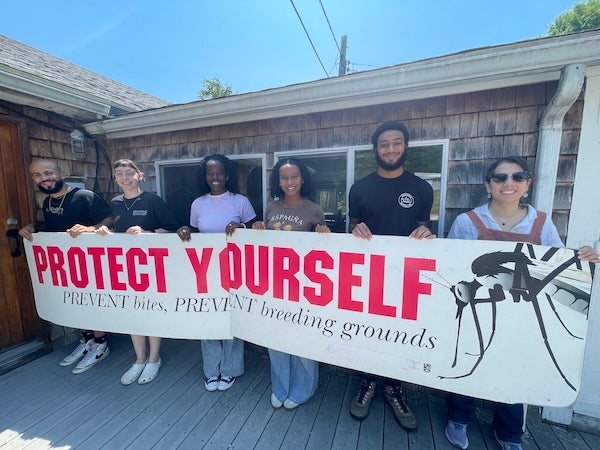
Research has been so much fun, and I’m really glad I got involved in mosquito surveillance. It was something I never expected to enjoy as much as I do, but the experience has genuinely been rewarding. I’m especially glad I stepped outside my comfort zone and gave myself the chance to try something new. I’d like to thank our mentors, Domingo Lora Medina and Dr. Jannelle Couret, who made this experience so memorable, as well as my fellow interns, Azaliah Lopes, Arman Araujo, and Emma Vollucci.