
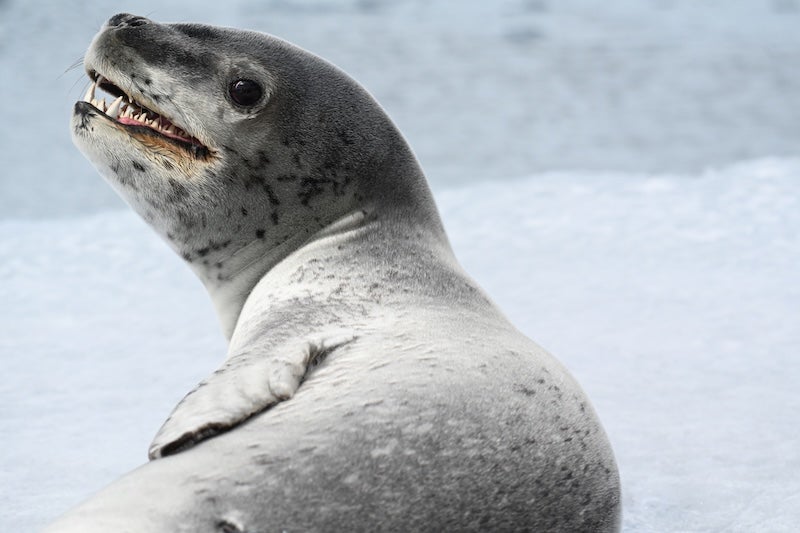
A new study led by the URI’s Dr. Emily Sperou offers the first systematic look at South Bay, Antarctica, as a location where leopard seals feed, linger, and may reproduce.
KINGSTON, R.I. – Sept. 28, 2026 – For decades, leopard seals have been opportunistically observed in South Bay, Antarctica. But no one knew how many were using the area, how long they stayed, or whether the bay served as anything more than a place individual seals passed through.
That began to change when University of Rhode Island researcher Dr. Emily Sperou and her colleagues, in partnership with the Bulgarian Antarctic Program, systematically surveyed the bay.
Over two months during the 2025–2026 austral summer, Sperou and URI Ph.D. student Ariel Leahy documented 33 individual leopard seals — a high seasonal count compared with other known aggregation sites — and began to see a pattern.
By season’s end, they had evidence that South Bay could be a multi-use habitat where leopard seals feed, linger, and may reproduce. The findings were published this month in Polar Biology, establishing the first systematic record of leopard seals in South Bay and providing a crucial foundation for future research.
“It was incredibly exciting to lead this work, document such a large aggregation of leopard seals, and start the first ever monitoring program of leopard seals in this area,” Sperou says.
The expedition
Sperou first heard about South Bay when fellow researchers mentioned seeing leopard seals near the Bulgarian Antarctic Station “St. Kliment Ohridski.” She joined the Bulgarian Antarctic Program’s expedition to find out whether the sightings represented a true aggregation or simply seals passing through.
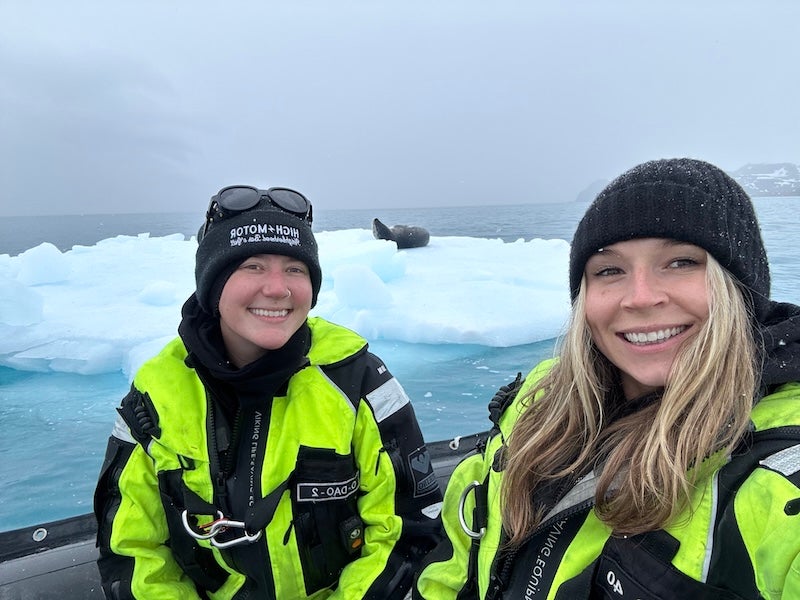
The answer was striking: From November 18, 2025 to January 9, 2026, boat and shoreline surveys recorded 68 sightings and identified 33 individual animals — on two days, eight seals at once. Nine were seen on multiple days: one juvenile male was documented four times over 68 days, while an adult female reappeared nearly two months after her first sighting.
Because weather limited survey effort, the researchers can’t know whether seals were present but undetected on other days. Still, the repeat sightings suggest some animals spent considerable time there.
“Our next question is whether they return year after year,” Sperou says. To help find out, the team photographed every seal they encountered, building an identification catalog from each animal’s unique spots and scars.
A varied menu — and signs of breeding
Repeated sightings showed that leopard seals were using South Bay over time. The researchers then began to document how they were using it.
“The leopard seals of South Bay appear to be living up to their reputation as apex predators by feeding on penguins and other seabirds,” Sperou says. “At the same time, they are demonstrating their ability to forage as generalists: we also observed them feeding on krill and fish, meaning they are consuming prey across multiple trophic levels.”
The team also found evidence that feeding may not be the only reason the animals gather there. Reproductive behavior was documented on 40% of survey days, including male vocalizations, males spyhopping near females, exposed genitalia, and males and females sharing icebergs. Near the end of the season, researchers spotted a female with the unmistakable bulge of late-stage pregnancy.
Whether she gave birth in South Bay remains unknown, but the observation adds to evidence that the area may be important during the breeding season. “Leopard seal breeding behaviors and patterns are among the least documented aspects of their biology and represent one of our largest knowledge gaps,” Sperou says.
A different pattern nearby
The findings are particularly interesting because on the opposite side of Livingston Island, roughly 25 km from South Bay, is Cape Shirreff, a long-monitored leopard seal site. Yet the animals appear to use the two areas differently and seem to be two distinct aggregations.
At Cape Shirreff, numbers typically peak in January and February, while South Bay saw many animals earlier in the season, including in November, when Cape Shirreff counts are historically low.
The difference may reflect the distinct habitats and food resources available at the two sites: leopard seals haul out on land at Cape Shirreff but on icebergs in South Bay and they seem to feed on different prey items at the different locations. Researchers also want to know whether individual seals move between the sites.
None of the South Bay animals carried the flipper tags commonly used at Cape Shirreff, but that does not establish whether the groups are separate. Genetic analyses underway with Hampton University researcher Dr. Carolina Bonin may provide additional insight.
What comes next?
For now, the first season provides something South Bay’s leopard seals have never had: a systematic baseline. The team collected tissue samples for future genetic, diet and health analyses, while its photo-identification catalog will allow researchers to track individual animals across seasons.
Sperou and her colleagues plan to return later this year to look for returning individuals, continued feeding and reproductive activity, and, eventually, direct evidence of mating or a pup.
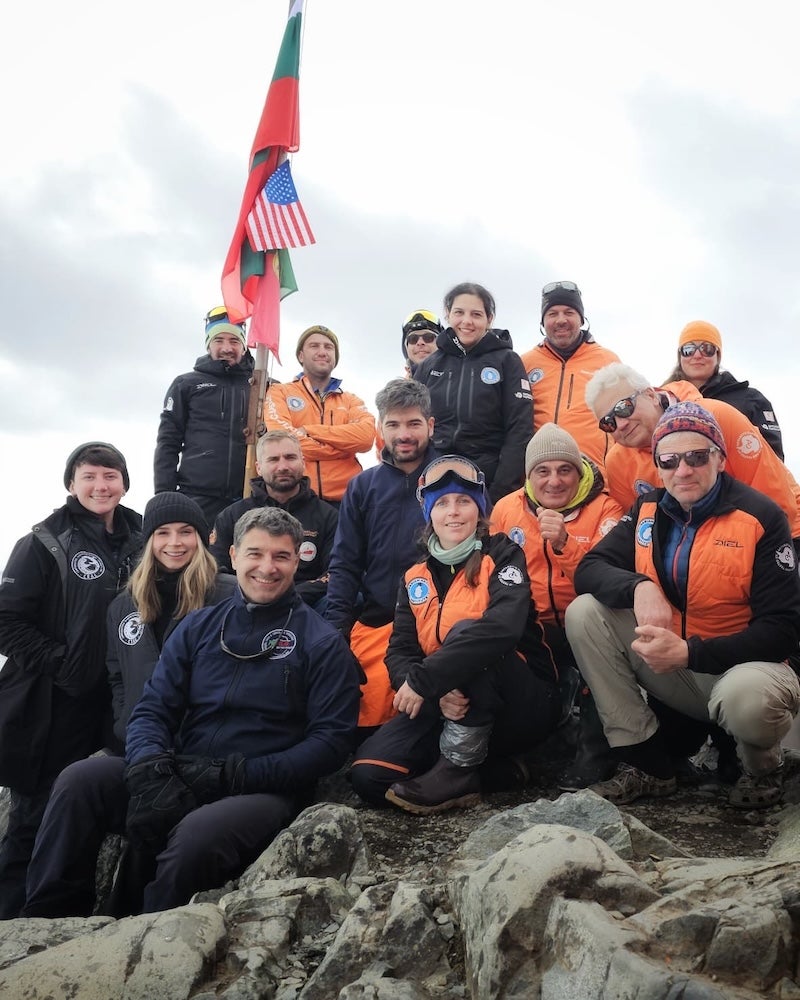
The work illustrates the collaborative nature of Antarctic research, Sperou notes. The Bulgarian Antarctic Program provided access and logistical support, while Portuguese polar researchers assisted with sample collection, and U.S. researchers led sample collection, documentation and and expertise.
“Research in Antarctica is highly collaborative, and that is part of the beauty of working there. Every discovery is made possible by people from different countries working together and believing in the importance of the research,” Sperou says. “No one does Antarctic science alone.”
At URI, Dr. Sperou and Leahy both work with Assistant Professor of Natural Resources Science Sarah Kienle in the CEAL Lab. This work will also contribute to a broader collaborative research effort with Dr. Sarah Kienle and other international collaborators to assess the adaptive capacity of leopard seals across their global distribution.