
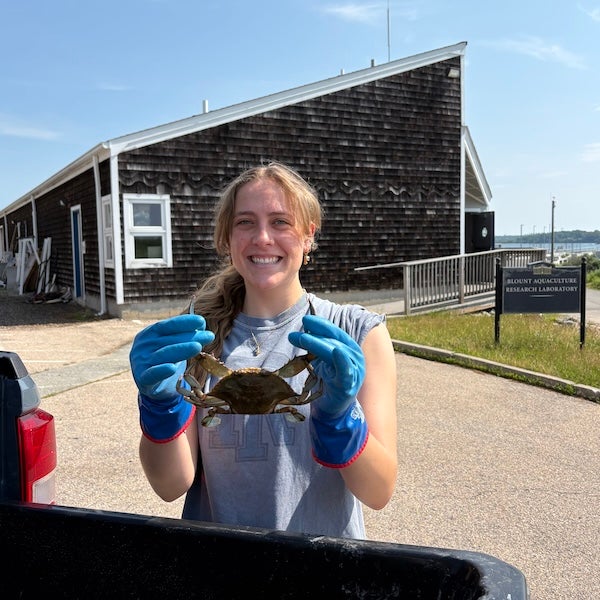
For Ashley Sauer, this summer’s CELS Summer Research Fellowship offered an opportunity to design and conduct her own experiment while working hands-on with live marine organisms.
A double major in marine biology and animal science from Bloomingdale, New Jersey, Sauer worked in Dr. Jonathan Puritz’s lab under the mentorship of graduate students Olivia Nieves and Dalia Bercow. Her research focused on a question with implications for oyster habitat restoration: How does the presence of blue crab predator cues affect the feeding rate of juvenile Eastern oysters?
To investigate, Sauer exposed young oysters to water collected from blue crab tanks and compared their feeding rates with those of oysters that were not exposed to predator cues. Her work was part of a larger project examining how multiple coastal stressors can affect marine populations through the development of Eastern oysters.
Q. What did you research for the fellowship, and what was the goal of your project?
The name of the CELS Fellowship project is “How do multiple coastal stressors structure the genomic diversity of marine populations?” We are investigating how a combination of coastal stressors affect the evolution of marine populations through the lens of eastern oyster development. Working in the Dr. Purtiz lab as a CELS fellow, under the mentorship of graduate students Olivia Nieves and Dalia Bercow, has allowed me the opportunity to design and construct my own research experiment. I attempted to answer “How does the presence of blue crab (Callinectes sapidus) predator cues affect the feeding rate of juvenile eastern oysters (Crassostrea virginica)?”
How would you explain your research to someone without a science background?
Blue crabs are eastern oysters’ primary predator. Knowing this, I wanted to explore how the presence of blue crabs influences the feeding habits of juvenile oysters, for the purpose of habitat restoration. To test this, I collected fresh water from blue crab tanks and exposed juvenile oysters to their predator cues. I recorded the feeding rates of oysters exposed to predator cues compared to control oysters, to see how stress affected their feeding behavior.
These results can help guide the best strategies for oyster habitat restoration, taking predator-prey interactions into account.
What did a typical day look like for you during the fellowship?
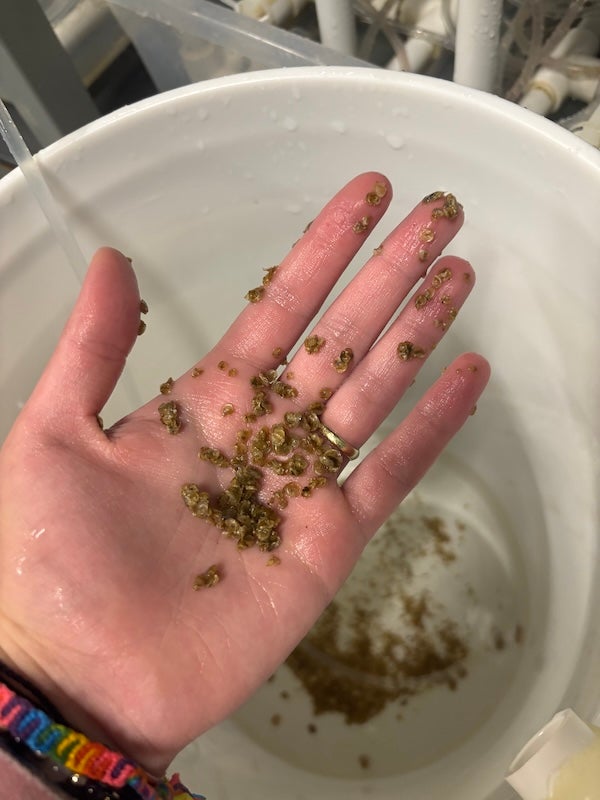
My day consists of baby oyster care! Most of my work is hands-on husbandry. This means I’m consistently checking water quality, cleaning tanks, feeding the oysters, and making sure their environment stays stable. I spend a lot of time measuring growth, doing size analysis, and keeping the salt water flow-through system running smoothly. When I’m working on my individual project, my husbandry skills extend to blue crab care as well. That includes feeding the crabs, monitoring their health, and collecting water from their tanks to use in my experiments. It’s a fun mix of animal care and data collection!
What was the most interesting or surprising thing you discovered this summer?
The coolest thing I have discovered has been oyster anatomy and physiology! It was so incredible to observe oyster larvae under a microscope and see them breathing with gills and moving with a foot. It reminded me that while they look like little pebbles, they are real, breathing organisms.
What has been one of the most rewarding parts of the fellowship?
The most rewarding moments have been working hands-on with live marine organisms and discovering a sense of community within the science world. This opportunity has confirmed my future in marine biology research, showing me I have the ability to positively contribute to our oceans.
What has it been like working with your mentors?
I worked in the Puritz Lab under the mentorship of graduate students, Olivia Nieves and Dalia Bercow. Working with them has shown me that there is no single “STEM Trajectory.” Life beyond undergrad feels uncertain, and people insist you need a plan. They taught me that every future in science is unique, and doesn’t require a set end goal. Their support and encouragement have made them the perfect mentors for an undergraduate still finding their way.
What has this experience taught you that you couldn’t have learned in a classroom?
This experience taught me that I have the knowledge and tools to make a real difference. As the world changes and humans continue to develop, our oceans are reaping the consequences. I want to help contribute towards species conservation through the use of science. It has always seemed like an unattainable goal, but being hands-on in a research laboratory, assisting with and designing my own experiment, proved to me I can be the change the ocean needs.