
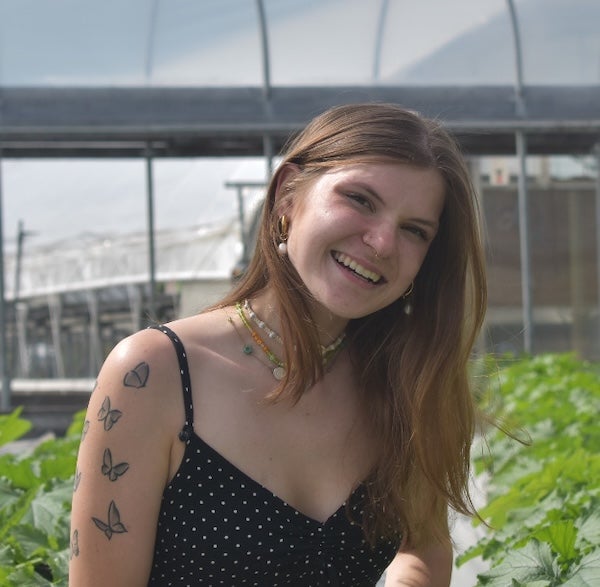
When Kaylyn Wood first arrived at the University of Rhode Island, she thought she had her future mapped out. Interested in psychology and social work, she envisioned a career helping young people navigate difficult circumstances. But somewhere between lecture halls and elective courses, she found a class that changed everything.
“I was looking through course options and saw there was a vegetable growing class,” Wood says. “I thought, ‘What is plant sciences?!’”
Learning Comes to Life
What began as an exploratory course quickly turned into a calling. Wood later enrolled in Hydroponic Vegetable Production with Professor Rebecca Brown, and the hands-on experience of that class immediately stood apart from some of the lecture-heavy courses she had been taking. Wood eventually declared a double major in plant sciences and psychology with minors in entrepreneurship and cannabis studies.
For Wood, the appeal of plant sciences at URI is deeply connected to the program’s experiential learning model. Classes combine lectures with labs, greenhouse work, field visits, and research projects, giving students the opportunity to actively engage with what they are learning. “In plant sciences, all the classes somehow connect to each other,” Wood says. “You learn similar concepts in different ways across your courses, and it really reinforces the knowledge.”
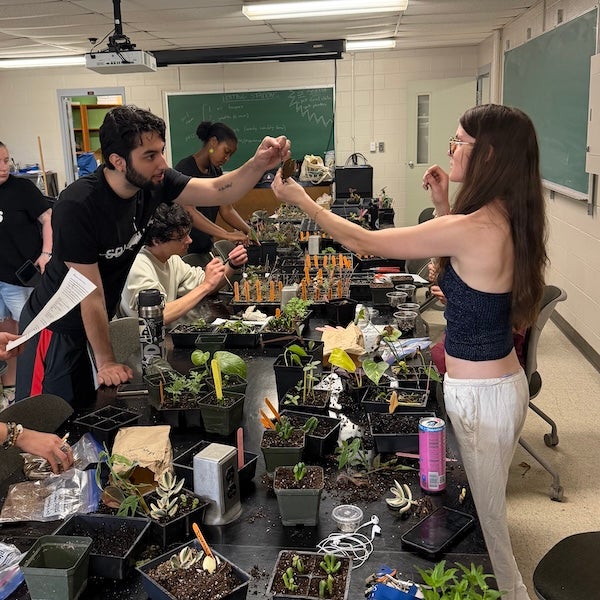
“I actually get to see things happen,” she adds. “I get to go through all the processes myself.”
That approach has been especially meaningful for Wood, who says she learns best by doing. “It can be hard to sit through huge lectures and absorb everything,” she says. “But in plant sciences, the professor gives you information and then you actually do it. That’s how I learn.”
Wood says URI’s plant sciences department fostered a welcoming and collaborative environment from the start. Small class sizes helped her build close relationships with both classmates and professors, something she says feels different from the experience of being in larger lecture courses.
“The people are so welcoming,” she says. “The professors are incredibly knowledgeable, and everyone feels comfortable asking questions.”
Growing Through Experience
Wood’s enthusiasm for the field extends beyond academics. Through coursework, independent studies, and employment at a Rhode Island microgreens farm, she has developed practical greenhouse and crop management skills that she says have prepared her for a future career.
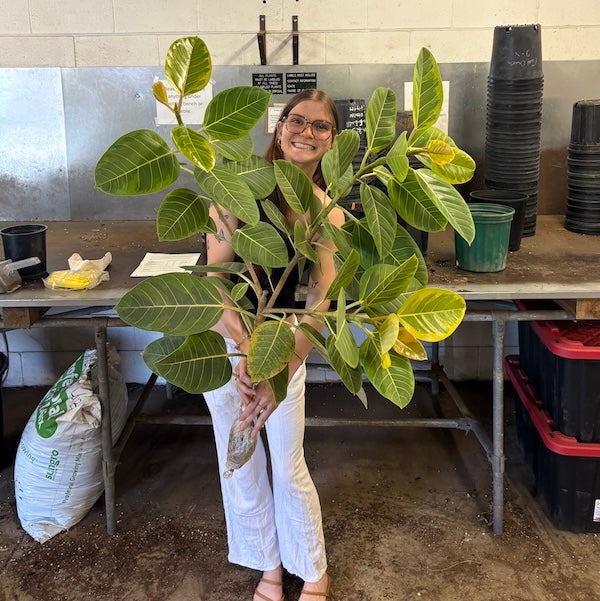
One of her favorite classes, Plant Propagation with Professor Nathan Lambstrom, required students to regularly care for and monitor plants outside scheduled class time. “You really learn how to pay attention,” she says. “Every plant is different, and you have to understand what it needs.”
That process, she says, also taught her something about herself. “You have to take care of yourself too,” she says. “How are you going to take care of a plant if you can’t take care of yourself?”
Wood recently completed an independent study on lavender substrate stratification, experimenting with different soil layering techniques to improve plant growth. The project challenged some of her assumptions about drainage and water retention in lavender production.“My favorite part was being proven wrong,” she says. “That’s how you learn.”
Her interests increasingly turned toward herbal medicine after witnessing the impact medicinal cannabis had on a close family member living with PTSD. “Seeing the difference before and after was so powerful,” she says. “It made me really interested in herbal medicine and how plants can help people.”
That experience inspired her to pursue URI’s cannabis studies minor, where she learned about plant-based medicine, cannabinoid receptors, and the science behind medicinal cannabis. “You think it’s just about cannabis, but you can apply what you learn to so many different kinds of herbal medicine,” she says.
Growing a Future
Today, Wood dreams of combining her interests in plant sciences, psychology, entrepreneurship, and herbal medicine into a business of her own. She hopes to one day grow medicinal and therapeutic plants while educating people about how to use them.
“I want to grow herbal medicine plants and teach people how to make things like essential oils,” she says. “There’s a real need for that.”
Along the way, URI’s plant sciences program has helped her discover a confidence she once struggled to find. “When I first started college, I felt like I wasn’t smart,” she says. “Then I started taking plant science classes, and I realized I just learn differently.”
Now, Wood encourages students — especially those unsure of their academic path — to stay open to unexpected opportunities. “There are so many majors people don’t even know exist,” she says. “Plant sciences ended up being exactly where I was supposed to be.”