
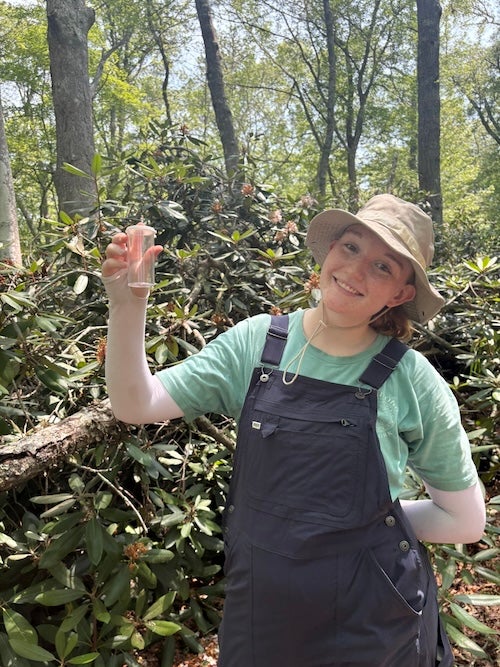
As a CELS Summer Research Fellow, rising University of Rhode Island sophomore Alyssa Kruger is spending her summer high above the forest floor, collecting insects from black cherry trees and studying the pollinators that play a critical role in healthy ecosystems.
She is one of 53 URI students in this year’s fellowship cohort. Now in its fourth decade, the program has given more than 1,500 students the opportunity to trade the classroom for a research vessel, greenhouse, farm, or forest, working alongside researchers and community partners on real-world research in the environment and life sciences.
Kruger, a wildlife conservation biology and cell and molecular biology double major from Sterling, Massachusetts, is being mentored by Ren Johnson, a Ph.D. candidate in biological sciences, on a project examining how climate change is affecting flowering and pollination patterns in the Great Swamp Management Area in South Kingstown, Rhode Island.
“Pollination is a key factor of reproduction for many plants, which is essential for the well-being of ecosystems,” Kruger says. “Two of our projects are identifying the insects that pollinate Rhododendron maximum and black cherry, as both have been previously understudied.”
Kruger’s interest in the topic began during her first year at URI, when Johnson—then a teaching assistant in Kruger’s introductory ecology course—introduced the research to the class.
Filling a research gap
Despite being one of the most common forest trees along the East Coast, black cherry’s reproductive biology remains surprisingly unknown. Much of what scientists know about its pollinators comes from research conducted more than 60 years ago.
The tree is one of the last to flower in Northeastern forests, blooming after maples and oaks have finished. That raises questions about which pollinators are still active in the forest canopy by the time black cherry begins to bloom.
Kruger is also studying phenology, or the timing of recurring seasonal events in nature. “The flowering time of a plant species determines whether it’s able to attract pollinators, which affects that species’ reproductive success,” she says. “We’re observing how changes caused by climate change have impacted competition between plant species for pollinators.”
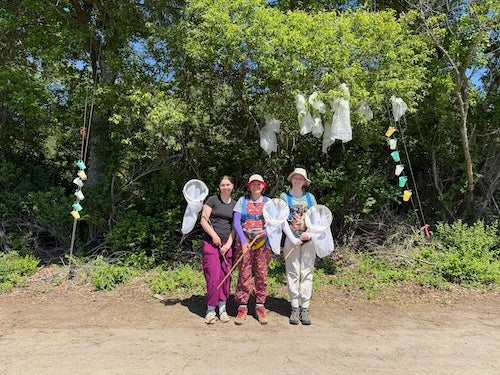
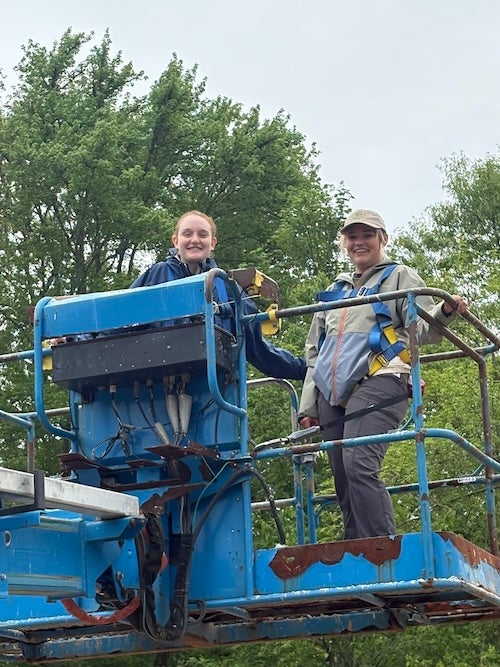
A typical day for the research team begins at 8 a.m. in the lab before they head into the field to net pollinators from black cherry trees, monitor flowering plants for phenology, and collect insects visiting rhododendrons. To reach pollinators high in the canopy, they use a boom lift that rises 30 feet in the air.
“Riding up in the boom lift and seeing how much activity there is so far above the ground has been one of my most memorable moments from the summer,” Kruger says.
The team also relies on a simple but effective tool: brightly painted cups filled with soapy water, suspended at different heights in the forest to trap insects over a 24-hour period.
Back in the lab, the insects are preserved, identified, and added to the project’s growing dataset. After lunch in the field, the team returns to organize samples and enter data.
Looking ahead
The stakes of the work extend well beyond a single growing season. Although black cherry trees can reproduce by sprouting from cut stumps, only seeds allow the species to spread into new areas.
Understanding whether pollinators are successfully supporting seed production could help researchers better understand how black cherry—and the forests it supports—may regenerate in a changing climate.
For Kruger, the fellowship has also been an opportunity to build practical research skills. “Through our black cherry project I have been able to gain experience problem solving on a research project as we worked to design methods of surveying,” she says.
She’s also learned how to catch, pin, and identify insects—and gained a broader sense of purpose. “I’ve learned how to use my scientific knowledge and the skills I’ve developed to raise awareness about environmental changes,” she says.