
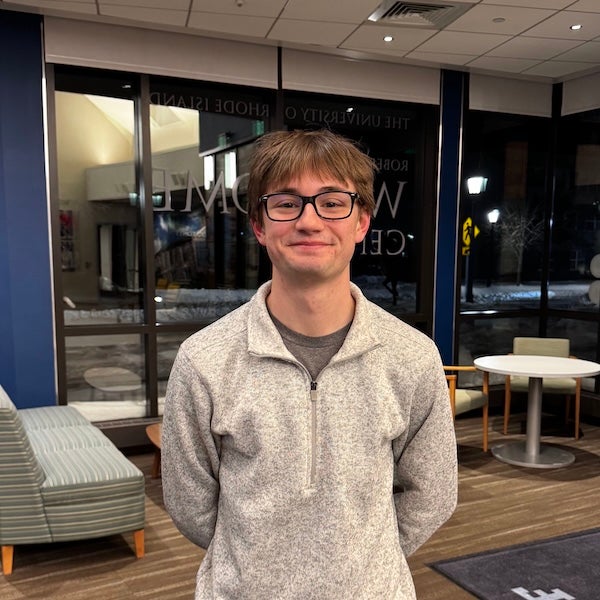
A double major in environmental and natural resource economics and marine affairs, Kyle Jolicoeur is turning classroom lessons in energy policy into real savings for Rhode Island farms.
KINGSTON, R.I. – Nov. 2, 2026 – For Kyle Jolicoeur, a University of Rhode Island senior from Cumberland, Rhode Island, studying the environment means more than understanding the natural world. It also means figuring out how people, businesses, and governments can protect natural resources while supporting a thriving economy.
That perspective drew him to the field of environmental and natural resource economics (ENRE), a field that examines how the environment, economic decision-making, and public policy intersect. He’s paired the major with marine affairs, added a business minor, and is also completing an energy economics and policy certificate.
Learning to think through environmental challenges
Jolicoeur describes ENRE as an umbrella. Faculty in the URI department specialize in areas from fisheries to water resources to renewable energy, but they share a common way of approaching problems.
In class, he has studied policy tools such as cap-and-trade systems, which use tradable emissions permits to reduce pollution. Class visits to a solar farm and a wind turbine installation helped him connect economic theory to real-world decisions.
An interest in offshore wind drew him to the field of marine affairs, which focuses on the policies, laws, and decisions affecting oceans and coastal communities. Marine affairs courses introduced him to international politics of the ocean and the problems affecting our oceans and coasts.
“ENRE is the landward environmental policy stuff, and marine affairs is the ocean and coastal policy focus,” he says.
The two programs also fit together on paper. Marine affairs courses count as ENRE supporting electives, which has allowed Jolicoeur to complete both majors, his minor, and his certificate and stay on track to graduate in May.
Helping Rhode Island farmers save energy
Outside the classroom, Jolicoeur is putting that policy knowledge to work as the 2026 Farm Energy Fellow with the Rhode Island Office of Energy Resources, through URI’s Extension Fellowships. Working with supervisor Abigail Hasenfus ’20 M.S. ’21, an ENRE alumna, he helps administer the Rhode Island Agricultural Energy Program, which offers farmers grants of up to $20,000 for renewable energy installations and energy-efficiency improvements.
His day-to-day work includes processing applications and payments, developing outreach materials, working with federal and private-sector partners, and conducting site visits. “We try to do a site visit with every farmer because we don’t want to be a faceless entity of the state of Rhode Island,” he says.
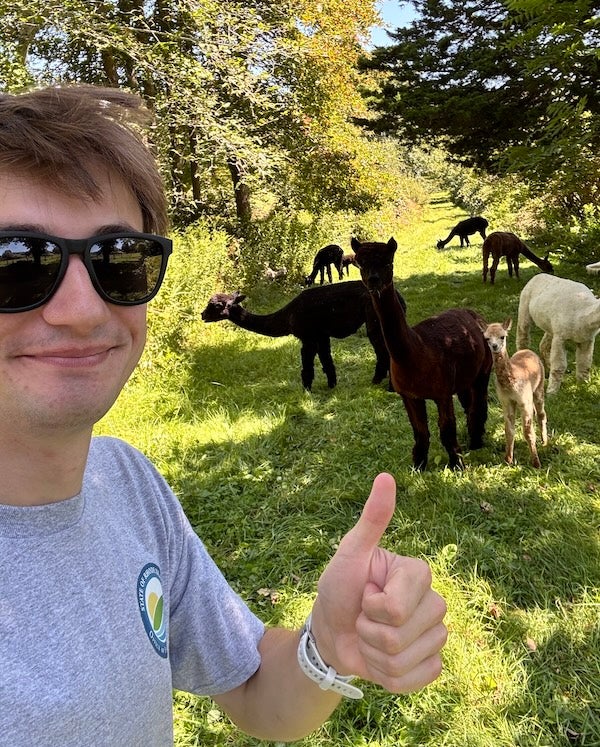
On one recent site visit, he met a farmer who relies on refrigerators and freezers to keep meat cold before it’s packaged and shipped. The farmer’s summer electricity bill had topped $1,000; with solar panels on his roof, he expects to offset it completely.
For Jolicoeur, that is where environmental economics becomes tangible. Rhode Island has some of the highest electricity prices in the country, and its farmland is among the most expensive per acre. “If we can’t give you land, we’ll give you a $0 electric bill,” he says.
The fellowship has also introduced him to the wider energy system. He and the other 2026 Energy Fellows have toured ISO New England, the region’s power grid operator, as well as a Providence power plant and state government facilities, including a rooftop solar array. He has also sought out work beyond his core duties, from a grid resilience program to helping develop a balcony solar program for Rhode Island.
“I love being a sponge,” he says. “I love being around super smart people and trying to learn something new every day.”
After a successful first year, Jolicoeur has been offered the chance to continue with the Office of Energy Resources through next year.
Building community through ENRE
That eagerness to learn from the people around him carries over to campus, where Jolicoeur serves as president of the ENRE Student Association. With just seven faculty members, ENRE is a small department, and he wants students to take advantage of that. He organized a get-to-know-you event that brought together professors, graduate students and undergraduates.
This fall, the association is focusing on community building, including a joint hike with the Economics Student Association. In the spring, it will shift to professional development, with alumni panels and career workshops.
Jolicoeur arrived at URI with no background in economics, and he says he’s still learning about the field as he prepares to graduate. That’s part of what he values about it.
“To think of the opportunities that have come from me being here and being in that small department and doing the fellows program and meeting the people I’ve met and doing the things I’ve done — I wouldn’t trade it for the world,” he says. “I’ve had a lot of fun here.”