
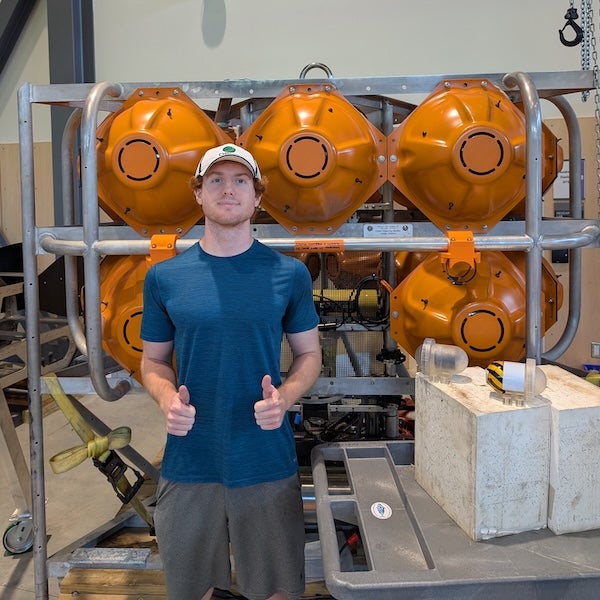
A junior double majoring in marine biology and aquaculture and fisheries science, Lewis Truckel is conducting research in URI’s Marine Ecology and Technology (Marecotec) Lab through the CELS Summer Fellowship program. The Marecotec lab develops technologies to observe the ocean and specializes in the study of deep-sea coral communities. After taking a course with his faculty mentor, Professor of Biological Sciences Andrew “Andy” Davies, Truckel became fascinated by the lab’s unique blend of marine biology and engineering, and was excited to apply for the fellowship. This summer, he’s working at URI’s Bay Campus analyzing data and helping prepare oceanographic equipment for deployment. Learn more about his research below!
Q. What are you working on this summer?
A. Our lab deploys observation platforms called “landers,” fitted with various oceanographic instruments and cameras across different seafloor sites. Currently, much of our work is assessing the status of native deep sea and mesophotic coral communities, and developing restoration methods. My particular job is to process, analyze, and visualize the data that we collect after retrieving these landers. I have also been able to use this data to conduct some independent research and form my own research questions.
What’s your most exciting finding so far?
Through my work on image and data analysis, I have been investigating a large spike in urchin activity at a site called Henderson Ridge, approximately 1,040 meters deep. It appears to be correlated with spikes in other water quality metrics picked up by our sensors at the same time and location.
What is it like working in the Marecotec lab?
Dr. Davies is very knowledgeable and very fun to work with. He places a large emphasis on independence and self sufficiency, so I have been getting a lot better at taking initiative and figuring things out for myself.
Working with the Marecotec lab has taught me a lot about research culture and the inner workings of the scientific community. I’ve been able to experience and observe the actual discipline, something I definitely would not have been able to learn in the classroom. Being able to contribute to research that has actual, tangible impacts on the world has been an amazing experience. Knowing that the work I’ve been doing will, in some way, assist deep-sea community restoration efforts in the Gulf has been surreal.