A rising junior majoring in marine biology with a minor in wildlife and conservation biology, Makenzie Denzler is conducting research through the CELS Summer Fellowship program with master’s student mentor Joseph Candia and Professor Kathleen Carroll. This summer, Denzler is analyzing camera trap data to better understand Rhode Island’s flying squirrel population. Learn more about her work below!
Q. What are you working on this summer?
A. My original fellowship was building and using baited remote underwater video systems (BRUVS) to assess elasmobranch populations off of Rhode Island. However, due to some boat issues, I pivoted to working in the Quest Lab with Dr. Carroll, where I’m now looking at terrestrial animals. This new project allows me to do similar work to my original one, where I’m analyzing data collected from cameras. Now, my research involves analyzing data from camera traps placed around Rhode Island. I’m specifically looking at flying squirrels, and trying to answer questions about their population in RI. My end goal is to create occupancy models, which tell us more about the distribution of animals.
What’s been the best part of your fellowship?
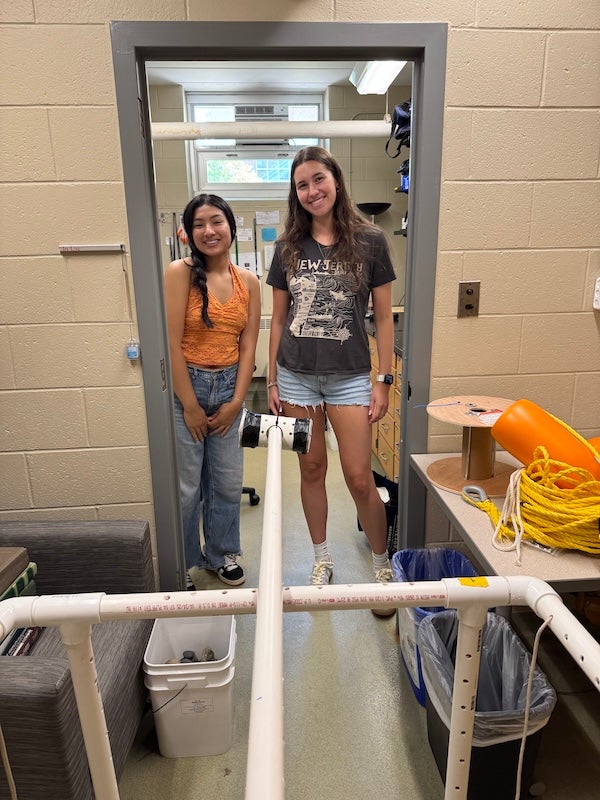
One of the coolest things I’ve done so far is build my own baited remote underwater video systems (BRUVS). By doing a deep dive into literature, and with the help of other students and fellows, I was able to design and build 2 BRUVS out of pvc pipe, each equipped with a GoPro. I’ve also enjoyed building on my coding skills. I got to dive deep into coding and really focus on learning the language, different tests to run, and how to get the results I want.
What’s it like working with your mentors?
I’ve been lucky enough to have three mentors during this experience: Joe Candia, Dr. Kathleen Carroll, and Dr. Brad Wetherbee. They’re all incredible scientists and have not just given me an amazing opportunity, but they’ve shared their knowledge and allowed me to grow as a scientist.
What has this experience taught you that you couldn’t have learned in a classroom?
How to adjust to unexpected situations. Having boat issues at the last minute and not being able to move forward with my original project was a hard thing to navigate, but it taught me that not everything works perfectly. I was also able to work with a new professor and experience different labs and different research methods/styles. With my project I’m working with data that tells us more about Rhode Island ecosystems and populations of animals, and knowing that this work creates a positive impact on both the community and environment is very fulfilling.
How has the fellowship prepared you for your next steps in academia and your career?
I intend to pursue a masters and PhD in marine biology, as my goal is to conduct research on marine ecosystems and organisms. After graduating, I would like to work either as a research professor at a university or as a scientist for NOAA or another similar organization. This fellowship has given me the opportunity to formulate my own research question and explore it, which is exactly what I want to do.