
At the University of Rhode Island, a unique partnership is bringing cutting-edge science into high school classrooms while opening doors for the next generation of scientists. Through the Amgen Foundation-funded Amgen Biotech Experience (ABE), a global science education program, URI leads a statewide effort to introduce students to the tools, techniques, and real-world applications of biotechnology.
First established in 2007, the Rhode Island ABE program is housed in the Department of Cell and Molecular Biology in the College of the Environment and Life Sciences. Over the past seventeen years, it has become an integral component of URI’s biotechnology program, combining university-based expertise with high school outreach to expand access to authentic laboratory science.
“This program brings hands-on science discovery to the high school classroom,” said Doreen Osgood, clinical associate professor in URI’s biotechnology program and director of ABE-Rhode Island. “We show students how science is applicable to real life and how they can continue that journey in higher education.”
Science Comes to Life
The ABE program provides teachers with professional development, curriculum, and up to $20,000 worth of research-grade equipment and supplies at no cost. Students carry out hands-on experiments that mirror real biotechnology workflows, including gene cloning and protein analysis.
Since launching in Rhode Island in 2007, the program has reached more than 30,000 students across the state and southeastern Massachusetts. Today, 39 teachers across 23 schools participate, with more than 80 trained overall. Globally, ABE spans 27 sites in 17 countries and has reached nearly 1.2 million students.
In classroom settings, that reach becomes tangible. One signature lab centers on producing a red fluorescent protein, a process that parallels the production of biologic medicines such as insulin. Using techniques like gel electrophoresis, students analyze DNA samples and determine whether genetic modifications have been successful—often encountering for the first time the precision and patience required in real laboratory science.
“The big idea we want students to understand is: how do you make a drug?” Osgood said. “We mimic that process in a way that’s accessible and engaging.”
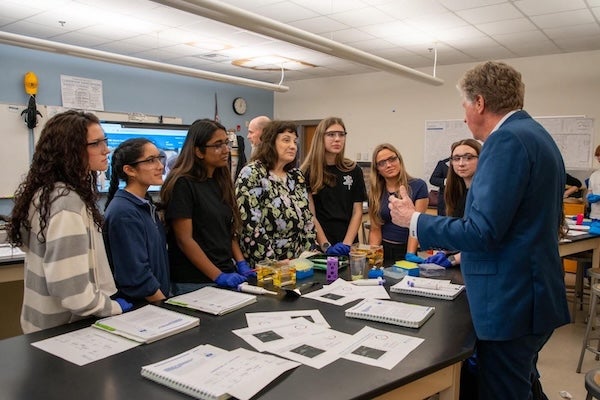
That approach was recently on display at Cumberland High School, where URI faculty partnered with Amgen to bring an ABE lab into an AP Biology classroom – an event that also drew Governor Dan McKee in attendance. Students used professional-grade tools to explore genetic engineering concepts involving plasmids and restriction enzymes, mirroring how scientists design and verify DNA used in medicine production. For many, it was a rare opportunity to use the same techniques found in professional labs.
In Rhode Island, these experiences also serve as a pipeline to higher education. Osgood estimates that at least five to six students each year from ABE classrooms enroll in URI’s biotechnology program, with others pursuing STEM majors across the university.
“We’ve seen more and more students come to URI as we’ve become more involved with the schools,” she said. “Sometimes they even recognize us at admissions events and say, ‘I met you in my high school class.’”
Supporting Teachers
Beyond student impact, the program provides critical support for educators, especially in under-resourced districts. “When you see what they have available, you realize how important it is to provide support and materials,” Osgood said.
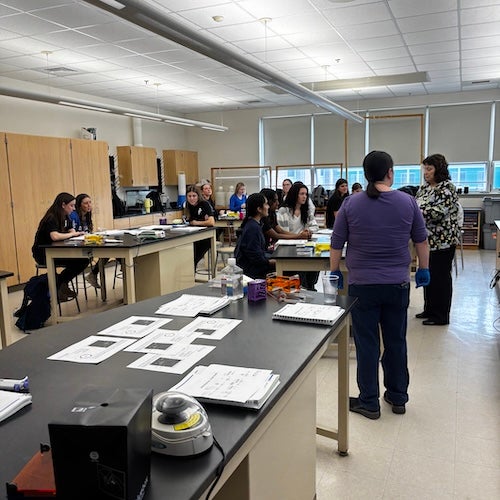
Teachers receive equipment, curriculum, and ongoing guidance from URI staff, including site visits and troubleshooting assistance. “They love the program,” Osgood said. “Why spend their own budget on expensive materials when they can use a full curriculum with support – for free – and invest their resources elsewhere?”
Much of that hands-on support comes from program coordinator Arielle Chaves who works closely with participating schools. ChaveS regularly visits classrooms, helps teachers implement lab activities, and provides real-time troubleshooting when experiments don’t go as planned.
Working with teachers and high school students has been the most rewarding part of the program, Osgood said, and it has also influenced how she teaches at URI. “It’s made me more aware of the transition from high school to college,” she said. “Understanding where students are coming from helps me create a more inclusive and effective classroom.”
Outreach with Purpose
Ultimately, the program is designed to strengthen scientific literacy while building a pathway into higher education and the biotechnology workforce across Rhode Island and the broader Southern New England region.
Osgood views the program as central to URI’s mission as a public, land-grant university. “This is outreach to the community,” she said. “It’s about what URI is doing for the state – bringing resources, opportunities, and awareness to local schools.”
Through partnerships with schools and industry, ABE continues to expand its reach while also creating opportunities for URI students, who help prepare lab kits and support teachers as part of their own hands-on training.
Osgood hopes the program inspires students to see themselves in science, whether at URI or beyond. “Obviously, we’d love them all to come here,” she said. “But if they pursue science anywhere, we’ve done our job.”