
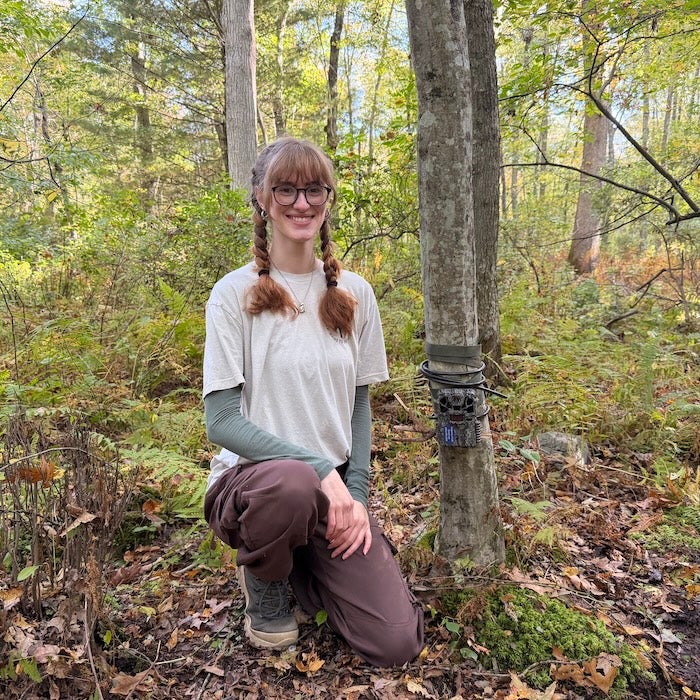
Motion-activated trail cameras at two Rhode Island locations are helping graduate student Madalyn Stoltz and the University of Rhode Island contribute to the Smithsonian’s Snapshot USA, a national effort to track how wildlife communities change over time.
KINGSTON, R.I. – Oct. 22, 2026 – A deer pokes its nose toward the lens. A coyote pauses, ears perked up. A fisher’s eyes flash in the dark. For University of Rhode Island researchers, these fleeting wildlife sightings are important data points in a growing national picture of how animal communities change over time.
The cameras capturing them are part of Snapshot USA, a nationwide wildlife-monitoring program coordinated by the Smithsonian and North Carolina Museum of Natural Science since 2019. Madalyn Stoltz, a master’s student in URI’s Biological and Environmental Sciences program, leads the university’s participation.
Working with Professor Kathleen Carroll in URI’s Quest Lab, Stoltz oversees two locations for data collection for the project from September 1 through October 31: the 225-acre North Woods adjacent to URI’s Kingston Campus and a site in Little Compton.
North Woods has been part of Snapshot USA since the project began. The Little Compton site grew out of URI’s collaboration with the Stonewall Stewards, who purchased cameras to support the research.
Where the stone walls meet wildlife
The Little Compton site also connects to Stoltz’s own research. With Carroll and Professor Shelby Rinehart, both faculty in URI’s Department of Natural Resources Science, Stoltz is investigating how Rhode Island’s historic stone walls compare with natural features in supporting wildlife biodiversity, a question that has not yet been studied extensively in the United States.
“There are tons of stone walls in Little Compton so we were able to get some great camera spots over there to both contribute to Snapshot and continue our work with stone walls,” Stoltz says.
Both Rhode Island sites share the same habitat classification under Snapshot USA. As part of the work, Stoltz will examine how wildlife uses features within them, including stone walls, downed logs, and other structures.
Previous work of Stoltz’s drew on camera-trap data from a long-term study conducted by the Rhode Island Department of Environmental Management and URI. The preliminary findings suggested that stone walls may serve as indicators of wildlife biodiversity, particularly for small mammals and species such as deer, foxes, and coyotes.
On the wildlife trail
Choosing a camera location for the Snapshot USA data takes more than pinpointing a spot on a map. Researchers consider land ownership, habitat, and accessibility before heading into the field to look for signs of wildlife activity.
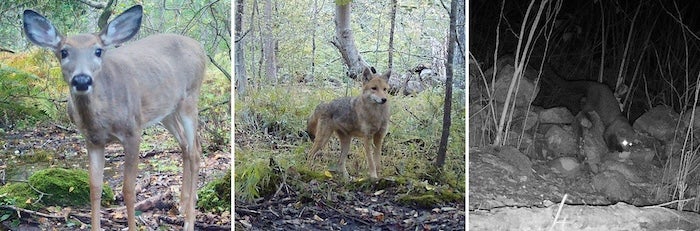
“More often than not we end up moving the camera site to a better spot,” Stoltz says. “There’s no way to know from a map where good camera spots will be, but it’s a helpful starting point.”
Each camera must also follow Snapshot USA’s standardized protocol, ensuring that data collected in Rhode Island can be compared with results from sites across the country.
The cameras remain in the field for at least a few weeks before the team replaces batteries, retrieves memory cards, and reviews the images. The photos are uploaded to Wildlife Insights, a platform used by Snapshot USA participants, where artificial intelligence helps identify animals. Researchers still review every image themselves.
Not every image yields a wildlife sighting. “Grass and leaves are often the banes of our existence when it comes to camera trapping,” Stoltz says. Windblown leaves and passing shadows can trigger the cameras, generating hundreds of images without a single animal in view.
Curious animals can cause trouble, too. “We also get some curious animals who come right up to the cameras or even mess with them (raccoons are naughty),” Stoltz says. “We also get a lot of animal butts.”
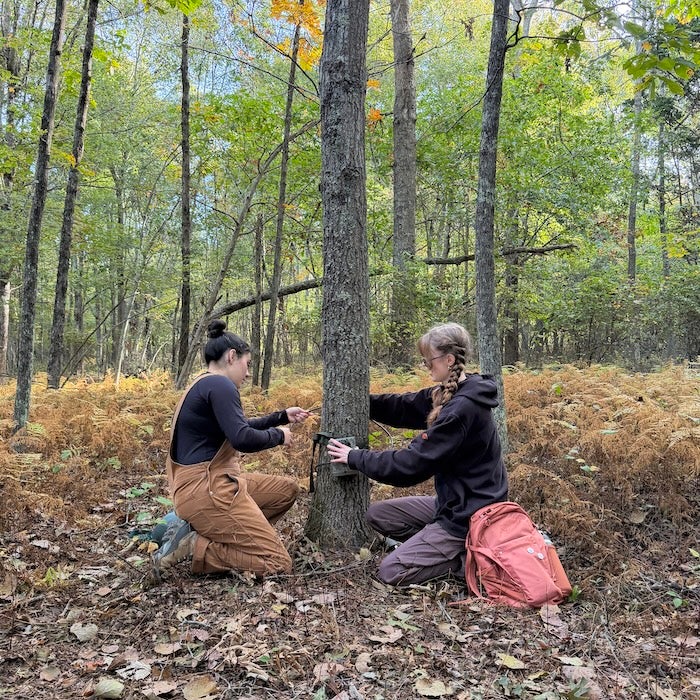
Stoltz mentors undergraduate students who help with fieldwork and image identification, including Isabella Noonan, Raven Szewczok, and Ava Watjko.
From camera traps to bigger questions
The scientific payoff lies in the thousands of images that accumulate each year. Because every participating site follows the same methods, researchers can study which species are present, biodiversity, population trends, and how animals use different habitats.
“You can answer so many questions with this kind of data, especially since we will have access to the data from all the other Snapshot projects across the country,” Stoltz says.
That consistency becomes even more valuable over many years. By returning to the same sites, researchers can distinguish real changes in wildlife communities, such as responses to development.
The images don’t stay with the research team, either. Once uploaded, they join Snapshot USA’s national dataset, free for anyone to explore through Wildlife Insights — raccoon close-ups and all.