
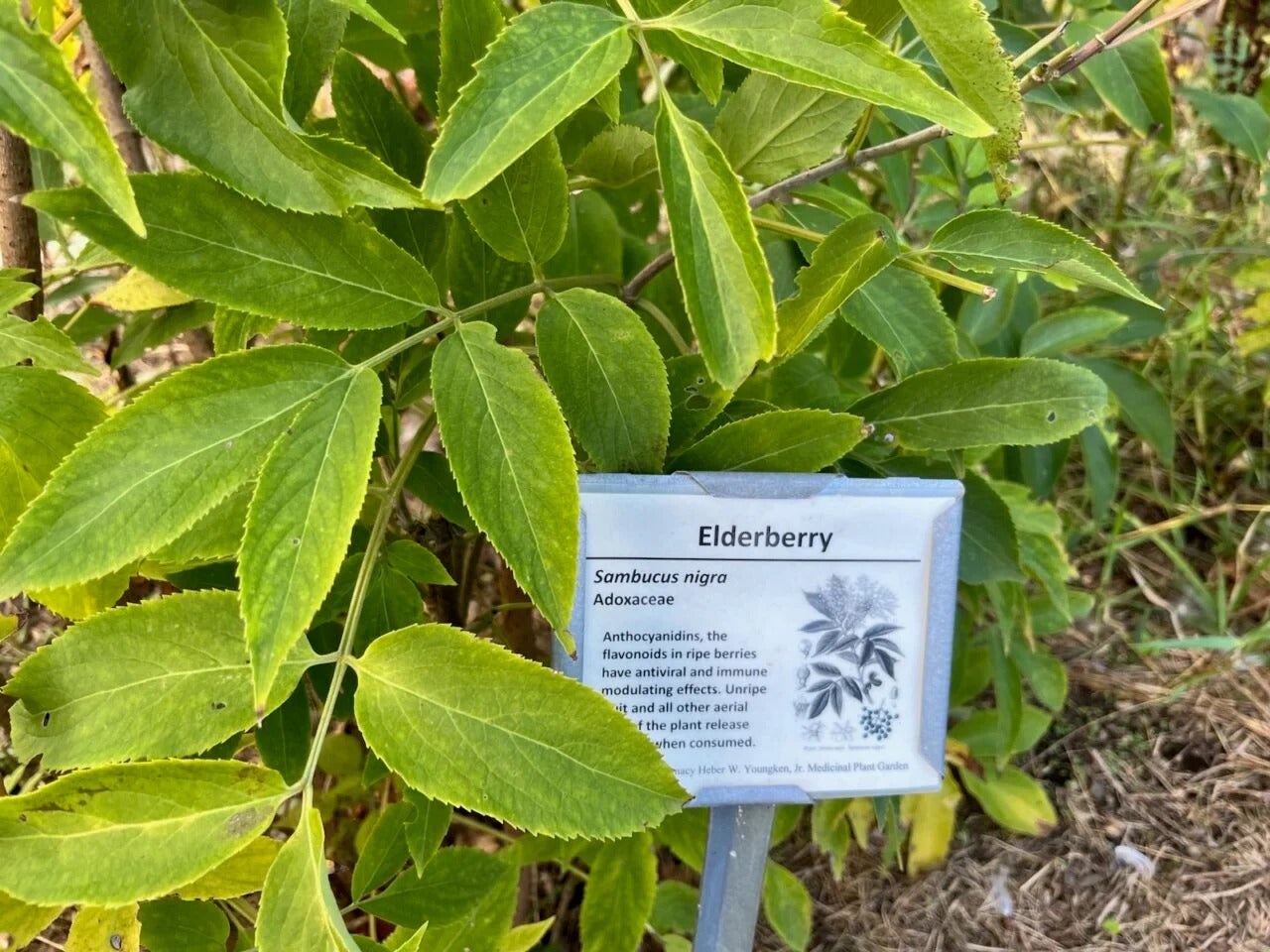
Yvonne Wingard, a DWELL Affiliate and recent graduate of Master of Environmental Science & Management (MESM), has created a site-specific audio tour of the Youngken Medicinal Garden to cultivate care for six important medicinal plants. This immersive work brings Indigenous knowledge and experience of medicinal plants to the forefront through an audiovisual tour accessible via NFC (Near-Field Communication) Chips and via the web. By tapping any smartphone on the chips, garden visitors can access descriptions of the plants and audio stories told by Silvermoon Mars LaRose, citizen of the Narragansett tribe and Assistant Director of the Tomaquag Museum. The garden tour is expected to launch at the beginning of September, right as classes at URI begin for the Fall Semester.
A central goal of the garden audio tour is to foster connection between people and the plants they see every day, but might not know the history of. “I feel like a lot of nature and plants are just kind of seen as this thing that’s separate from humans,” says Wingard. “For a lot of people, I feel like we go through our everyday lives not really noticing the plants around us. With this tour, the immersion adds that extra element. Rather than you just walk up and see a plant, you can hear a story with it.” A multimedia experience allows people to take in the visuals of the garden, and connect the plants to the stories being told about them.
Elizabeth Leibovitz, Garden Coordinator of the Youngken Medical Garden, noticed there is interest from visitors in indigenous uses of medicinal plants, and thus thought of the idea of a garden tour that highlights these often overlooked perspectives and stories. Such knowledge comes only from generations of storytelling and transferring that information down lineages, which is why the perspective of Indigenous groups is so important to highlight. “There are a lot of ways that the settlers and colonists that came here learned of these [medicinal] uses from the Native Americans,” notes Wingard. “So I think it’s important to give that credit to those groups as well as highlight their stories as opposed to just making it a footnote under the Western medicine perspective.”
One of the plants described, Mullein, is considered a decongestant and grows naturally even in urban areas. Two other plants, Rosehip and Echinacea, support the immune system. In a healthcare system that is becoming increasingly inaccessible, self-reliance and independence can really change the way people care for their bodies. In conjunction with modern medicine, these natural remedies can both connect people to the nature they see every day, and make them more communally interdependent and provide alternative methods of healing in conjunction with modern medicine.
As grocery prices rise, outbreaks in produce become more frequent, and the current administration disrupts supply chains, people are also growing their own food more often. Community gardens, indoor hydroponics, and rooftop gardens are another form of independence through plant knowledge. “As we start to see supply chain issues continue to rise, there’s going to be more of a shift towards people learning more about their food and, in turn, learning more about plants and connecting a little bit more to their environment,” says Wingard. This is the groundwork of building your own world- realizing that you don’t have to rely on the wider system and that you can instead build your own.
An important aspect of building knowledge of the natural world has to do with the concept of the “extinction of experience,” the idea coined by Robert Pyle that urbanization and digitization are replacing physical contact with wildlife and plants with mediated representations, reducing environmental care. This alienation from the environment creates a negative feedback loop where indifference leads to a lack of care, then to a lack of motivation to fight for the protection of natural systems. “If we’re not caring about nature, then when we have issues with the current administration and efforts to tear down habitats and to remove plants, people are not going to fight for it. Then we lose even more nature, and it’s like the cycle just keeps going over and over again,” says Wingard. On a local level, the garden tour strives to combat this indifference towards ecosystems that people often experience, bringing people closer to the flora they experience every day.
In the future, Leibovitz and Wingard hope to continue promoting the work of the Tomaquag Museum, and to connect to other tribal organizations in New England, expanding the idea behind the garden tour to more plants and stories. Check out the garden audio tour this Fall at the Heber W. Youngken, Jr. Medicinal Garden!