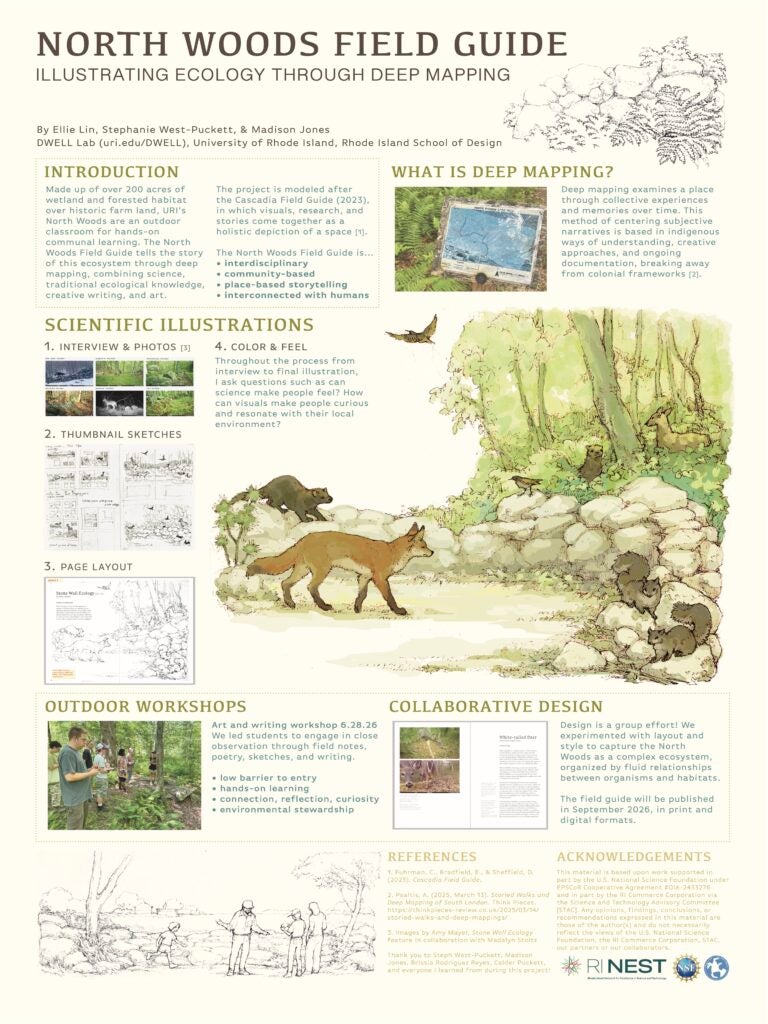
The landscape of URI’s North Woods holds layered histories–evidence of Narragansett inhabitance, alongside the walls left by colonial settlers, a solar panel array built on a remediated Superfund site, and an intricate ecosystem of vernal pools, wetlands, and dense undergrowth. The North Woods is a testament to the ways humans relate to and shape their environment, and reciprocally, the ways environment shapes us.
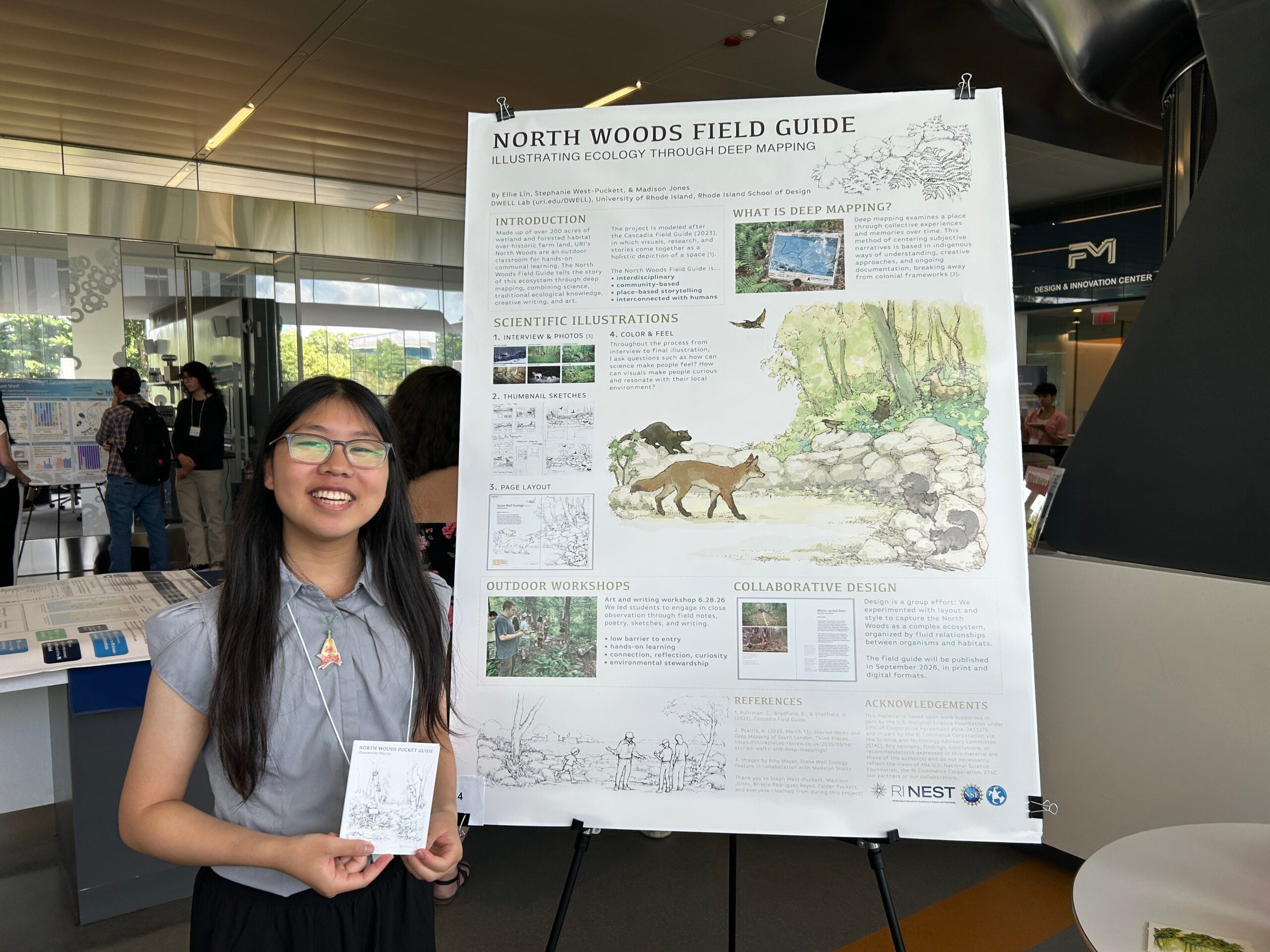
This summer, DWELL Lab SURF Ellie Lin, a RISD student majoring in Illustration, contributed to the development of the North Woods Field Guide, culminating in a poster presentation at the annual SURF symposium. Lin’s fellowship is integral to the larger Writing Wild: North Woods People’s Field Guide grant funded by the Rita Allen Civic Science Media Foundation. The guide, projected to be released in digital and physical open-access formats this Fall, will be a collection of scientific, creative, and journalistic writing and imagery that cover animals, vegetation, flowers, minerals, and other elements of the woods. Through her work, Lin has engaged with Natural Resource Science students to contribute research and visualization of entries revolving around current research topics in the North Woods like bobcat tracking, stone wall ecology, and wetland ecology.
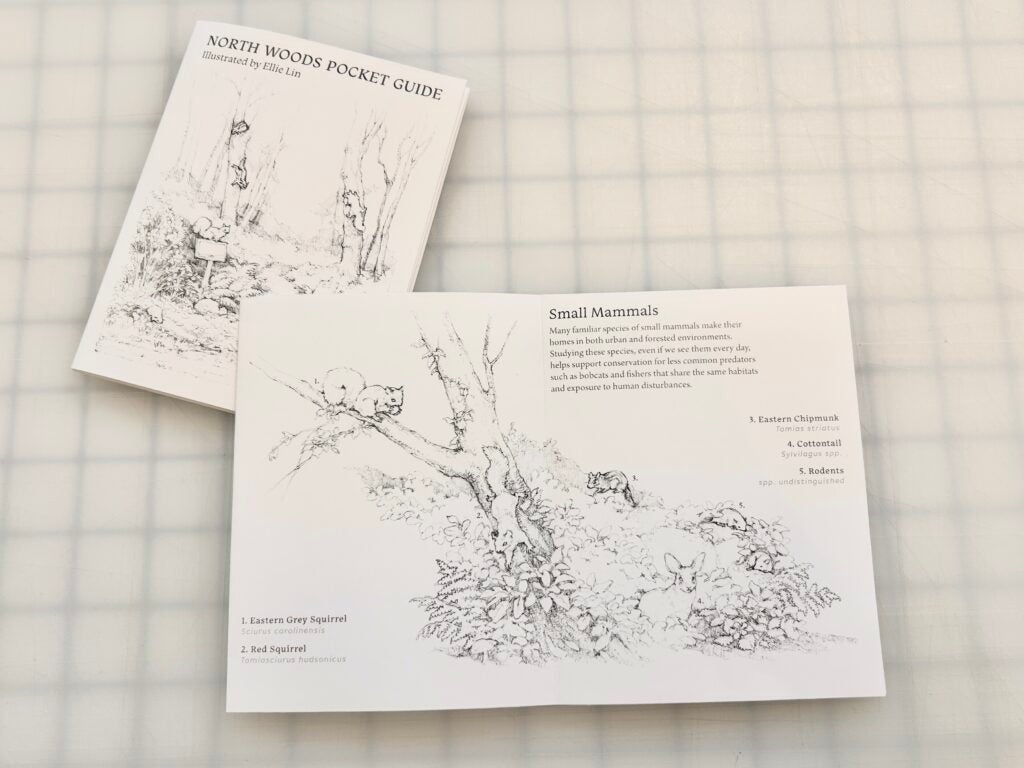
Lin contributed graphite drawings digitally colorized in Photoshop, and handed out a Zine during the symposium, where each page is dedicated to a different research initiative happening in the North Woods. With Stephanie West-Puckett, Associate Professor in Professional and Public Writing and DWELL Lab affiliate faculty, Lin hosted an on-site workshop where participants of all backgrounds experienced the North Woods and contributed their interpretations to the North Woods Field Guide.
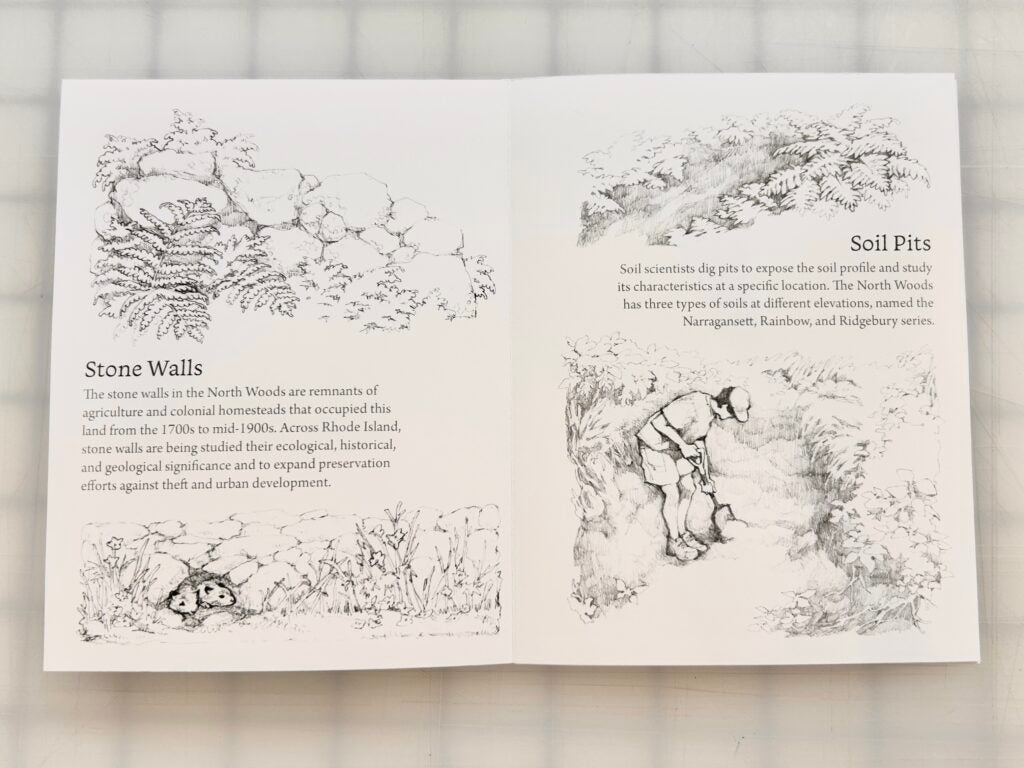
During the school year, the North woods is also utilized as a teaching forest, where classes learn from the woods and each other through direct interaction with the ecosystem. Soil science students study characteristics of the soil and geological changes over time, and Field Botany classes work together to identify plants in the North Woods throughout the semester.
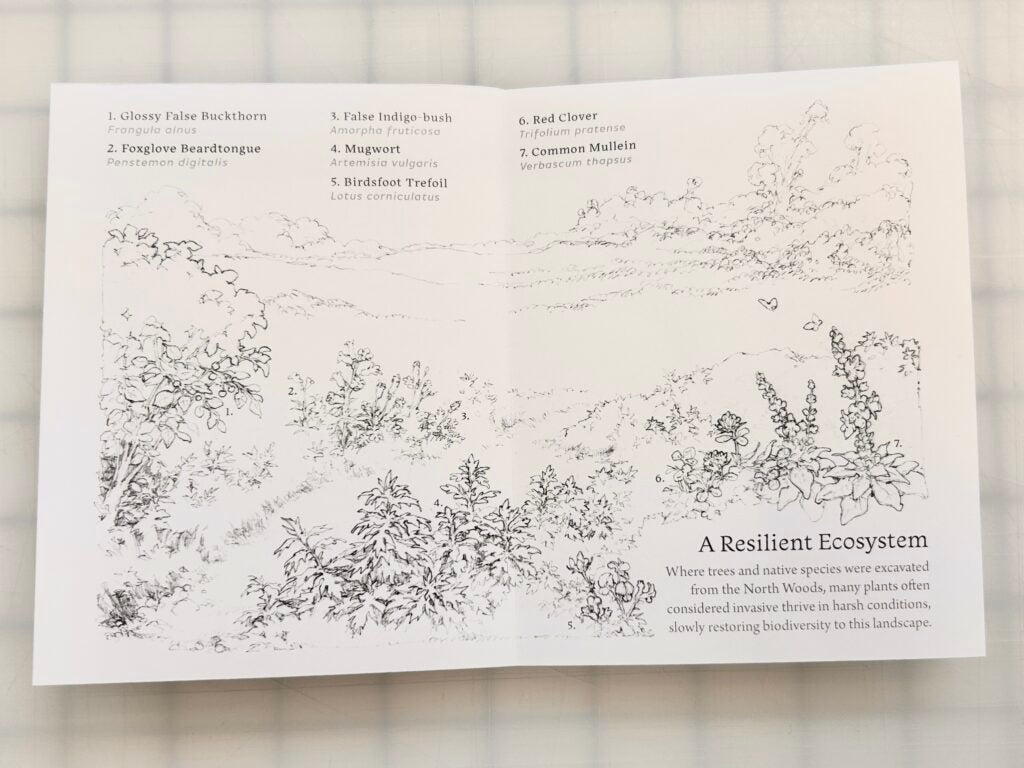
According to Lin, the barrier of entry to understand ecosystems like the North Woods is lowered through physical immersion. During these workshops over the last few years, scientists and non-scientists alike came to a deeper understanding of layered ecological and human histories by experiencing the forest together. “Learning about the things in this one small space captures what’s going on in the broader picture,” says Lin. “I found it to be a microcosm of the natural history of Rhode Island.” The North Woods’ colonial-era stone walls, decomposing waste from when it was a Superfund site, and ecological complexities hint to larger systems at play across the state and beyond its borders- wider interactions between human and nonhuman agents. The North Woods Field Guide attempts to come to a closer understanding of these larger systems by zooming into the case-study of the North Woods and how people of different backgrounds learn from it.
The North Woods Field Guide is expected to be released this Fall in both physical and digital versions. If you’d like to contribute your work to the guide, submit using the link below
https://web.uri.edu/dwell/call-for-submissions-north-woods-field-guide/