
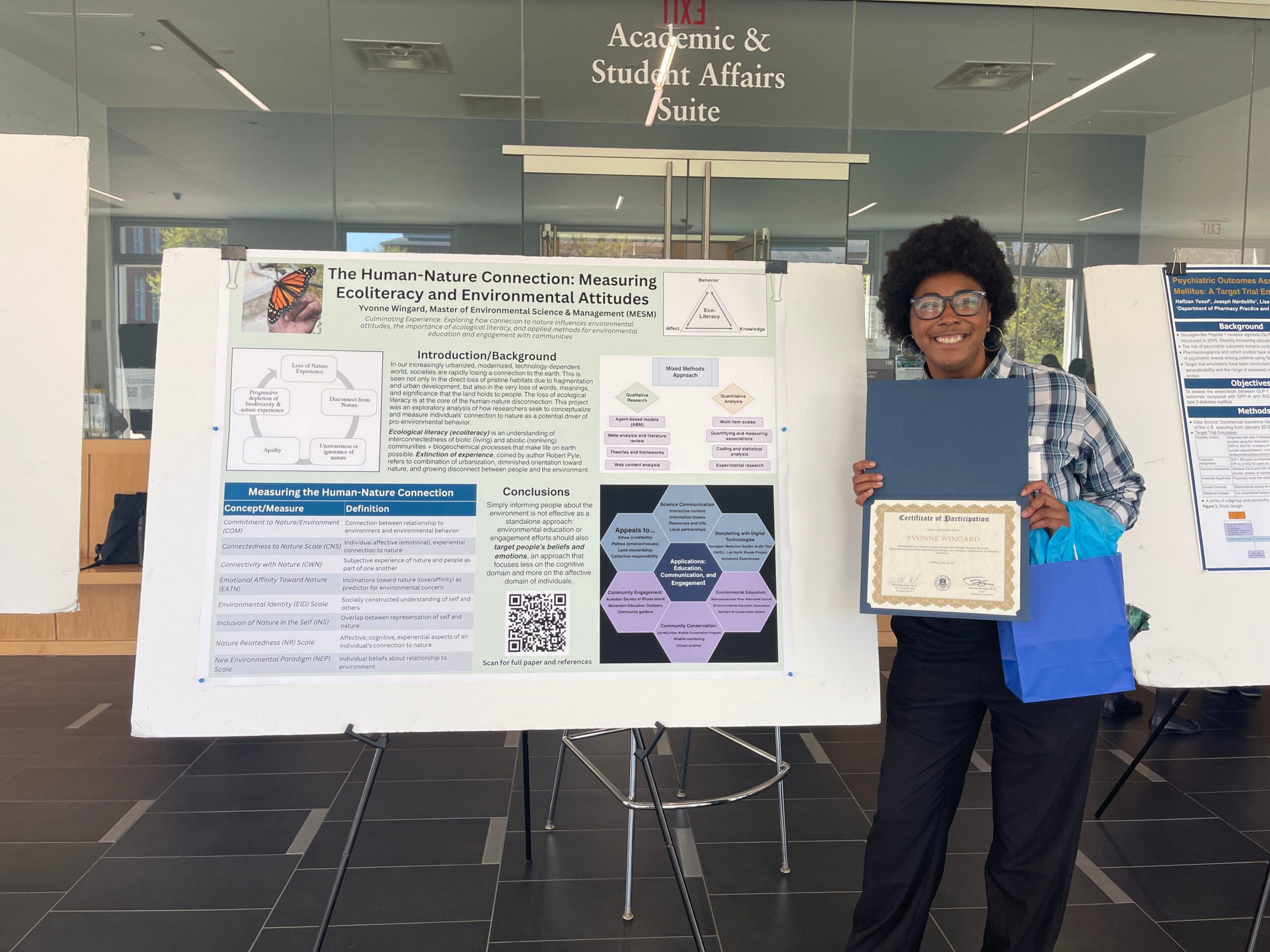
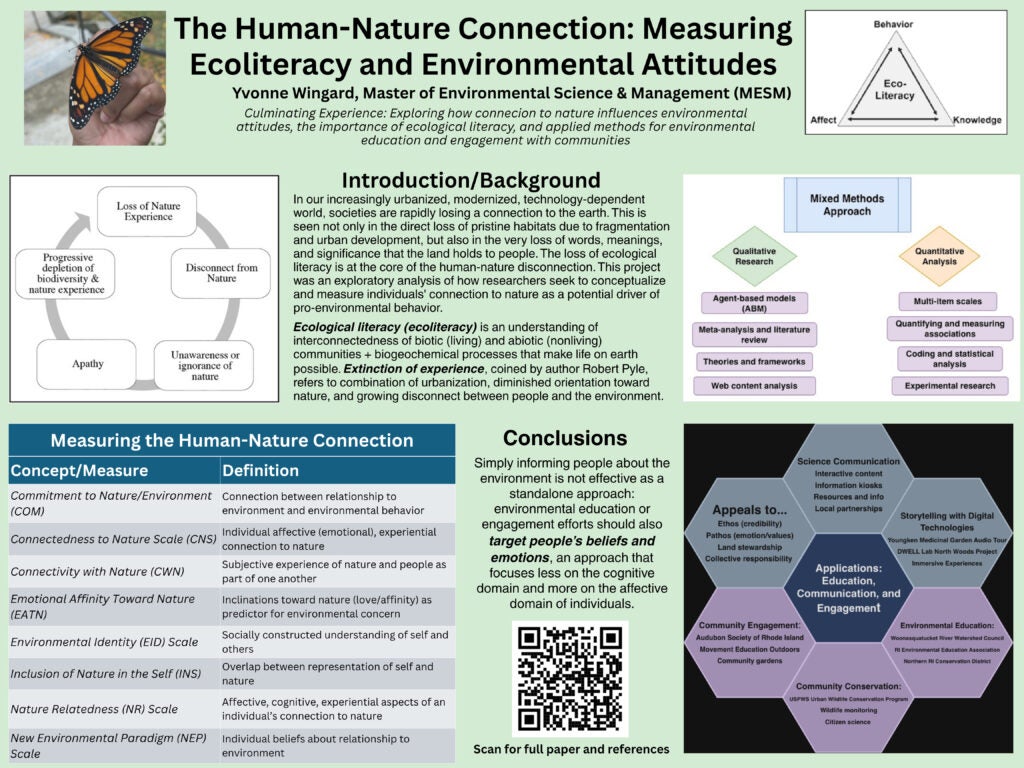
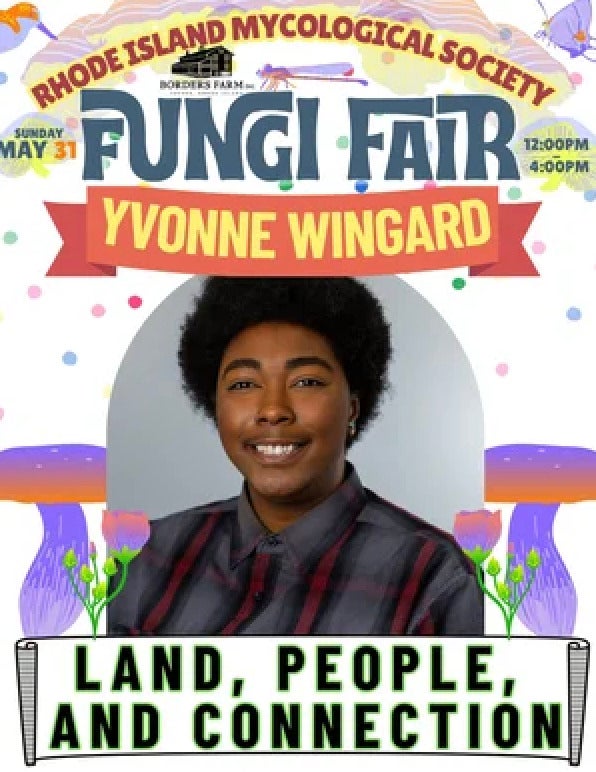
Yvonne Wingard, a recent graduate of Master of Environmental Science & Management, recently presented their research, The Human-Nature Connection: Ecoliteracy and Environmental Attitudes. The academic side to this work seeks to understand how personal connections to nature influence pro-environmental behavior, and Wingard simultaneously pursued a more personal project– a multisensory tour of the Heber W. Youngken, Jr. Medicinal Garden at URI. Wingard has presented their research at the International Graduate Student Showcase, and will give a talk at the Rhode Island Mycological Society’s yearly Fungi Fair in late May. Looking forward, Wingard’s findings will be held on a multimedia website.
With support from the DWELL Lab, Wingard was able to interview Silvermoon Mars LaRose of the Tomaquag Museum to learn more about the Indigenous use of local plants including Mullein, Rosehip, and Echinacea, as well as LaRose’s medicinal and ceremonial use of these plants throughout her life. The garden tour will feature excerpts from these interviews, guiding people through the long history of Indigenous knowledge of Rhode Island plants, and the larger non-Western approach to medicine. Wingard strives to understand plants not only as a thing to be extracted, but their value in ritual, ceremony, and the daily lives of Indigenous peoples.
In the current economic and political landscape of healthcare in the U.S., Wingard’s research is particularly relevant. With health insurance costs skyrocketing, people are not able to afford basic care and necessary medications. LaRose speaks on her use of Mullen tea as a medicinal plant, which she credits with helping her through a period of illness. Non-Western medicine focuses heavily on preventative measures and stabilizing overall health, while Western medicine treats illness after-the-fact (Ramavhoya). Understanding both perspectives could lead to a more holistic approach to personal healthcare.
Wingard’s research also has a larger importance in addressing the current climate crisis and people’s disconnection from land, which leads to a lack of personal obligation when it comes to environmental stewardship. “What I want to do in my work is inspire people by showing not just the benefits that nature can have for us, but also showing how reconnecting is the key to improving this environmental crisis that we’re in,” says Wingard. “Until you get people to incorporate the environment into their sense of both individual and collective identity, then you’re not going to feel the responsibility or obligation to care for the land.” By closely understanding our direct environments, like the plants we see every day, we can feel care and responsibility towards it.
Through this work, Wingard hopes that illuminating human connection to plants inspires people to reflect on their own relationship with the natural world, especially in urban areas that are often thought of as disconnected from nature. “How do you connect if you don’t really have physical land that you can be on?” asks Wingard. “There’s so many other ways you can still engage with nature.” Connecting with nature can be as simple as growing a plant in your house, joining a community garden, having a birdfeeder, or just spending time in the sun.
In the future, part of Wingard’s work will be featured in a multimedia page for the Youngken Medicinal Garden, where people can listen to the interviews, see the plants, and experience how the audiovisual garden tour takes viewers on a journey through history, ecology, and the benefits of medicinal plants.
Citations
Ramavhoya TI, Nesengani TV. Indigenous practices in health care promotion and disease prevention. In: Mulaudzi FM, Lebese RT, editors. Working with indigenous knowledge: Strategies for health professionals [Internet]. Cape Town: AOSIS; 2022. Chapter 2. Available from: https://www.ncbi.nlm.nih.gov/books/NBK601348/ doi: 10.4102/aosis.2022.BK296.02