
College’s 41st annual Seminar By the Sea examines how to responsibly integrate
AI into medication management
Despite its relative infancy among world-changing technologies in human history—the wheel, the printing press, electricity, the Internet—artificial intelligence has most rapidly become ubiquitous, already adopted by billions of people just a few short years after becoming publicly available. AI has infiltrated virtually all aspects of life, including health and medicine, presenting enormous opportunities and challenges for clinicians.
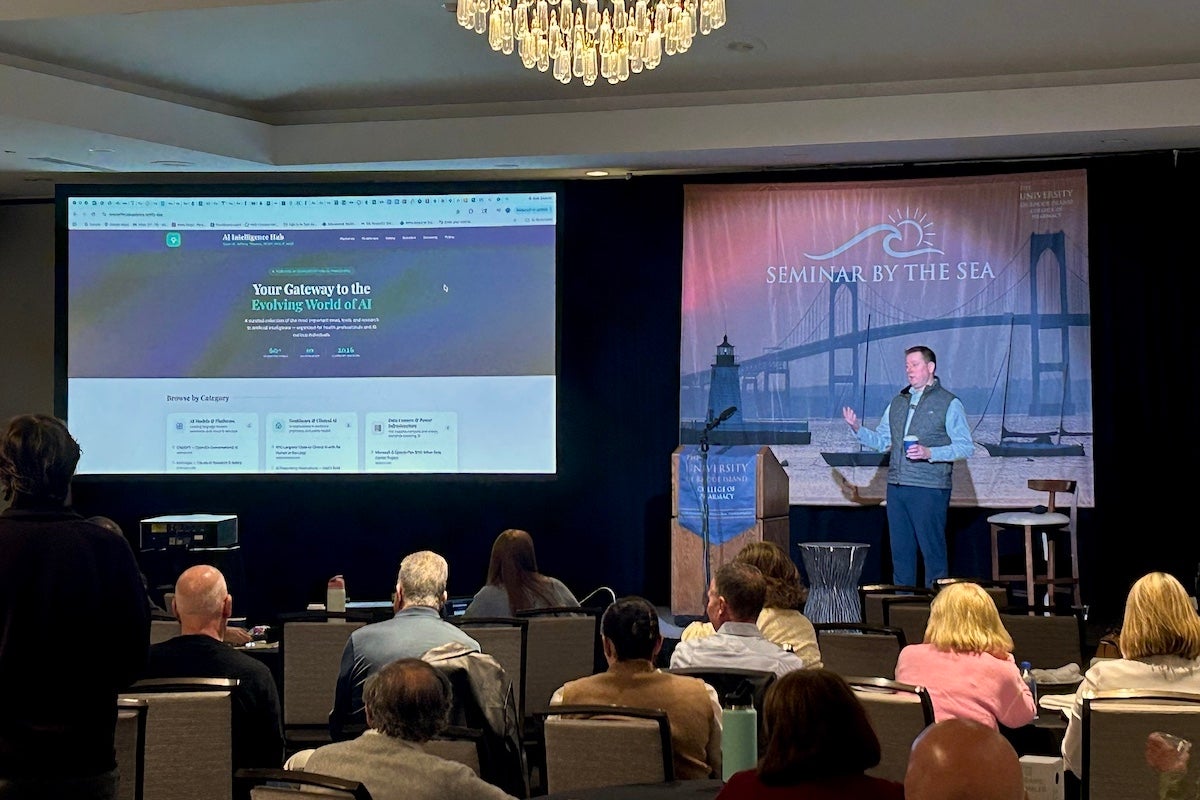
The technology’s advantages and pitfalls were front and center during the University of Rhode Island College of Pharmacy’s 41st annual Seminar By the Sea Northeast Regional Conference, which incorporated AI in a way that aligns directly with pharmacy practice. Rather than positioning AI as a standalone topic, as they have in previous conferences, organizers embedded the technology into the program throughout the event held March 19-20, creating interactive sessions and practical demonstrations that reflect real-world medication management workflows, according to Mary-Jane Kanaczet, director of continuing professional development.
For example, participants explored:
- Drug information and clinical question support: Using AI tools to efficiently retrieve and synthesize evidence in response to pharmacist and patient inquiries.
- Patient communication and health literacy, including language translation and simplifying complex medication instructions.
- Prompt refinement: Helping pharmacists ask better questions to generate clinically useful, reliable outputs.
- Administrative efficiency: Reducing documentation burden and supporting workflow optimization.
“The session was designed to be highly interactive, allowing pharmacists to engage directly with these tools and consider how they can be applied responsibly in practice,” Kanaczet said. “These conversations are woven throughout the conference as part of our focus on translating emerging tools into safe, effective, and patient-centered medication use.”

The conference reflects efforts in the College of Pharmacy to incorporate AI into teaching and practice, said Dean Kerry LaPlante. “AI has tremendous potential to enhance how we deliver medication-related care, but it must be approached thoughtfully,” the dean said. “Our responsibility as a college is to prepare pharmacists who can critically evaluate these tools, integrate them safely into practice, and always keep patient care at the center.”
Sessions surrounding AI included an interactive activity in which audience participants questioned an AI platform on health-related issues and tested the bot’s response. Led by URI pharmacy professors Brett Ferret, Jeffrey Bratberg, and Todd Brothers—who explained how to submit specific queries to get the most accurate responses—audience members tested AI’s accuracy with questions such as, “Is a course of Linezolid (an antibiotic used to treat serious bacterial infections) with a fentanyl infusion a cause for concern?” While the AI platform offered advice to monitor patients carefully when combining the drugs, it added a disclaimer: “I am not a physician or pharmacist.”
That is an important distinction to keep in mind, according to Sean Jeffrey, professor of pharmacy practice at the University of Connecticut, who presented a session on the “Promise and Pitfalls of AI in Pharmacy Practice.” Jeffrey detailed the on-going progression from AI to Artificial General Intelligence, where machines start to learn for themselves—which he said the technology is close to achieving—to the eventual goal of Artificial Super Intelligence, where machines exceed human capability.
Some scientists believe ASI may be achieved in as little as four years, exacerbating the need for society to find a way to place controls on the technology to “prevent unintended consequences,” said Jeffrey, who is also director of pharmacy at Hartford Healthcare Group. “The tech doesn’t matter if people don’t trust it.”
That need for trust and control over the technology is even more evident in health care as more clinicians take advantage of AI’s potential—from ambient listening technology, which automatically transcribes patient-physician interactions during appointments, to companies such as MedMe Health, which offers a pharmaceutical chatbot that answers patient calls, gathers patient information, books appointments, and even answers some patient questions. Other examples of AI in health care include using wearable tech to monitor vital signs, and the increasing use of platforms to diagnose symptoms.
“We’re moving closer to clinical services being performed without a human, but what happens when AI gets a dosage wrong? We need to keep humans in the loop,” said Jeffrey, noting organizations like the Coalition for Health AI is working to ensure responsible adoption of AI in health care. “We’re not at the point of robots interacting with patients, but it’s possible in the future. Pharmacists need to control the ultimate decision.”
Other tech-driven sessions at this year’s conference, “From Data to Dialogue: Where Science Meets Patient Care,” included advice on using social media for pharmacy communication; and the use of AI in antibiotic stewardship, addressing how pharmacists can anticipate safety problems with cognitive automation in pharmacy practice.
“At this year’s Seminar by the Sea, we’re not treating artificial intelligence as a future concept—we’re demonstrating how it can be responsibly integrated into everyday medication management,” Kanaczet said. “From supporting drug information and clinical decision-making to enhancing patient communication and reducing administrative burden, our goal is to help pharmacists translate emerging technologies into safer, more effective, and more patient-centered care.”