
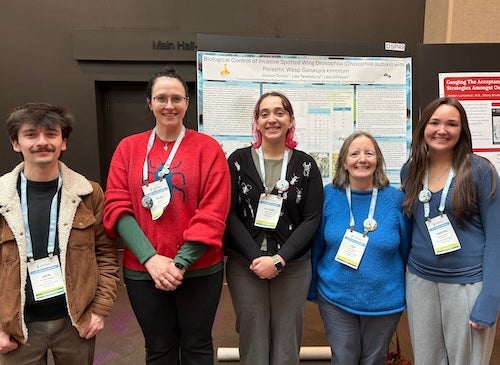
Undergraduate, graduate students, and alumni from multiple research labs at the University of Rhode Island recently presented at the Eastern Branch Meeting of the Entomological Society of America (ESA). Representing both the Biocontrol Lab—which develops sustainable solutions to invasive species—and Professor Evan Preisser’s pollinator ecology lab, which studies plant-pollinator interactions and environmental change, students shared findings spanning applied and ecological entomology.
While these labs focus on different aspects of insect science, both emphasize hands-on learning, giving students the opportunity to engage directly in research that supports sustainable ecosystems and informed environmental management.
“Take a closer look”
For Jules Bentz, a wildlife conservation and biology major with a minor in entomology, working with the Biocontrol Lab has been an opportunity to dive deeper into a lifelong interest. “I’ve always loved insects, and since I started working here I’ve learned so much about the field of entomology,” they say. “I really can’t reiterate how much I’ve learned, from hands-on experiences to meeting experts and learning from my coworkers.”
At the ESA meeting, Bentz enjoyed connecting with other entomology professionals. “It’s always a really fun time when you can get professionally excited about your research and have other people genuinely interested,” they say.
Bentz’s poster focused on the proposed biological control of the spotted lanternfly and its native counterpart in Rhode Island, examining whether a native parasitoid wasp might also target the invasive species. “The most rewarding part was seeing our data from this year come together,” they explain, describing the extensive analysis of over 24 hours of behavioral footage. “It was immensely satisfying to go from rearing them to actually having results, and even some hopeful ones.”
“Insects are around us all the time, and they’re fascinating when you take a closer look,” Bentz adds.
“Support local farmers”
For Kristen Goodrich, a double major in wildlife and conservation biology and animal science, the most rewarding part of the lab is exploring insect diversity while contributing to various research projects. “I’ve especially enjoyed being surrounded by people who are just as passionate about the field,” she says.
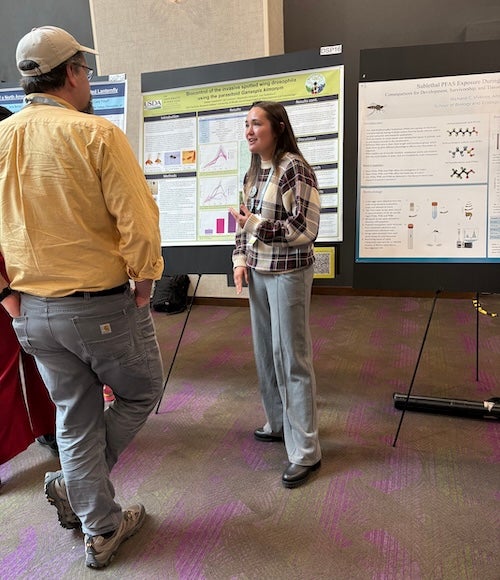
Goodrich presented her research on biological control of spotted wing drosophila using a parasitoid wasp, participating in every stage—from rearing flies to conducting field releases and monitoring outcomes. “The best part of the conference was connecting with other scientists working on spotted wing drosophila,” she says. “It was exciting to hear the different approaches people are taking and to exchange ideas on how to improve our methods.”
She hopes to reassure the public that while spotted wing drosophila may seem unappealing, it poses no harm to people. “I hope people continue to support local farmers who work hard to grow healthy, fresh fruit for their communities while managing pests like this,” she says.
“Incredibly rewarding”
For Alyson Torino ‘25, the most rewarding part of working in the Biocontrol Lab is seeing the impact of her work on the local community. “We are in direct contact with landowners, farmers, and state agencies,” she says, “and it’s rewarding to see the positive change that comes from our work.”
At the recent ESA conference Torino most enjoyed hearing from fellow students. “It’s exciting to see others early in their careers speaking with such passion about their research,” she says, adding that the experience was also reassuring: “It’s confirmation that I belong in this room and add value to the field.”
Her poster focused on the biological control of spotted wing drosophila, an invasive fruit fly affecting berry crops. “The best part is seeing that my work is helping farmers,” she says.
“Moving forward”
For Jack Bashaw ’25, working in the Biocontrol Lab offered a chance to contribute meaningfully to environmental management while spending time in the field. He now works as an assistant entomologist with URI’s Agricultural Extension and Plant Diagnostics Lab, where he continues to build on his undergraduate research experience.
At the ESA meeting, Bashaw was especially inspired by the breadth of work being conducted by fellow early-career scientists. “I loved getting to hear about all of the great new research being done all over the Eastern U.S. by other young entomologists,” he says. “At a time when the future of the field can feel uncertain, it was really encouraging to see how others are moving forward.”
“It’s energizing to exchange ideas”
At URI, Ren Johnson, a Ph.D. candidate in the Department of Biological Sciences, works alongside Professor of Biological Sciences Evan Pressier studying pollinator ecology. She finds the most rewarding part of her work is being part of an incredible research team and mentoring undergraduate students.
At the ESA meeting, Johnson enjoyed chatting with other rising scientists and hearing about the research they are conducting. “It’s energizing to exchange ideas with others who are passionate about entomology,” she notes.
Her talk focused on the changing flowering phenology of local shrub species due to global warming. “The most rewarding part was answering questions from audience members who have a genuine curiosity about these plants,” she says. “I am hoping that the general public understands how fragile our ecosystems really are, and how we must advocate for sustainable policies that reduce our carbon footprint.”
“Appreciate biodiversity”
Faye Santaniello, a double major in wildlife and conservation biology and marine biology, works alongside Johnson and Professor Preiser studying pollinator ecology. She notes that the conference was both motivating and rewarding. “I got to practice engaging with other scientists and asking creative questions,” she says.
Santaniello has worked in Professor Preisser’s lab for over a year, transitioning from slug experiments to pollination ecology. “It’s been such a journey. I’m really proud of how far I’ve come and how much I’ve learned,” she says, crediting her mentors for building her confidence as a biologist.Her poster examined the role of great rhododendron (Rhododendron maximum) in supporting pollinators in southern Rhode Island forests. Blooming between other flowering shrubs, it provides a critical resource for bees, though little is known about its visitors. Field surveys documented bumblebees, sweat bees, and a specialist species, Andrena cornelli.
“I hope more people take time to appreciate the tiny biodiversity all around them,” she says.