
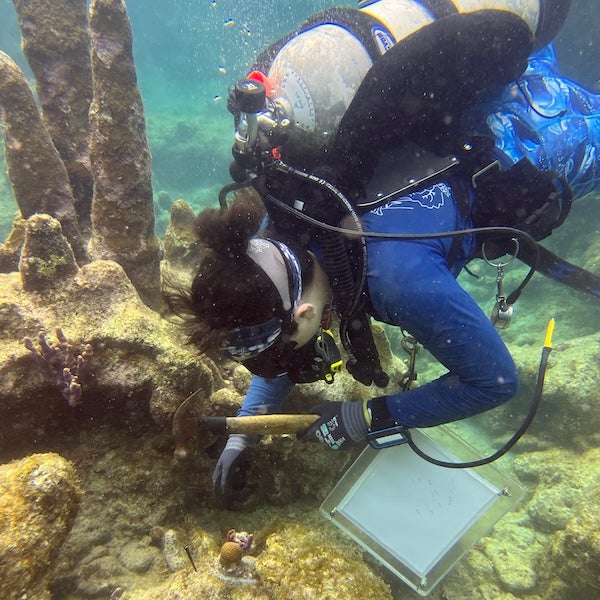
A marine biology major from Boston, Massachusetts, Sofia Grabiel Butler is studying how the loss of coral reef habitat affects fish populations. As a CELS Summer Research Fellow, she conducted fieldwork on Guana Island in the British Virgin Islands this summer with Dr. Graham Forrester to better understand how changes in reef structure may be contributing to declines in sand-canyon goby populations. During her time in the field, she helped replicate a long-term experiment, surveyed reef communities, and assisted with coral restoration. Learn more about her work and experience below!
Q. How would you explain your research to someone outside your field?
A. As corals die due to climate change, the physical reef structures are degrading and breaking down. We know that this degradation leads to declining fish populations, but our question is what exactly is causing this decline. Specifically, we are looking at a species of reef gobies that use crevices in the reef to hide from predators. We are replicating an experiment that Dr. Forrester conducted in 2000 to monitor goby mortality in habitats with different numbers of refuges. By recreating the conditions of the experiment in 2000, we will be able to confirm if the decline in the goby population is due to a lack of refuges, or if the gobies have instead changed their behavior.
Why is it important to understand how coral reef habitat loss affects fish populations?
Corals are undergoing increasing amounts of stress, disease, and fatal conditions due to climate change, and we have seen dramatic reef habitat loss in the past decades. Coral reefs are home to more than 25% of marine species we know of, despite only covering 1% of the seafloor. As a result, any change in coral reef structure or health will greatly affect the fish populations that rely on them. Our gobies are a major food source for a lot of mid-size predators on the reef, so their health and population size is important to the reef ecosystem itself.
What kinds of fieldwork did you do while conducting this research? What did a typical day look like?
I conducted fieldwork on Guana Island in the British Virgin Islands for two weeks in August, with Dr. Forrester and Katie Nickles. Our days in the field followed the same routine: have breakfast, prep dive and research gear, do 2-3 dives around the island, return and rinse gear, have dinner, and enter data before winding down and setting things up for the next day. The objective of our dives varied throughout the trip. At the beginning and end of our two-week stay, we did several dives monitoring the predators and counting the gobies in each of the experiment’s eighteen plots. During the middle section of the research trip, we did a combination of coral restoration dives and survey dives. There are many long-term monitoring sites around Guana and many of the other islands in the BVI, and we surveyed the fish species, benthic cover, and coral species along thirty transects at ten of these long-term monitoring sites.
Your project involved studying sand-canyon gobies and the crevices they use as shelter from predators. What did you find most interesting about this work?
One of the most interesting things I’ve come across doing this work is how these gobies use shelter in an uncommon way. Rather than each goby having its own refuge that it retreats to when threatened, all the refuges are up for grabs. The gobies exhibit a “musical chairs” behavior: when a predator comes, it’s everyone-for-themselves as each fish tries to get to an unoccupied refuge. During the fall, when I continue working with Dr. Forrester to analyze the data we collected, we will incorporate this idea by looking at the ratio of gobies to crevices, something that was not explored in the original 2000 experiment.
You also had the opportunity to assist with coral restoration. What did that involve, and why is this work important?
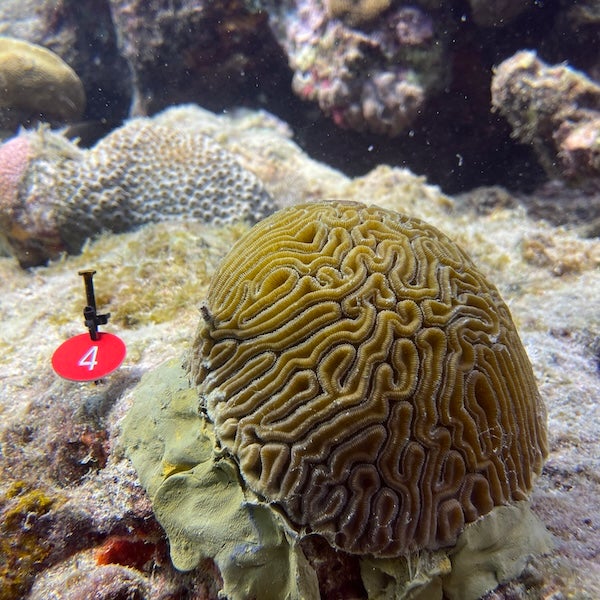
The hands-on nature of the coral restoration made it very fulfilling! We did visit a past restoration site to check on those corals, but our main focus was relocating threatened and rarer corals from areas where ships anchor and moving them to shallower reefs closer to shore. We identified Montastrea spp., Orbicella spp., and brain coral species that had been dislodged or broken off the main reef, and transported them on our boat over to the restoration site. We found suitable places for each coral on the reef structure and glued them to the reef using epoxy. We then nailed tags next to each coral, catalogued its number and location on the reef, and took a photo for visual reference. All told, we relocated over 50 corals. In a world where they are already so threatened by disease and bleaching due to rising ocean temperatures, being able to remove the threat of careless anchoring will go a long way and help preserve these coral species.
Was there a memorable moment or challenge from your time conducting research in the Caribbean?
Conducting fieldwork in the BVI was a conflicting amount of inspiring and emotionally challenging. On the one hand, it was incredible to contribute to field research and to learn from Dr. Forrester about the research process and the logistics and techniques of research diving, especially in a location he knows so well and has been researching for so many years. On the other hand, the British Virgin Islands have been ravaged by Stony Coral Tissue Loss Disease in the past five years, and have had two major bleaching events recently that have also killed off much of the coral. As someone who loves the ocean and its biodiversity so much, it was difficult at times to reckon with the demoralizing state of the reefs there. That said, I was pleasantly surprised with how resilient the ecosystem itself seemed to be. We saw several sharks, many different reef fish and eel species, beautiful ostracod bioluminescence, and even a pod of dolphins! The experience gave me a stronger resolve than ever to protect marine ecosystems, and it was very inspiring to learn from and hear the advice and career paths of not only Dr. Forrester, but many of the other BVI-based researchers we collaborated with.
What has it been like working with your faculty mentor and research team?
Dr. Forrester has been a fantastic mentor, throughout all the different phases of this fellowship and research project. Since we are replicating an experiment of his, featuring a species he has studied for decades, he is a wealth of knowledge. He is very open and encouraging, but also clearly passionate about his research and about the marine ecosystems and the people of the BVI. He and Katie Nickles – who I met briefly during my AAUS Research Diving course at URI – make a fantastic team. Katie has worked with him on projects in the BVI before, so I felt very comfortable working with the two of them. While Dr. Forrester was the lead researcher, we worked very well together as a group of three: prepping gear and slates, comparing notes and proposing ideas, organizing data, hauling tanks and dive gear, and going on adventures and hikes around the island.
Is there anything else you’d like readers to know about your research or your experience this summer?
Because of this fieldwork in August, my fellowship has a unique timeline, and I will be continuing to work with Dr. Forrester in the fall as we analyze the data from this experiment. I look forward to seeing what takeaways we come to, and to learn more about data analysis!