
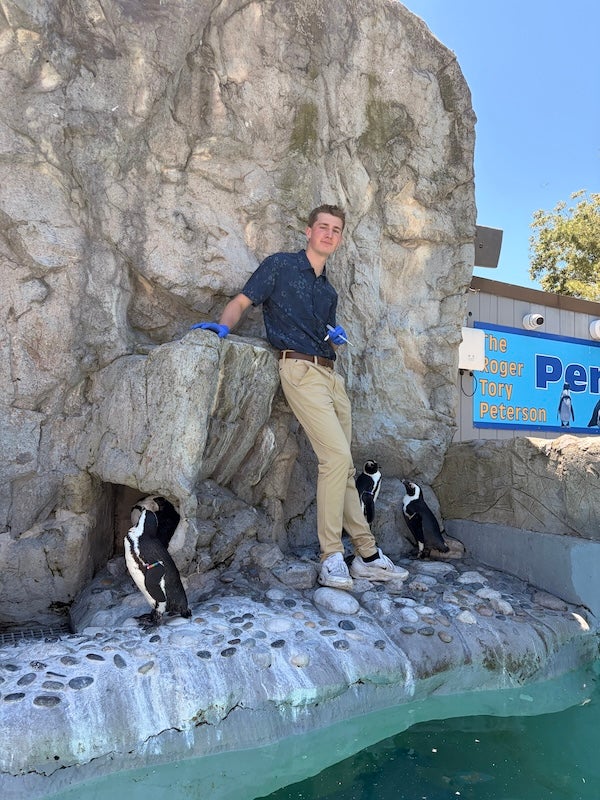
KINGSTON, R.I. – Aug. 31, 2026 – This summer, Sophia Webster has been crushing up rabbit droppings, and Evan Morgan has been watching penguins socialize. And the best part? It’s all in the name of science.
Webster, a medical laboratory science major at the University of Rhode Island, is helping to develop a pregnancy test for New England cottontails in partnership with Roger Williams Park Zoo. Morgan, a double major in marine biology and wildlife conservation, is studying pair bonding in African penguins at Mystic Aquarium. Although their research focuses on different species, both projects seek to answer the same fundamental question: How can scientists improve the success of conservation breeding programs for imperiled species?
As CELS Summer Research Fellows, Webster and Morgan are working under Dr. Justin Richard, assistant professor of animal and veterinary science, whose research focuses on reproductive physiology and conservation partnerships with zoos and aquariums. ”Mystic Aquarium and Roger Williams Park Zoo are hubs for wildlife conservation and research, and also provide unique opportunities to train the next generation of animal scientists,” said Richard. “Not even sophomores yet, Evan and Sophia are already contributing to important work in animal conservation made possible through these collaborations.”
Detecting rabbit pregnancy more quickly
The New England cottontail is the region’s only native rabbit species and has experienced significant population declines and habitat fragmentation. In Rhode Island, it’s listed as a Species of Greatest Conservation Need. To help bolster wild populations, Roger Williams Park Zoo maintains a conservation breeding program, with young rabbits released once they are old enough to survive on their own. Since the program started in 2010, over 500 New England Cottontails have been released throughout New England.
One challenge in conservation breeding of the rabbits is that researchers currently have to wait the full gestation period before knowing whether breeding was successful. Webster’s project, led by PhD student Lindsay Culpepper, aims to change that by developing a pregnancy test using fecal samples. In the laboratory, she processes rabbit fecal samples and measures hormone concentrations through assays. She and her team expect pregnant rabbits to show distinct hormonal patterns, allowing pregnancy to be detected much earlier than is currently possible.
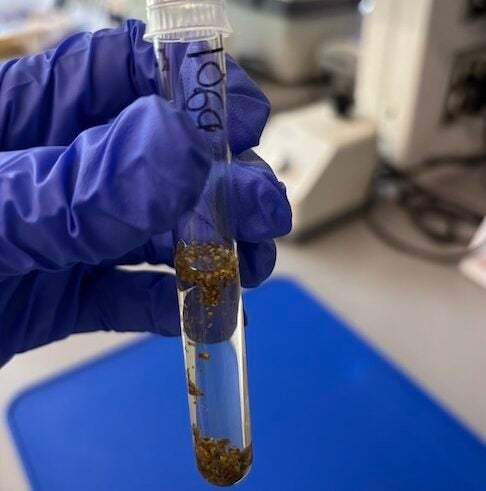
“The goal is to develop a noninvasive pregnancy test,” Webster said. Using fecal samples instead of more invasive methods such as ultrasounds, urine, or blood samples “minimizes stress on the animals while also providing more reliable hormone measurements,” since stress itself can influence hormone levels.
With earlier pregnancy detection, scientists and zookeepers can make informed decisions about breeding plans sooner, allowing them to allocate time and resources more efficiently. In turn, this can improve the success of breeding programs and strengthen conservation efforts for this at-risk species. The zoo’s partnership with URI “has proven that research-driven decisions have had a great impact on the success of the breeding program,” said Lou Perrotti, director of conservation programs at Roger Williams Park Zoo.
Reading penguin emotions through facial temperature
The African penguin, native to the waters off of southern Africa, is listed as critically endangered on the IUCN Red List. Its population is declining rapidly due to habitat loss, overfishing, and climate change. Across the world, zoos and aquariums maintain conservation populations of African penguins, to act as ambassadors for their species, and act as a “back-up” in case the wild population plummets even further. As for any species, successful conservation breeding programs for the African penguin depend on identifying the most compatible and productive mates.
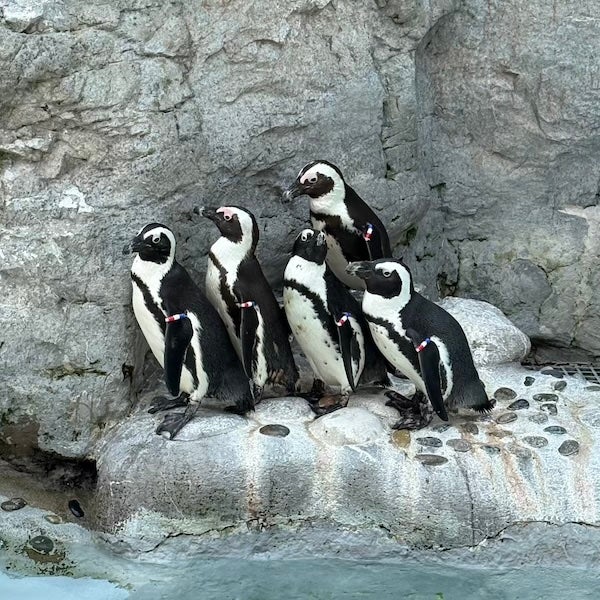
Through his fellowship, Morgan is assisting PhD student Molly Langevin in a project at Mystic Aquarium aimed at better understanding African penguins’ emotional response to different stimuli, such as getting satisfying head scratches from their trainers or socializing with other penguins. Thermal cameras and behavioral observations capture the birds’ responses, allowing researchers to investigate whether facial temperature corresponds with behavior associated with pair bonding. Previous studies in mammals have shown that blood flow, and therefore surface temperature, changes with emotional state, analogous to blushing in humans, but the technique has not been extensively studied in birds, and much less in penguins.
“We expect that penguin facial temperatures will change in different ways depending on the scenario,” Morgan said. Ultimately, this research could help zoos and aquariums improve breeding success by identifying the pairings most likely to reproduce. “Every successful pairing and chick produced through a conservation breeding program represents an important contribution to the future of this critically endangered species,” said Tracy Camp, assistant curator of birds at Mystic Aquarium. Camp added that research like Morgan’s strengthens global efforts to protect African penguins for generations to come.
A summer they’ll never forget
In speaking with the students, their enthusiasm about their summer projects was abundantly clear: Webster gushed about her fascination with the technology of the assay machine, and Morgan expressed feelings of awe and privilege for getting to work face to face with a critically endangered species. But the fellowship’s impact extends far beyond a single summer, equipping students with tangible research skills, supporting the conservation work of partner institutions, and generating knowledge to give imperiled wildlife a better chance at recovery.
Written by CELS Communication Fellow Jessica Minker