
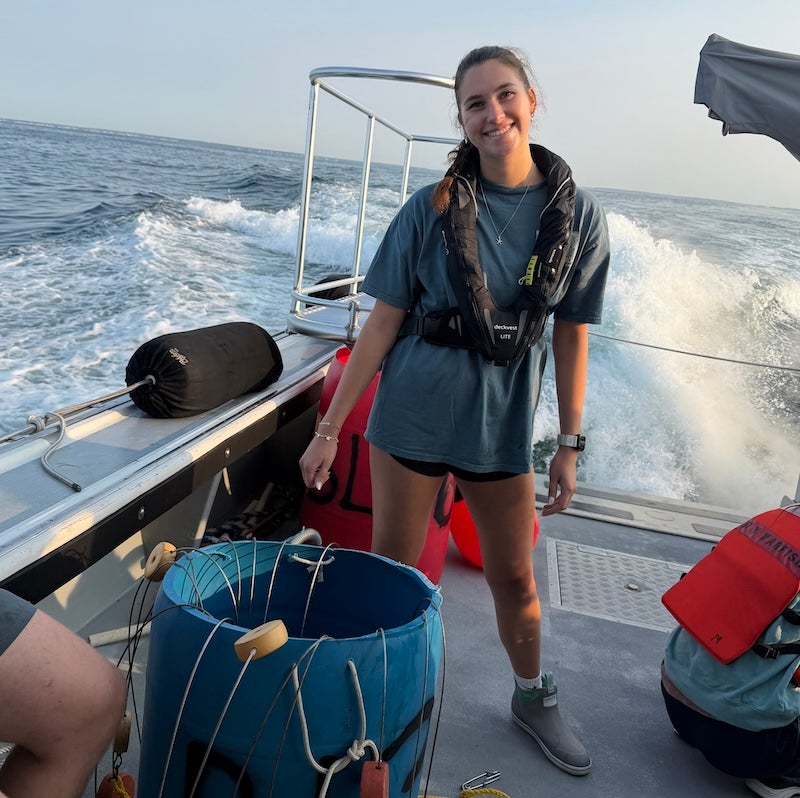
On a small research vessel, scientists double as crew. On the R/V Warfish, that teamwork produced a first in common thresher shark research.
KINGSTON, R.I. – Nov. 12, 2026 – The first trip lasted more than 15 hours and ended without a shark. Ten hours into the second, a ten-foot common thresher surfaced on a longline, and everyone aboard the R/V Warfish went to work to tag it.
That shark gave researchers what is likely the world’s first fine-scale depth profile for the species: a detailed record of how it moved through the water column over 24 hours.
The work is part of University of Rhode Island graduate student Owen Fleischer’s research. Working in Dr. Kathleen Carroll’s Quest Lab in URI’s College of the Environment and Life Sciences, he is chasing a deceptively simple question: What do sharks actually do all day?
Satellite data can show where sharks go, but not what they do moment by moment as they move through the ocean. Fleischer’s tag, provided by the Guy Harvey Foundation, is built to fill that gap.
But a good research question and the right technology can only get you so far. Getting the tag onto an actual shark took Brian Caccioppoli, who captains the Warfish for URI’s Graduate School of Oceanography and began running university small boats in 2013, and a team of students and scientists each willing to put in the work.
Hitting the waypoint
“Scientists aboard small research vessels often double as crew,” Caccioppoli says. So before the Warfish leaves the dock, everyone aboard checks in as a group to agree on their roles and assess the mission’s risks.
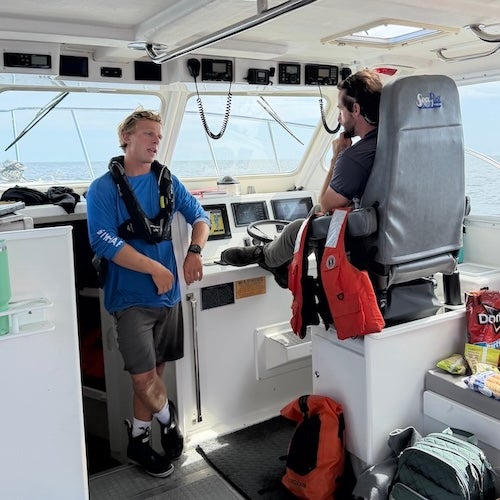
Once underway, the division of labor is clear. “Owen is the science expert and I defer to him on all big picture planning such as location, fishing methods, and timing,” Caccioppoli says. “My role is to make sure that the vessel does exactly what is needed to safely conduct the science.”
Fleischer used years of catch records to select fishing locations around Narragansett Bay and gave Caccioppoli precise GPS coordinates, or waypoints, to target. Before each trip, Caccioppoli checked the weather and tides. At each location, he read the wind and current and positioned the Warfish upwind so it would drift over Fleischer’s mark.
“An ideal drift would bring us right over that waypoint,” he says, “and bonus points if that drift is stable and comfortable along the way.” Aside from occasional detours around crab pots, the boat’s movements were “completely dictated by the science,” he says.
Patience and persistence
Even a perfect drift can’t make a shark take the bait, and on the first trip, in August, none did.
Makenzie Denzler spent much of that day baiting longlines and drop lines. A marine biology major who joined URI’s Shark Research Lab as a freshman, she has worked on projects ranging from underwater video systems to whale shark movement. Out on the Warfish, she learned what fieldwork at sea demands.
“This is something totally out of our control, but something that we have to prepare for out in the field,” Denzler says. “It’s not always successful on the first try, and patience is key.”
She watched Fleischer model that patience. “I’m so impressed with how he led with composure and stayed positive the entire time,” she says.
Shark on the line
On the second trip, in September, the patience—and hard work—paid off. “Seeing our thresher come up with one of the long lines was surreal,” Denzler recalls.
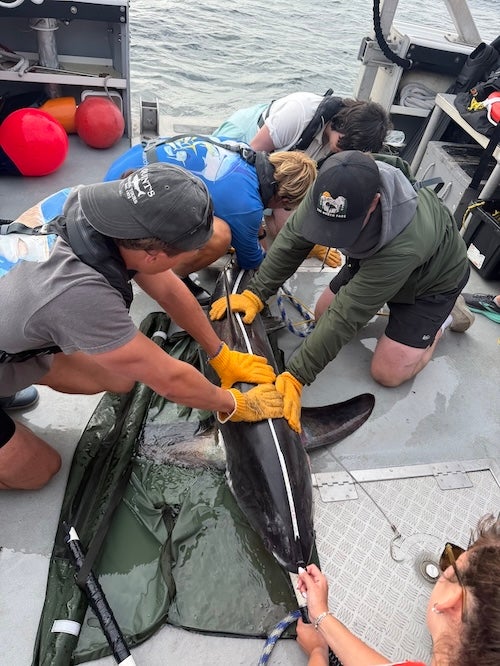
The team brought the shark aboard. Fleischer and Denzler worked with Carroll, assistant professor of applied quantitative ecology, undergraduate Luke Johnson, and Ph.D. students Christopher Hickling and Kayla Austin. While Fleischer and Johnson fitted the tag, Denzler kept water flowing through the shark’s gills.
“Working with a shark sounds really intense, but everyone was so prepared and ready that I felt comfortable doing this for the first time,” she says. “I’ve never seen a shark that big so close before.” The common thresher happens to be her favorite species.
In the pilothouse, Caccioppoli kept the boat steady, pointing its bow into the wind and waves to reduce rolling. Two Seakeeper gyroscopic stabilizers helped keep the Warfish level.
Still, equipment can only do so much. “The most important thing as captain is to remain situationally aware and clearly communicate with the scientists,” he says, “as their attention needs to be dedicated to tagging.”
Fleischer’s focus was singular. “As soon as the shark’s on board, all I’m thinking about is how fast we can get it back in the water,” he says. When the shark was released, he slipped into the water beside it in a mask and flippers, ready to help if it needed support. It swam off steadily.
A needle in a sea of haystacks
The job wasn’t finished when the shark swam away, though. The tag recorded data 100 times per second for 24 hours before releasing from the shark and floating to the surface. The team returned the next day to recover it near Martha’s Vineyard.
“Even with a GPS location provided by the tag, it would be a bit like finding a needle in a haystack, in a sea of haystacks,” Caccioppoli says. “Thankfully, the tag was equipped with a radio frequency transmitter making the search process significantly easier.”
Fleischer called out the bearing from the tag’s radio signal, Caccioppoli steered, and lookouts scanned the water from the pilothouse roof. They spotted the tag in about 10 to 15 minutes.
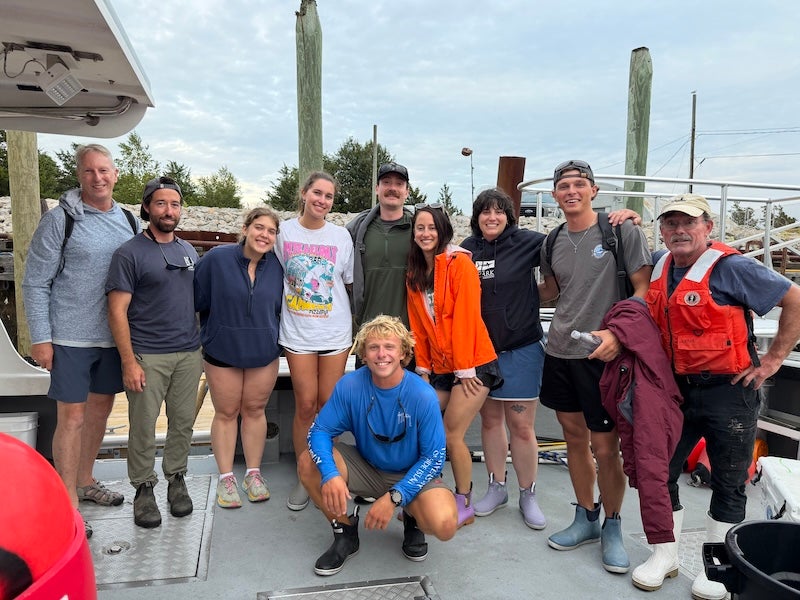
The shark was the headline, but asked what stuck with him from the trip, Caccioppoli pointed to the people. “Owen’s team was incredibly prepared,” he says. “All equipment was functioning and at the ready, and everyone had defined roles.”
For Caccioppoli, that’s part of the reward. “I am just so thankful for the privilege to work alongside such talented and dedicated scientists, students and communicators of science,” he says. “Their work inspires me and keeps me eager to learn!”