In partnership with the RI NSF EPSCoR’s Summer Undergraduate Research Fellowship (SURF) program at the University of Rhode Island, DWELL Lab is seeking students interested in collaborating on the North Woods Field Guide project in Summer 2026 (see the project description below for details). Selected undergraduates will be paid a stipend of up to $6,400 (proportional to time worked, up to 40 hours per week) and up to $550 for research supplies. Students who cannot commit to the full 40-hour per week program should still apply for SURF Flex, at 20 hours per week with a stipend of $3,250 ($275 for supplies). Prospective students can learn more and apply on the SURF Website, or reach out to Stephanie West-Puckett and Madison Jones with any questions.
Deadlines
Undergraduate application window: Friday, Dec. 5, 2025 – Friday, Feb. 6, 2026
Project Description
Writing Wild: A Woodland Community Field Guide is a civic-science storytelling collaboration between the Digital Writing Environments, Location, and Localization (DWELL) Lab at the University of Rhode Island and ecoRI News. The project brings together environmental journalists, natural resource scientists, community members, artists, and undergraduate students to co-create a multimedia “people’s field guide” to URI’s North Woods, a teaching forest largely unknown to the wider public despite its ecological and cultural significance.
Students will participate in field-based research and multi-media content creation, contributing to the development of field guide entries that integrate science communication and environmental storytelling.
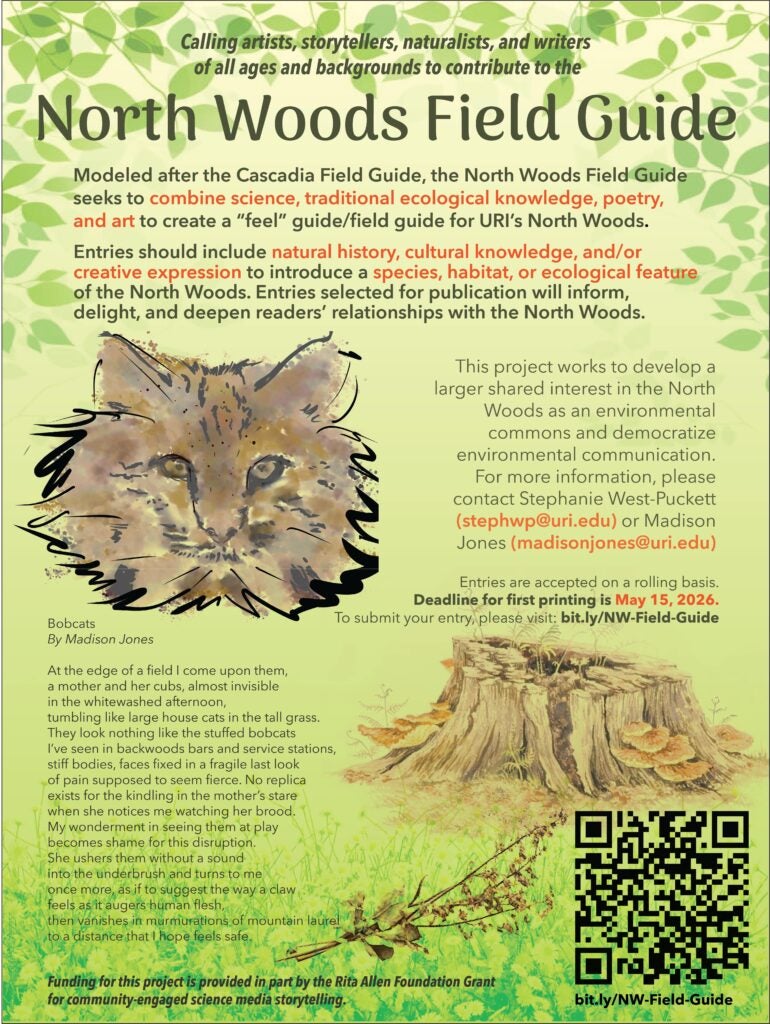
Project activities include collecting field observations, conducting interviews with community partners and environmental scientists, developing multimedia content (short videos, sound recordings, sketches, photographs), and designing accessible digital field guide materials. Students will also manage community submissions and help to publish volume one of the North Woods Field Guide.
This project directly aligns with RI-NEST goals by strengthening student pathways into the Blue Economy workforce through applied environmental communication and field-based ecological observation. This project catalyzes partnerships between the University, ecoRI News, and Rhode Island community groups to advance science communication that is accessible, inclusive, and grounded in place. Students will complete the SURF program with strengthened research skills, digital media competencies, and experience working with a multidisciplinary team at the intersection of environment, community engagement, and public communication.
The SURF student will:
- Conduct ecological field observations in the North Woods (habitat features, species presence, seasonal changes, human uses).
- Collect and curate multimedia content (photography, sketches, audio recordings, short videos, and other visual artifacts).
- Contribute to writing, revising, and editing field guide entries that integrate science, traditional ecological knowledge, narrative, and art.
- Collaborate with ecoRI environmental journalists to learn about story development, interviewing, and public communication.
- Help organize and manage digital submissions and assets (text, audio, images, written work) for an accessible, public-facing online field guide.
About SURF
From their website: “RI NSF EPSCoR’s Summer Undergraduate Research Fellowship (SURF) is a 10-week introduction to research in marine-based sciences and engineering. Students who are RI residents and/or matriculate at a RI college or university are eligible to apply. Selected students receive hands-on training with faculty and graduate students at colleges and universities across Rhode Island, learning about everything from how diatoms in Narragansett Bay are responding to climate change to developing classroom materials that help middle and high school students understand basic engineering concepts.” [Learn More and Apply Today on the SURF Website].
RI NSF EPSCoR is supported in part by the U.S. National Science Foundation under EPSCoR Cooperative Agreements #OIA-2433276 and in part by the RI Commerce Corporation via the Science and Technology Advisory Committee [STAC]. Any opinions, findings, conclusions, or recommendations expressed in this material are those of the author(s) and do not necessarily reflect the views of the U.S. National Science Foundation, the RI Commerce Corporation, STAC, our partners or our collaborators.