
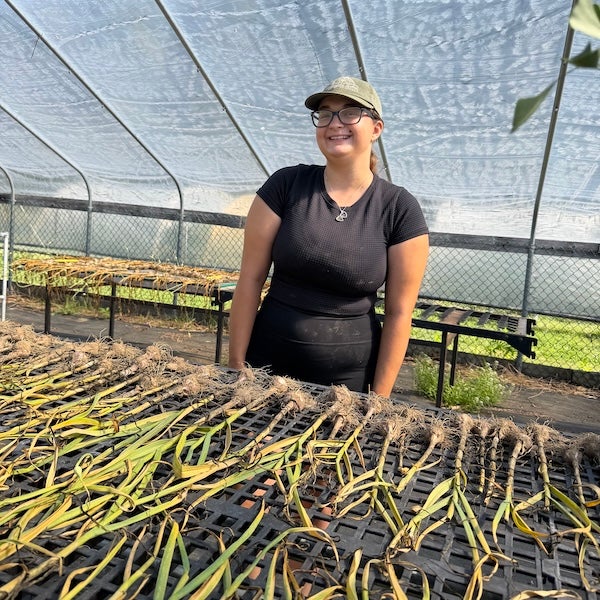
By 9 a.m., Carolyn Milaszewski is walking the rows of produce at the University of Rhode Island’s Agronomy Farm, harvesting produce. She had never farmed before this summer and wasn’t sure what to expect. But after earning a placement through URI Cooperative Extension’s Agriculture and Food System Fellows Program this year, she discovered a new passion.
“It’s made me much more mindful of how I’m consuming food,” she says. “When you see how much work goes into growing something, you appreciate it more. It feels community-based.”
For Milaszewski, seeing fresh produce harvested and distributed across campus has underscored the role local agriculture can play in addressing food insecurity and strengthening communities – especially on a public university campus. “When you have a farm right there, it should be bringing good food to the people around it,” Milaszewski says.
“Anything extra we donate to food pantries around here,” she adds, noting that the farm supplies dining services, the Rhody Outpost basic needs pantry for students, and other campus food access programs.
Connecting conservation and economics
The fellowship, part of URI Cooperative Extension, pairs students with organizations working to strengthen Rhode Island’s food system while providing professional development and networking opportunities throughout the year. Alongside their real-world placements, fellows participate in leadership training, actively network at industry events, and thirty hours during a Summer Industry Training visiting key sites and hearing from key changemakers in the sector. Milaszewski says those experiences have helped her build friendships with students from across Rhode Island’s food and agriculture community.
That hands-on view of the food system has carried over into how Milaszewski thinks about her academic path. Now entering her senior year, she is pursuing double majors in environmental and natural resource economics (ENRE) and wildlife conservation biology.
Through environmental economics, she studies how economic systems influence environmental decision-making. She added wildlife conservation biology as a second major after realizing she wanted a stronger scientific foundation to complement the policy and economics side of her education.
“The wildlife conservation classes give me the foundational biology and conservation piece,” she explains. “Environmental economics is where I get to take that knowledge and actually apply it — using surveys, cost–benefit analysis, all of that — to solve real problems.”
Creating community
Milaszewski chose URI in large part because of its combined bachelor’s and master’s (4+1) programs and hopes to continue into graduate study after completing her undergraduate degrees. She also remembers a faculty member who stayed after an orientation session to answer questions after she and her mother accidentally arrived late.
“That was one of the moments where I thought, ‘Okay, I want to be part of this community,'” she says.
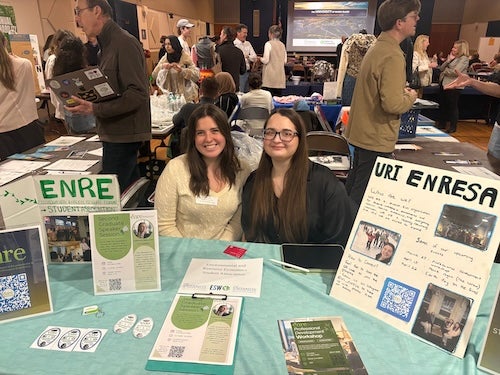
But finding that sense of belonging wasn’t immediate. During her first year, Milaszewski struggled to find her place, an experience that now shapes the advice she gives new students. “I tell people to get comfortable being alone,” she says. “Once you’re comfortable being alone, you’re much more comfortable building friendship.”
She also credits faculty mentors with helping her succeed, describing professors who saw her as a person, not simply another student. “If teachers see me as a human instead of just a number, it makes me want to do so much better,” she says. “I want them to know that the effort they put into helping me paid off.”
That same sense of belonging now shapes the way Milaszewski gives back to campus. She is launching a Wildlife Conservation Club that she hopes will become an inclusive space where students can connect, share ideas and build community. “I don’t want it to feel exclusive,” she says. “I want people to be able to come to a place where they can build community.”
Whether she’s harvesting tomatoes, cucumbers, and garlic; exploring the intersection of ecology and economics; or creating spaces where other students feel they belong, Milaszewski has learned that some of the best opportunities begin with embracing new opportunities.
“I think keeping an open mind has been the biggest lesson,” she says. “Some of the best opportunities are the ones you never planned for.”