
URI oceanography student spends 18 months researching effects on oysters
January 20, 2026
The Rhode Island aquaculture industry is more robust than ever. The value of aquaculture products was $8,795,493 in 2024 and 89 active aquaculture farms covered 392.5 acres, according to a report by the Rhode Island Coastal Resources Management Council.
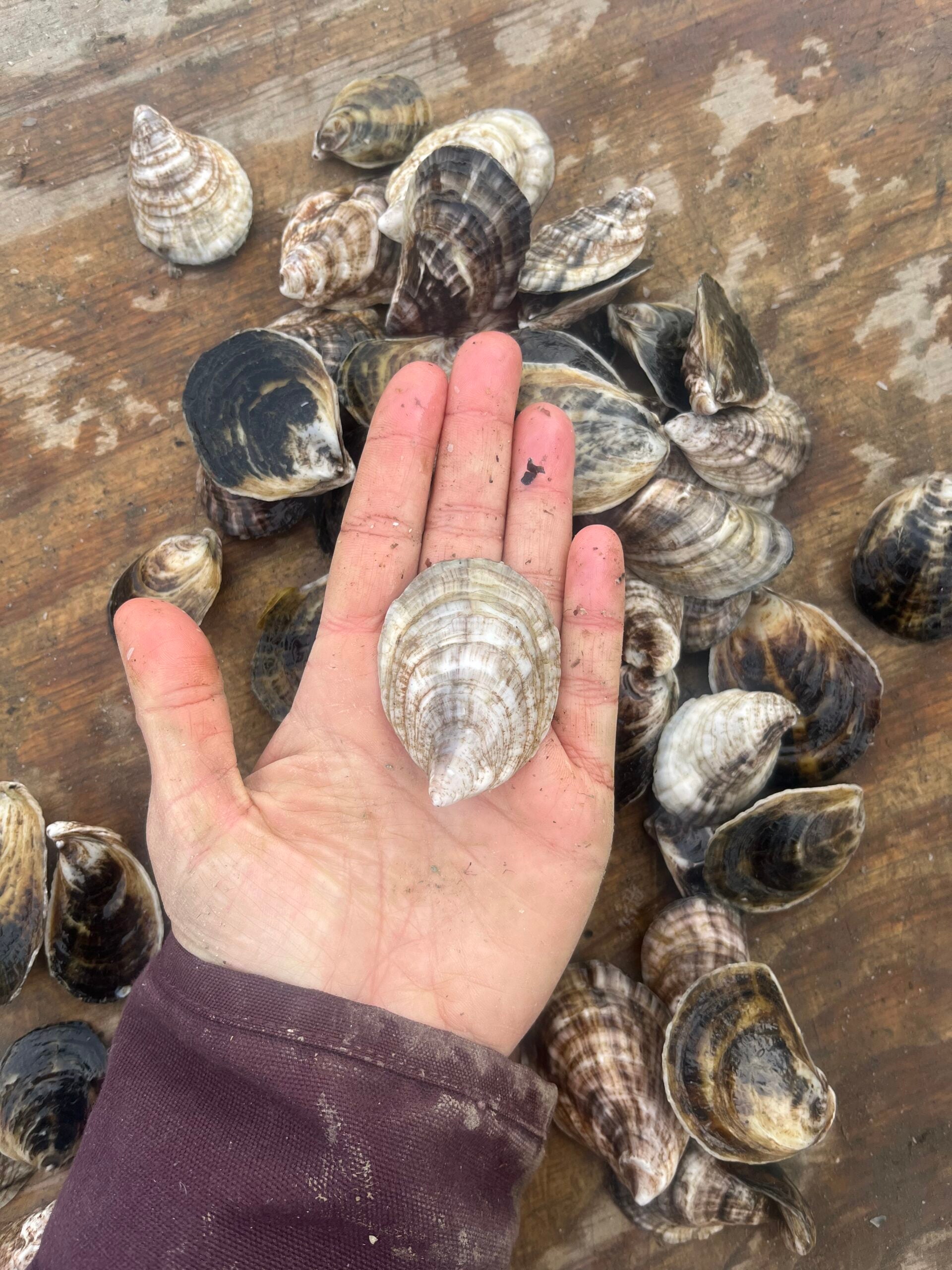
Eastern oysters account for approximately 99% of the state’s aquaculture production, the report noted. Jacqueline Rosa, who is pursuing her master’s degree in oceanography from GSO, spent 18 months conducting field work on how water quality and farming practices impact these mollusks.
Eastern oysters grow in Narragansett Bay and Rhode Island’s salt ponds. Rosa’s field work was done in the lower west passage of Narragansett Bay, an area that hosts 48 acres of oyster farms.
Testing the waters

To examine the environmental conditions, Rosa deployed two sensors at Wickford Oyster Company’s 4-acre farm in May 2024, one at the surface of the water and one at the bottom of the water column.
Rosa revisited the farm each week to collect water samples from the surface and the bottom. She brought the samples to the Ocean Carbon Laboratory at the Graduate School of Oceanography for analysis.
“I tested the samples for pH, salinity, alkalinity, and dissolved inorganic carbon,” said Rosa, who is from Newtown, Connecticut. “These carbonate chemistry parameters help us understand trends in ocean acidification and how changing conditions may impact calcifying organisms. Shifts in carbonate chemistry can influence shell formation, growth rates, and survival, particularly during early-life stages, making these measurements critical for understanding potential stressors for farmed oysters.”
Assistant Professor Hongjie Wang is Rosa’s academic advisor, and she leads the Ocean Carbon Laboratory where studies are conducted on the biogeochemistry of seawater and sediments to answer questions related to carbon and oxygen cycles in the context of climate change and anthropogenic stressors in ocean systems.

“Jacque’s research fills a critical data gap by establishing baseline water quality conditions in oyster-farming areas,” said Wang. “Our hypothesis is that oyster mortality is linked to specific, abnormal environmental conditions, such as low dissolved oxygen and/or pH. By pairing continuous water quality observations with oyster performance data, this project provides the foundation needed to evaluate whether observed mortality events are environmentally driven.”
Rosa collected and tested 127 water samples. She also maintained the sensors, replacing them with a newly calibrated set every few months.
Working on the farm
The second component of Rosa’s field work involved studying the equipment and methods used for farming, with the goal of informing best management practices, reducing operational costs, and enhancing the long-term resilience of Rhode Island’s oyster industry.
To measure the potential impact of gear type on oyster growth, Rosa placed approximately 2,700 early-life stage oysters across three types of gear at Rome Point Oyster Farm in August 2025. Oysters were evenly deployed across traditional surface gear, traditional bottom gear, and a newly developed surface gear, called FlipFarm.
From August through December, Rosa worked alongside farmers to monitor oyster survival, measure shell growth, and subsample oysters for additional laboratory analyses.
Rosa was struck by the different types of aquaculture farming methods and how each system has its advantages and disadvantages.
“Aquaculture gear is rapidly evolving, making it critical for farmers to select equipment that is most effective for their operations,” said Rosa. “Traditional grow-out methods are highly susceptible to biofouling, which can reduce growth rates, restrict water flow, and increase mortality. Surface and bottom gear are also labor and time intensive to maintain. The FlipFarm Oyster Growing System addresses several of these challenges, although it’s not perfect and has its drawbacks.”
Rosa observed a substantial reduction in biofouling with the FlipFarm system. The baskets can be mechanically flipped using a shuttle attached to a vessel. The manufacturer estimates labor reductions of up to 60%, lowering maintenance costs, fuel use, and vessel time while increasing production and product quality.
Digging through data
In the final semester of her master’s degree program this spring, Rosa will be evaluating the data she collected and writing her thesis.
“These findings will support Rhode Island’s growing aquaculture industry by optimizing cultivation strategies to meet the growing demand for sustainable seafood,” Rosa said.
Wang has been impressed with the initiative Rosa has demonstrated.
“Jacque has taken ownership of the work and is leading the project independently, from field operations to laboratory processing and data organization,” said Wang.
After Rosa graduates this May, she wants to work in Rhode Island as a research scientist.
“I’m interested in conducting research and community outreach that supports local, sustainable seafood and continues to bridge the gap between science and industry,” said Rosa.