
URI researcher’s findings inform strategies for removing atmospheric carbon dioxide
March 6, 2026
There is growing interest in the scientific community and private sector in biological approaches to marine carbon dioxide removal–strategies designed to enhance the ocean’s natural ability to absorb carbon from the atmosphere. However, a study led by Megan Sullivan, a postdoctoral researcher at GSO, suggests that some proposals may overlook an important factor.
“Most conversations only focus on how much carbon sinks out of the surface ocean,” said Sullivan. “We show that it’s just as important to consider how nutrients cycle through the system. Understanding these differences will help scientists better predict how effective ocean-based climate interventions might be over decades or centuries.”
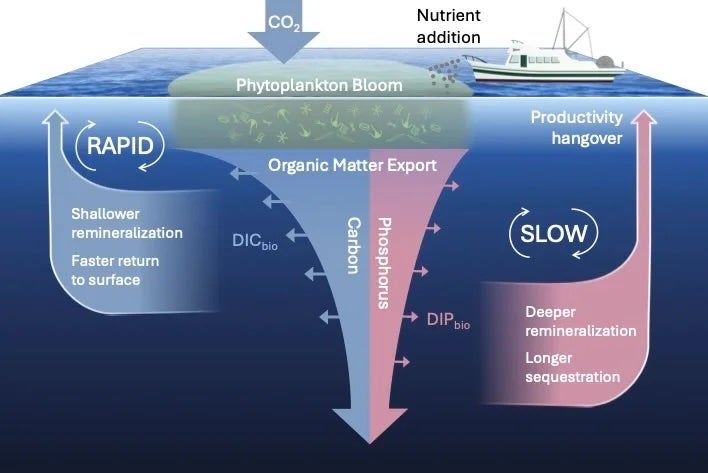
One widely discussed carbon removal approach is ocean fertilization, particularly adding iron to certain regions of the ocean to stimulate phytoplankton growth. Like planting trees on land, the idea is that increased growth will pull more carbon dioxide from the atmosphere. This biologically captured carbon then sinks to the deep ocean, where it can remain stored for decades to centuries.
Sullivan and her colleagues developed a modeling framework to run large-scale ocean simulations on high-performance computing systems. Their model tracked how both carbon and phosphorus, a key nutrient required for phytoplankton growth, move through the ocean over time. Because carbon uptake is tightly linked to nutrient availability, the simulations helped the researchers understand how carbon and nutrient cycles interact.
They found that carbon and nutrients do not follow the same timeline. Biologically captured carbon may return to the surface ocean relatively quickly, while nutrients such as phosphorus remain trapped in the deep ocean for much longer.
“This mismatch matters,” Sullivan explained. “If nutrients like phosphorus are locked away in the deep ocean, phytoplankton growth is suppressed, reducing the ocean’s ability to continue absorbing carbon dioxide.” The team describes this as a potential “productivity hangover,” where an initial boost in carbon uptake is followed by a longer-term slowdown. In other words, an intervention that appears successful in the short term may not deliver sustained climate benefits.
The findings suggest that some proposed marine carbon removal strategies, including iron fertilization, could overestimate their long-term impact if they focus only on carbon export without accounting for nutrient redistribution. As interest grows in ocean-based carbon removal projects, understanding these long-term nutrient feedbacks will be critical for accurately assessing climate benefits.
Sullivan’s research, which began as part of her Ph.D. dissertation at the University of California, Irvine and has continued at URI as a postdoctoral fellow, was published in the journal PNAS in February. At UC Irvine, Sullivan worked closely with her advisors, François Primeau and Adam Martiny. At URI, Sullivan worked with Keisuke Inomura, an assistant professor of oceanography, to further develop and refine her manuscript.