
In the summer 1963, Tom Rossby, then a young engineer, took on a question from one of the most influential pioneers in physical oceanography, Hank Stommel: Why does cold water sink in only a few polar regions yet rise slowly almost everywhere else? Rossby heated a tank of water unevenly from below. The water rose over a narrow warm region and sank slowly everywhere else. That upside-down ocean is what we now call the meridional overturning circulation, and it began a career focused on science and technology with the mission to measure how the ocean moves.
Rossby was born in Boston, Mass. on June 8, 1937, the son of meteorologist Carl-Gustav Rossby, and grew up in Chicago, Ill. and Stockholm, Sweden. He studied applied physics at the Royal Institute of Technology and admitted he was “tired of the continual gruel of homework and wanted to get cracking on my career.” Geophysicist George Veronis, physical oceanographer Joe Pedlosky, and Rossby’s mother pushed him to give graduate school a try and he earned his Ph.D. at MIT in 1966.
Stommel wanted to follow deep currents with neutrally buoyant floats, so he connected Rossby with Woods Hole Oceanographic Institution engineer Doug Webb. “I was one of many who benefited from Hank’s wonderful way of enticing people into the field and letting them loose,” Rossby said. The partnership with Webb worked well, and Rossby remembered that “Doug joked that his job was to put the sound in the water and mine was to get it out.” Their SOFAR floats were heard across the ocean by distant hydrophones and gave the first glimpse of abyssal motion. Rossby credited Webb with “instilling a sense of the possible—-seeing solutions rather than problems.” In the Mid-Ocean Dynamics Experiment, the floats revealed a deep ocean filled with eddies and Rossby waves, the phenomenon his father had first described in the atmosphere.
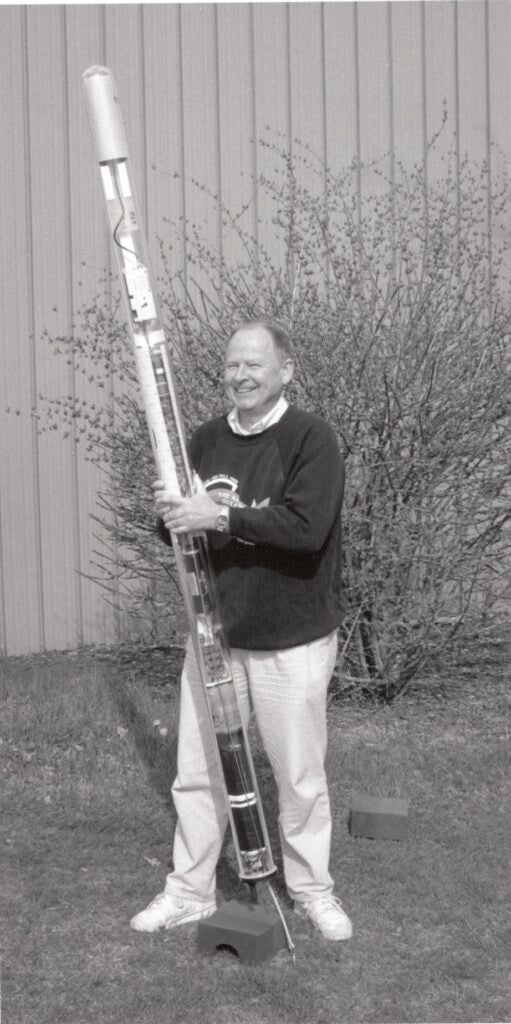
After WHOI, Rossby spent a few years at Yale, but he finally found his intellectual home at the University of Rhode Island’s Graduate School of Oceanography in 1975, recruited by Dean John Knauss. He assumed he would move on after half a dozen years, but he never did. His technology pursuits included contributions to the inverted echo sounder, the YVETTE and Pegasus velocity profilers, and the RAFOS float. RAFOS reversed the SOFAR design where a float listens instead of transmitting sound.
More innovations followed including isopycnal following floats, f/h floats to measure stratification, bottom-following floats to track deep overflows, and a miniature tag to track fish. In accepting the AGU Ewing medal in 2009, Rossby recognized the key role of engineers, postdoctoral researchers and students in these technical successes: ‘’Honestly, this honor is every bit theirs as mine!”’
“Tom helped set the trajectory of my entire life after grad school,” said URI Research Professor of Oceanography Randy Watts. “I owe so very much to him. I joined Tom at Yale in late 1972 as a postdoc. He handed me the inverted echo sounder project, and turned me loose. I received his encouragement and insights along the way and thrived.”
In 1992, with Charlie Flagg, they installed an acoustic Doppler current profiler on the M/V Oleander, which was the start of the longest-running record of Gulf Stream velocity. The Nuka Arctica, transiting between Greenland and Denmark, and the ferry Norrona in the Faroe Islands followed. Rossby called these systems “ocean-level orbiting satellites,” and he spent his later years urging the oceanographic community to join forces with the Merchant Marine to scan the ocean.
Rossby liked to say, “Oh, I am just an engineer.” His colleagues disagreed. Veronis called him “the most creative and important ocean engineer of the second half of the 20th century. Most of the cited references are involved with development of instrumentation that is novel or previously unavailable. But about half of Tom’s contributions have made use of these instruments to study dynamical and observational features of the flow in the world’s oceans. So his engineering contributions are also scientific advances.”
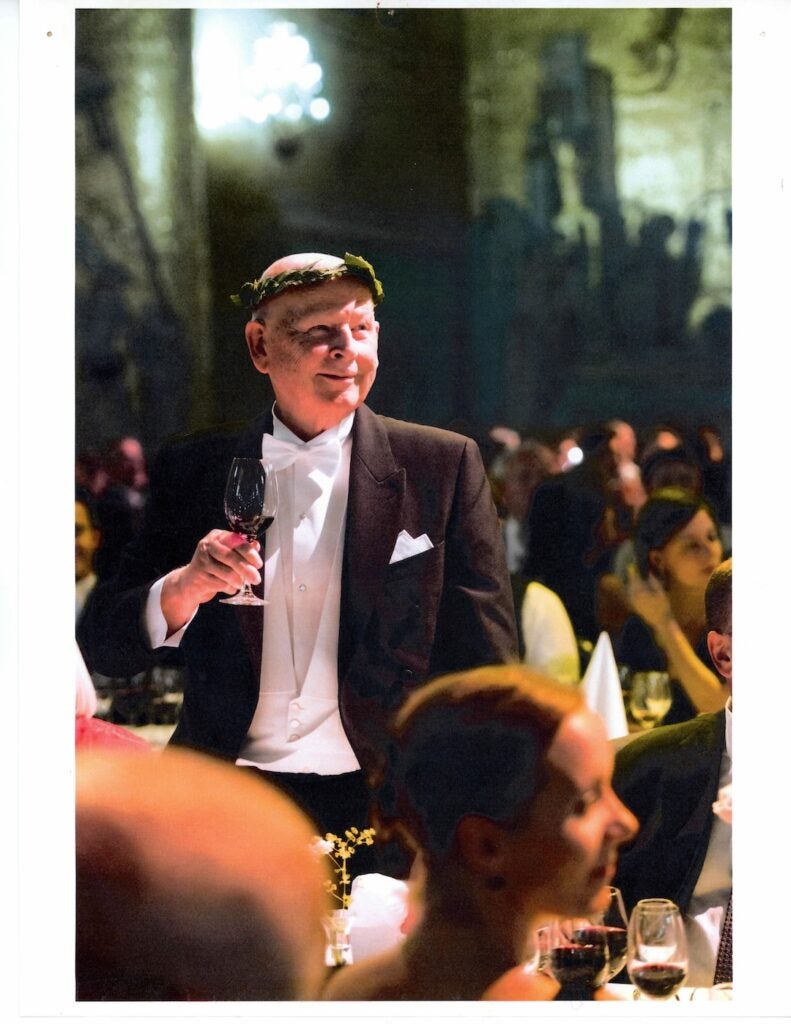
His honors included AGU’s Maurice Ewing Medal, The Oceanography Society’s Munk Award, the American Meteorological Society’s Suomi Award, and WHOI’s Bigelow Gold Medal. He was elected to the National Academy of Engineering, the American Academy of Arts and Sciences, and the Norwegian Academy of Science and Letters. He received an honorary doctorate from Stockholm University.
He had more ideas than time, so he gave them away. He regarded students as colleagues, and treated colleagues as friends. The community often gathered at his home for Friday happy hours, where he was happiest when we continued turning over an oceanographic problem or telling stories of life at sea into the evening hours. Rossby was a strong advocate for our community. “GSO’s strength lies in encouraging the faculty to be daring, to think outside the box,” he said. “My students and I were partners in this process, and I dare say it worked.”
Rossby remained a proud Swedish-American all his life. Entering his home felt like entering a bit of Sweden: the bright yellow house, the park-like yard and tea house. Swedish fabrics cover pillows, lampshades and furniture. The house is filled with artwork, including paintings by Rossby’s mother. He listened to Swedish television and news, and he loved and sought out opportunities to converse in Swedish.
Retirement in 2011 changed little in Tom’s enthusiasm for science and technology. At the Bay Campus lunch table, Rossby was a storyteller, from his father’s participation in the Conrad Holmboe expedition to Greenland in summer 1923, to whatever paper had provoked him that week. He engaged us in discussions about open questions in oceanography and preached for the observing systems he believed the ocean needed. In 2023, encouraged by Laura Glastra, he began Mr. Tom’s Blog. The collection of 130 posts reflect on Gulf Stream transport and the overturning circulation, along with stories about a 1954 eclipse watched from Gotland, sun dogs over Stockholm, and swim calls in the Gulf Stream. Any reader will be struck by his generosity, curiosity, enthusiasm, and wit.
Share a tribute
If you knew Tom, worked with him, or studied under him, we invite you to share a memory, a lesson, or a reflection on what he meant to you or to the field. Submissions will be posted on this page and attributed to you. Thank you for helping us honor Tom’s life and work.
Share your tributeTributes
In 1980, Tom took a chance on a 20-year-old physics major at Tufts University when he invited me to be a summer undergraduate intern at GSO, testing a new dissolved oxygen sensor for possible use on floats. I bumbled around in the lab, setting up a throughflow system with the parts and pieces that Tom piled on the bench and instigating more than one flood in Watkins Building! I don’t think I ended up with any useful results that summer, but this first opportunity to work at something no one had done before turned out to be my first steps toward a career in research.
In the following years, as a Ph.D. student in the Rossby Lab, working collaboratively with Tom, his engineers, technical staff, postdocs and my fellow students, I gained a broad understanding of what it takes to be successful in observational oceanography and have fun at the same time. The teamwork and camaraderie Tom fostered in the lab extended onto the many research cruises he led to the Gulf Stream and beyond. Even though it was not part of my thesis research, Tom took me on a cruise to study the structure of Mediterranean salt lenses (meddies) in the eastern North Atlantic with the Pegasus profiler, which he had developed. This introduction to meddies exposed me to new ocean processes, and set me up for my first NSF grant as an Assistant Scientist at WHOI, where we used the RAFOS float technology Tom had also developed to discover where meddies form. I so much appreciate the many opportunities I had to go to sea as Tom’s student—he often said that it was a privilege to spend time at sea, an environment on Earth that very few people have the chance to experience. I could not agree more.
Someone said Tom had more ideas than time, which is so true. Moreover, he was generous with those ideas—he didn’t care about getting credit—he just hoped to see the ideas flourish in the hands and minds of his students and colleagues. Tom passed on his fascination for the Lagrangian view of ocean circulation to me—he would often say that the trajectories of acoustically tracked floats, which trace out the motion of individual fluid parcels, “articulate what the ocean is doing in its own language.”
I’m sure that observing Tom manage his hearing loss through all the years I knew him helped prepare me for coping with my significant vision loss, which started when I was a grad student. Although we never discussed our coping strategies explicitly, his perseverance and success through decades when the number of scientists with disabilities could be counted on one hand convinced me that I could probably overcome my own challenges and continue to pursue a career in oceanography. Over the years, at conferences we both attended, we developed an unspoken partnership: he would help locate meeting rooms and I would repeat parts of talks and discussion that I knew he didn’t catch.
In Tom, I found an intellectual partner whose insatiable curiosity about how the oceans work matched my own, for which I will be forever grateful. I will dearly miss my good friend, mentor, and colleague. – Amy Bower, WHOI
Tom helped set the trajectory of my entire life after grad school. I owe so very much to him. The statement, “He had more ideas than time, …” is particularly pertinent. When I joined Tom at Yale in late 1972 as a postdoc, Tom had three big projects jointly with Doug Webb (WHOI – OE) for the Mid-Ocean Dynamics experiment (MODE) to develop SOFAR floats, Inverted Echo Sounders (IES), and a microstructure profiler concept that later evolved into YVETTE. The floats and IESs were already in the water. Tom needed help, handed me the IES project, and turned me loose. I received his encouragement and insights along the way, and thrived from the collaborative, daring ambience in MODE and from Tom’s many connections to colleagues. People would brainstorm together informally at scientific meetings about the broad range of challenges from microstructure to mesoscale eddies to general circulation, and of course about the engineering and instrumentation needed to address them. It was simply fun and inspirational.
In 1974 I got hired as Assistant Professor at URI and Tom started here in 1975. (In a sense his relatively unknown coat-tails arrived before him.) The cooperative and engaging atmosphere among Physical Oceanographers at URI grew, and interactions developed over the next few years throughout New England – from Columbia and Yale to URI, Woods Hole, MIT, Harvard, and Dartmouth. It was a very special time, and Tom’s enthusiasm and his insistence that ocean observations are the key to success helped hold it together. – Prof. D. Randolph Watts, URI
When I was hired at GSO Tom allowed us to stay at his house. We didn’t know it was the Newport Folk festival. He helped me to get my research program started as a new faculty member. Then, we had years of working together on projects and many cruises. It was great to be his next door office neighbour. I had daily discussions with him. It was always a pleasure. – Dave Hebert
I vividly remember getting to know Tom at the pantry of the Meteorology Department at Stockholm University, as a young PhD student. I was telling him I was working on the Nordic Seas dynamics, and he immediately got interested. He had already been working in the region for many years. Since that day we have been more than colleagues.
“I never put my head above the water,” he always said when I started talking about the atmosphere. It was his way of showing modesty, that he knew little about it, although he probably knew more than he admitted. That was him, humble, and caring too. Always talking to others so no one felt alone or left out, always supporting young scientists and colleagues, always willing to help.
It also happened that he received his honorary doctorate the same year as my PhD, and we were both at the City Hall that evening, which I will always remember. We have written a bunch of papers together, and it was always enjoyable and I learned so much from him. He never put pressure on things and never chased that high-impact paper. He was interested in doing the science, and doing it very well. For some reason I became his “altimetry guy”, as he used to call me.
He has supported me in ways I could never describe, and has been there for me throughout my career until this day. He welcomed me and my family at his house multiple times, and he was the main reason I did my postdoc in the US, and probably the reason I am still in research and doing oceanography today. Without him and his support I would never have been here. Despite my nagging about the situation for researchers and the lack of permanent positions, his answer was always “It will be fine”. Always positive, always seeing the beauty in things small and big.
Dear Tom, I am not really sure what my days will be like without talking to you and asking you all the questions I never dare ask anyone else. Thank you for passing on your knowledge and intuition for the ocean to me. I hope I can live up to a tiny fraction of what you were. Your presence, and you, will be hugely missed. – Dr. Léon Chafik, Stockholm University
Tom was a genuinely nice and pleasant person to be around. Although I’m no oceanographer, I learned a lot about the oceans from Tom to be sure, but that is not my main memory of him; it is his personality. Tom was a frequent guest at the International Meteorological Institute (IMI), hosted at the Department of Meteorology, Stockholm University; both institutions BTW founded by his father, Carl-Gustaf Rossby. For a while I was the IMI director and I had the pleasure to welcome him for several longer visits, and he was always volonteering to teach classes, give seminars – and always open for a discussion over coffe, about science, about life, about a lot of things because he was a whole person! When I was Chair, I had the pleasure to successfully nominate Tom for an Honorary Doctorate at Stockholm University, and I recall vidily when presenting him as such at a staff meeting in the coffee room. It obviosly became an emotional moment for Tom, I even think I saw a tear in his eye. And you can all see the pride in his face in the photo shown in the In Memoriam, toasting the speaker for all the honorary doctors on the banquet after the ceremony in the City Hall. It couldn’t have happened to a nicer guy! He will be missed, but all my memories of Tom are glad and happy ones. –Michael Tjernström, Stockholm University
Tom was friendly, kind and always excited about anything to do with oceanography and new ways to measure the ocean. My first project as a graduate student was with Tom and Randy, and, of course, involved a new technological approach to ocean monitoring. Our paths, unfortunately, have not crossed in many years but I have many fond memories of Tom. My condolences to his family. – Stephan Howden
I have always admired his curiosity and passion for science. In many ways, the MINION float we are developing today carries on his legacy. Years from now, if I still have the chance to send floats into the ocean, I know I will think of him. The floats he developed, and those inspired by his work, will continue to listen quietly in the deep ocean for signals from afar.
Rue and I will remember him. And whenever the sea breeze blows across Narragansett Bay, it will bring back memories of Tom and the Newport Jazz Festival. – Yixuan Song, URI GSO
Tom Rossby’s contributions to oceanography have shaped not only how we observe the ocean, but how we think about it. Through his pioneering work with Lagrangian platforms—especially RAFOS floats—Tom helped make it possible to follow the movement of water itself, revealing ocean circulation through the trajectories of instruments carried along with the currents.
When I started a faculty position at GSO in 2015, I moved into the office next to Tom. I had no idea how profoundly he would influence my early research directions, or how indelibly he would shape my career. Tom infected me with enthusiasm for Lagrangian measurements and helped guide me through the myriad engineering choices involved in building what he called “mini-RAFOS”—miniature versions of his floats. When I added cameras and biogeochemical sensors to the floats, he was both delighted and mournful (in his characteristic, cheeky way) about the core physical oceanographic opportunities he felt remained untapped.
Tom joined our biweekly lab meetings in 2018 and continued attending regularly until September of this year. He was a treasured resource, a mentor, and a friend to me and to all the students, postdocs, and staff in our orbit. His influence on our science and on our lives will endure, and he will be deeply missed. – Melissa Omand, URI GSO
I first met Tom as a SURFO student at GSO. He came to a cohort-hosted social wearing a bright Hawaiian shirt, smiling radiantly, and holding a bottle of wine. I was struck by his kindness and approachability. Tom was a key collaborator early in my graduate studies, providing data from the Oleander that I used in my master’s thesis and first publication. He was so gracious in sharing his time and ideas. Tom also took an interest in the remote sensing data I worked with. Backscattering imagery I showed in a student seminar piqued his interest; in his words, it was the clearest depiction of a physical phenomenon he had seen. We wrote a draft together early in my Assistant Professor days. It did not make it through first review, and I set the idea aside to prioritize funded work. Tom approached me a few times to revive the idea, most recently in 2025. Realizing now that these opportunities have an expiration date, I wish I had made the time… Tom’s joy for science and mentorship touched so many. –Colleen Mouw, URI GSO
Tom was a wonderful inspiration to us all. I remember fondly his participation and insights in seminars way back when I was at GSO, over 40 years ago. He was also always ready for and great fun at the social events. We would have such a good time discussing science and all manner of topics. He will be greatly missed by so many. – Deborah French McCay
Tom possessed a lot of good qualities. Arguably the most striking ones were his unbounded curiosity and his willingness to share his expertise with students and fellow researchers alike. I had the privilege to collaborate with him on multiple research projects, and I will dearly miss his critical feedback and helpful suggestions. With his passing, we have lost a great researcher and a very kind human being. –Godi Fischer, URI Dept. of Electrical and Computer Engineering EngineeringI
Tom was an absolute pleasure all around. His wit, intellect, humor, and general good nature put everyone at ease. I think we all loved his involvement on the Bay Campus, within Saunderstown, and of course globally within the scientific community. His science was incredible, his inclusiveness, down to the regular lunches at Mosby’s where everyone was welcome to join, made a lasting impact on the community at large. I was reminiscing how inclusive and thoughtful he was with everyone… right down to bringing a crock pot of Glögg (Nordic Mulled Wine) to a handful of parties we threw as students so he could share his culture and have a good time. I always appreciated his thoughtful and insightful comments and questions during the weekly student seminar series, where he always sat up front intently paying attention to each student talk. He really will be missed. -Matt Horn, Tetra Tech & GSO