
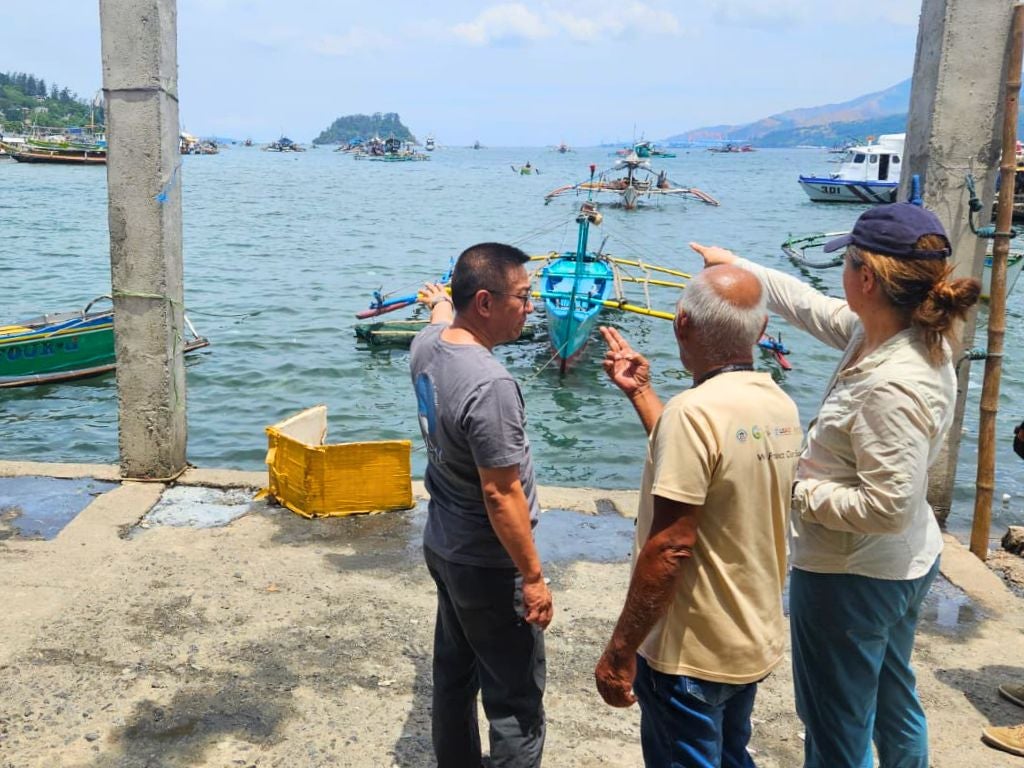
New phase of Fish Right Program expands research, student opportunities, and international partnerships
June 10, 2026
The University of Rhode Island Coastal Institute has received $24 million in new funding from the U.S. Department of State to continue its fisheries work in the Philippines.
Led by principal investigators Elin Torell, director of the Coastal Institute, and Tyler Pavlowich, assistant research professor, the initiative builds on eight years of URI-led fisheries management work in the region. The new funding will enable URI to work with coastal communities, Philippine government counterparts, and the private sector to address illegal, unreported, and unregulated fishing, and expand efforts in maritime domain awareness, sustainable fisheries management, and international collaboration, while creating opportunities for both U.S. and Filipino faculty and students to participate in hands-on research abroad.
The Philippines is recognized as a global center of marine biodiversity and ranks among the world’s top fishing nations, with an average annual catch of roughly 4 million metric tons. Fish and fish products are a critical source of food and income for millions of Filipinos, particularly families whose livelihoods depend on the sea.

However, marine ecosystems in the Philippines are under increasing pressure. Harmful fishing practices, illegal, unreported, and unregulated fishing, climate change, and the degradation of coral reef and mangrove ecosystems, are contributing to the decline of key fish stocks. In addition, developments in the West Philippine Sea have affected where and how some Filipino fishers operate. These changes have significant implications for food security, economic stability, and the long-term resilience of the fisheries sector and coastal communities.
“The small-scale industrial fishing fleet in the western Philippine part of the South China Sea faces many challenges, including declining resources and reduced access to traditional fishing grounds,” said Torell. “Through the Fish Right Program, we hope to empower these fishers as trusted observers at sea while improving real-time coordination, reporting, and access to information for those working at sea.”
Building on past successes
The new award builds on previous investment in the Fish Right Program, which was supported from 2018 to 2025 by the U.S. Agency for International Development through an original $24 million grant followed by an $8 million extension. The program was previously implemented by the URI Coastal Resources Center international team, which now works under the Coastal Institute, ensuring continuity in collaboration and implementation. URI’s engagement in the Philippines extends even further, with collaborative fisheries and coastal management efforts dating back to the 1980s.

The first phase of the program focused on operationalizing an ecosystem-based fisheries management framework across regions, municipalities, and the national government. From 2026-28, the next phase of the program will expand its work on maritime domain awareness, using scientific research to better understand marine resources, foreign and domestic fleet activity, and the links between fisheries and coastal ecosystems. The program will focus on small-scale commercial fleets operating along the western seaboard of the Philippines, including areas facing the West Philippine Sea, a region of increasing strategic importance.
The team will deepen its work in maritime domain awareness while continuing to strengthen fisheries management. A key component is a growing network of local fishers who document and report what they encounter at sea, from vessel activity to environmental conditions. Program leaders emphasize that this is a two-way exchange: “Fishing communities help ground-truth our data through real-time observations, while we are providing the tools and technical support that directly assist those working on the water,” said Sarah Gaines, director of international programs at the URI Coastal Institute.
At the same time, the initiative continues to explore the economic dimensions of fisheries management, including value chain development and private sector engagement, with the goal of creating economic opportunities, supporting long-term sustainability in coastal communities, and increasing U.S. business interest in the country.

Partnerships and student opportunities
The program is supported by a Manila-based team in the Philippines, including administrative and technical experts and field staff working at project sites. The effort is led in-country by Chief of Party Nygiel Armada, a fisheries scientist with decades of experience managing similar programs.
URI partners closely with PATH Foundation Philippines Inc., which provides additional field capacity and local expertise. Additional collaborators include Philippine government agencies such as the Bureau of Fisheries and Aquatic Resources and the National Maritime Center, as well as regional institutions including the Palawan Council for Sustainable Development. Together, these teams coordinate closely to advance shared goals while recognizing that the Philippines maintains ownership of its data and decision-making processes.
The partnership with the U.S. Department of State will also expand opportunities for both American and Filipino students to engage in hands-on research through the Fish Right Program. The initiative aligns with State Department priorities to provide U.S. students with international experience while strengthening academic and research collaborations with institutions in the Philippines. Six graduate students will begin studying at URI this fall with support from the program, benefiting from the opportunity to work together as a cohort using scientific, policy, and engineering perspectives to address pressing real-world challenges.
“The increased support for marine scientific research in this iteration of Fish Right is an opportunity to demonstrate the real-world impact students and faculty can have, especially when collaborating across disciplines as diverse as seafloor mapping, fisheries ecology, and ocean governance,” said Pavlowich. “It is a tremendous opportunity for students to learn about navigating intercultural and political dynamics, in addition to their academic work, as well as for URI to demonstrate its global reach.”
This continued investment reflects both the success of the Fish Right Program and the broader strategic significance of the region. By advancing sustainable fisheries, strengthening community networks, and deepening international collaboration, the work contributes to a more resilient, and economically secure coastal environment in the Philippines and beyond.
This story was written by Mackensie duPont Crowley, digital communications coordinator in URI’s Graduate School of Oceanography.