
Marine Technician V
Californian Finds East Coast Homeport
I grew up on the west coast, in California. During the school year I was living in northern California, but I spent summers in the San Diego area. When I was young, that meant going to the beach, exploring tidepools and snorkeling. Later I took classes at Scripps Institution of Oceanography, SeaWorld and University of California at Santa Barbara (UCSB) and learned about sharks, fish, marine biology and went snorkeling for class. While taking college courses at UCSB, I volunteered on short cruises to get some “hands on” experience. One trip had a marine technician, and I thought, “that’s s a really cool job.” I kept remembering that trip and that there was a person who did such work.
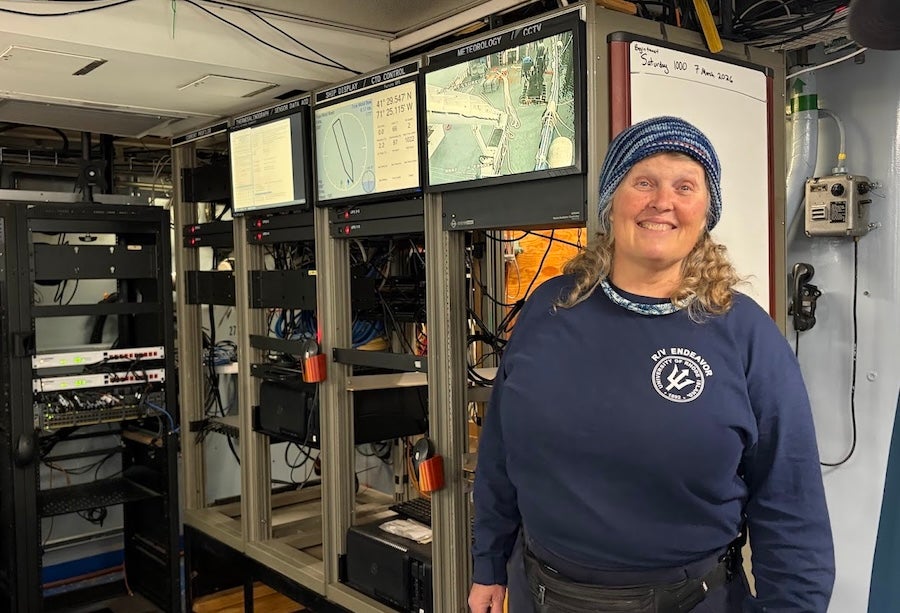
My first research cruise on R/V Endeavor was out of San Diego, Calif. I was working for the National Oceanic and Atmospheric Administration (NOAA) and Scripps. In 1998 there was a NOAA marine mammal cruise that involved three ships, including Endeavor. I was hired as an “oceanographer” for Endeavor for the 5-and-a-half-month cruise. We saw so much and I loved the work. In 1999 there was an opening for a marine tech on Endeavor. I was hired and I’ve been here ever since. I think I was the first female marine technician on Endeavor. This is my 27th year and I’m one of the longest serving crew members of Endeavor. And I’ll be continuing here, working on Narragansett Dawn.
Technically, the marine techs are not crew members but serve as a bridge between the crew and the science party. The responsibilities of marine techs vary depending on the size of the ship. Endeavor is a smaller ship, and the marine techs do a lot. For example, on Endeavor the marine tech communicates with the person manipulating the winch to deploy the scientific equipment. Another example is I work with crew members to make sure the continuous flowing seawater system has the appropriate pump for the needs of the science party. In addition to making sure all the appropriate data gets to the science party, I usually write a cruise report that is a summary of accomplished objectives and includes pictures of the science party.
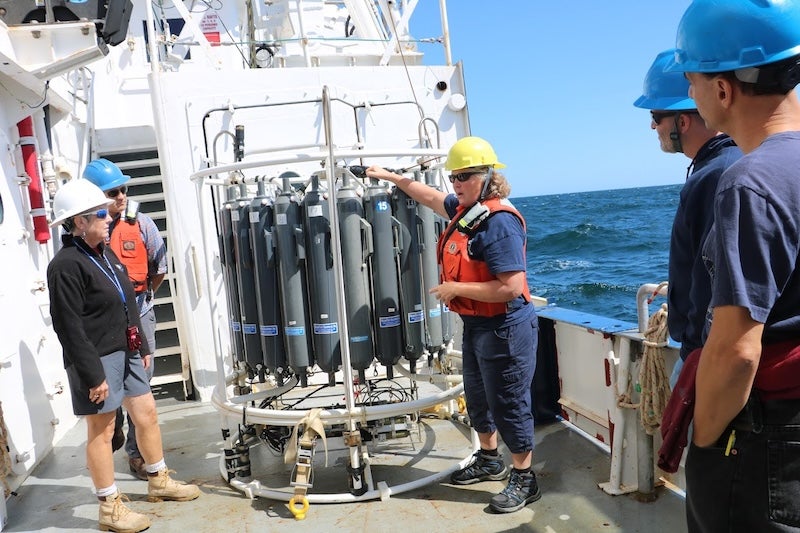
Endeavor has a tradition of long-serving marine techs. I worked alongside Bill Fanning who was here for 29 years and taught me a lot. Tom Orvosh worked on Endeavor for decades, was very skilled at electronics and designed the bow thruster and winch controls which are still in use. Dave Nelson was a marine technician extraordinaire, working here for 31 years. John Freitag was a marine tech and then became marine technician manager. What I like about my work as a marine tech is that each cruise is different, I’ve enjoyed each one I’ve been on. Some aspects are challenging, but I’m never bored, there is always someone to talk to, something to do and something to learn. I’m glad I can assist the scientists.