PFAS have emerged as national priority pollutants, and more than 2000 sites contaminated by PFAS have been identified across the U.S., including 180 EPA-identified Superfund sites. Elevated human exposures to PFAS have been associated with adverse health outcomes, including metabolic disruption, immunotoxicity, and endocrine disruption, although exposure-dependence and individual vulnerability need to be better understood.
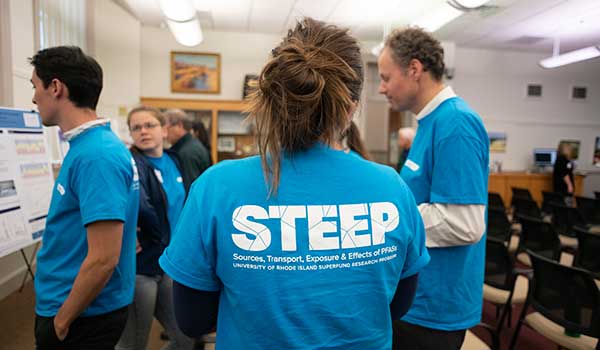
Building on the successful collaborative it established within the first grant cycle, University of Rhode Island (URI)-led STEEP (Sources, Transport, Exposure and Effects of PFAS) SRP Center will continue to further advance the science, training, engagement and outreach in support of SRP mandates. Researchers will continue to collaborate with state agencies in Rhode Island and Massachusetts and with federal agencies and will expand to work with state agencies in Delaware, Maine, New Jersey, and Michigan in support of their needs for knowledge on PFAS.
The environmental engineering and chemistry projects focus on the transport and transformation of PFAS precursors, as well as legacy, novel, and total PFAS. They developed and use novel detection tools support remediation of PFAS-contaminated groundwater, the atmospheric transport and fate of PFAS, and to predict bioaccumulation of PFAS relative to modeling predictions.
“One of the problems we face in the United States is that unfortunately, there is a combination of an anti-science bias that people are—for reasons that sometimes are, you know, inconceivable and not understandable—they just don’t believe science and they don’t believe authority,” Dr. Anthony Fauci said on a US Department of Health and Human Services’ podcast, Learning Curve
Building on their leading research on the critical effects of PFAS in children, with a focus on immunotoxicity and metabolism, and given the public health importance of breastfeeding, Center researchers will focus on understanding cellular mechanisms that dictate PFAS uptake and elimination into milk and accumulation in the infant, thereby advancing understanding of toxicokinetic mechanisms and potentials for preventing PFAS from reaching human milk.
Research projects, working with the Community Engagement Core (CEC) and the Data Management and Analysis Core (DMAC), will perform a thorough human exposure assessment for PFAS and risk assessment. STEEP trainees and mentors will remain key to the ongoing growth as a unified Center, via cross-cutting collaboration fostered by the Research Experience and Training Coordination Core (RETCC), and joint mentorship. The center also includes an additional focus on Diversity, Equity, and Inclusion (DEI) training for trainees and mentors alike.
Together, the STEEP Center goals aim to assess the distribution, transformations, and bioaccumulation of PFAS; investigate the processes affecting PFAS distribution and uptake and assess critical adverse effects in humans; engage new and established stakeholders across multiple sites; integrate STEEP internally and execute effective outreach and collaboration with stakeholders.
Tracing the Path of PFAS
STEEP is characterizing sources of PFAS through in situ groundwater measurements combined with geochemical modeling to assess transport and fate, including chemometric approaches to fingerprint sources of PFAS as a function of distance from the contaminated site. In other words, STEEP is a real-world CSI, figuring out where PFAS are coming from, where they are going, and where they end up—both in humans and the environment.
Determining Human Health Impacts
Researchers have conducted—and continue to conduct—parallel laboratory and human epidemiologic studies to assess the impact of in utero and early-life PFAS exposures on immune dysfunction and metabolic abnormalities. The relationship of PFAS will be used to derive benchmark dose levels to determine when PFAS levels move from less concerning to harmful. Through this research, researchers will determine how PFAS can impact a child through exposure in utero to PFAS in the mother’s body as well as how PFAS transfer from mother to child through the nutritional gold standard for infants—breastmilk.
Engaging the Community
High levels of PFAS can be found at firefighter training facilities that use aqueous film forming foams (AFFF). This is the case on Cape Cod, where the use of AFFF for fire training activities has led to contamination of public and private drinking water wells in Hyannis and other parts of the Cape. STEEP has sampled and tested for PFAS over 100 private wells on Cape Cod, and has engaged with the communities to discuss their PFAS exposure levels, listen to their concerns, and by working with local officials and regulators, help them to reduce their exposure to PFAS. Unfortunately, Cape Cod is not unique in PFAS exposure, and it mirrors the situation at hundreds of other sites around the country.
Spreading the word
STEEP has developed educational materials for communities on the human and environmental health impacts of PFAS based on the work of STEEP researchers. Outreach materials range from social to traditional media, from documentaries to print materials, from podcasts to virtual webinars, and serve audiences of diverse socioeconomic, racial and ethnic, and cultural backgrounds as well as ensure inclusion through the recognition of challenges that prevent or reduce community engagement and influence. STEEP remains committed to incorporating the most timely and best available science in its materials to ensure that community leaders have the necessary information as they decide whether prevention or intervention is appropriate to reduce PFAS exposure in their communities.
Passing the baton
We have moved from the age of “better living through chemistry” to the age of “better living through research,” and to ensure that environmental and human health challenges like PFAS are continuously addressed, STEEP is committed to training the next generation of scientists. The skills and knowledge that are passed on to these graduate students and post-docs today will enhance their ability to identify and hopefully mitigate these stable, long-living compounds in the future.
Coordinating the STEEP Effort
STEEP is led by co-directors from URI and Harvard T.H. Chan School of Public Health, Department of Environmental Health with guidance from STEEP partner Silent Spring and the Internal and External Advisory Committees. This expert perspective improves the daily interaction between and among STEEP’s projects and cores and ensures that STEEP is fully integrated with the NIEHS and SRP communities. STEEP leadership is instrumental in reporting progress, touting successes, and staying engaged with the larger PFAS science network as well as our fellow citizens.
A Cautionary Tale
It is too late for us to completely mitigate the impacts of PFAS. These “forever chemicals” are already in our environment and bodies, but lessons learned through STEEP will help communities avoid continued PFAS exposure. At a time when science is being politicized, STEEP remains committed to conducting thorough research and drawing sound conclusions. By keeping the focus on understanding the facts of science as opposed to “believing in” broad generalizations, STEEP provides tools for communities to understand the impacts of PFAS and to use that information to choose from a range of policy solutions.
These lessons learned through STEEP can also foster a stronger impetus to analyze potential harm of new chemicals before they are released into the environment. But this requires that regulatory standards are fully informed and ready to prevent harmful exposure, a structure that has not been historically adopted in the U.S. Currently, as the two most prevalent PFAS—PFOS and PFOA—are being phased out, the chemical industry is developing and releasing slightly modified versions of PFAS (e.g., GenX) without sufficient self-regulation or government oversight. The result is a high-risk game of whack-a-mole.