By Ellen Liberman
A strong breeze was blowing out of the northwest at 25 knots, gently rocking R/V Endeavor at the pier. At the dinner hour on this late October evening, the bridge was quiet, but evidence of the day’s activity could be found in the nest of disconnected cables on the bench and the empty spaces on the O1 deck. The bank of screens in the main lab continued to collect meteorological data, some of the ship’s historic artifacts, like a framed piece of the original Endeavour’s wooden rudder, were still on the library wall. But the flow-through science seawater system was gone and the ship’s vaunted ice cream freezer—which fueled many a midnight watch—was low.
Marine technician Lynne Butler opened the lid.
“All kinds of goodies in there. It’s a popular spot—especially when it’s hot out,” she says. “But we aren’t buying any more now because the ship is being retired.”
“She’s a working ship and she’s out there to get a job done and get everyone home safely.”Christopher Armanetti
After half a century carrying thousands of scientists, students, and teachers on 736 missions to 22 countries, the ship’s owner, the National Science Foundation, declared her mission accomplished. She became the oldest ship in the University-National Oceanographic Laboratory System’s (UNOLS) academic fleet of 17 vessels, garnering the prestigious “Order of the Ancient Albatross.” Endeavor outlasted her two sisters, her builders, her vendors, her shipyard. Crew members and scientists completed entire careers within her term of service.
“There are a lot of things on her that you’ll never see again, like the teak rails and all the woodwork,” says Captain Christopher Armanetti. “She has a lot of class, but she’s not the Queen Mary. She’s a working ship and she’s out there to get a job done and get everyone home safely.”
Frankie Frain, affectionately known as the thirteenth crew member—although he never sailed on Endeavor—kept the Gordian knot of pipes on the hydraulics deck going for 43 years, installing winches, servicing the hardware and replacing rotted deck and hoses as one of Endeavor’s long-time outside contractors.
Endeavor was laid down in Sturgeon Bay, Wisconsin, in the shipyard of Peterson Builders Incorporated, and named after another working ship, a Whitby-built collier that attained scientific distinction in the eighteenth century. Helmed by Capt. James Cook, HMS Endeavour explored the Pacific Ocean and observed the 1769 transit of Venus across the Sun. At 14 years old, she went to the bottom during the American Revolution, sunk by the British with four other transports to block French ships from entering Newport Harbor.
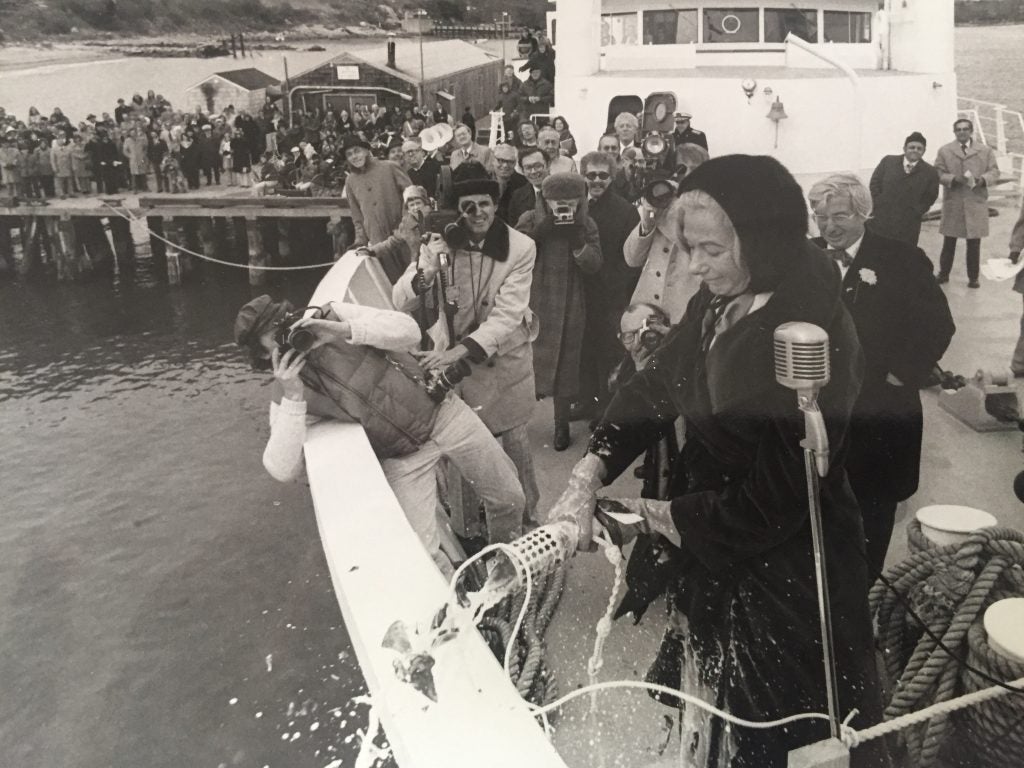
Peterson, founded in 1907, became a major U.S. Navy contractor during World War II, specializing in building small, complex boats. Its yards produced everything from mine sweepers to a floating aquarium for the New England Aquarium. In the early 1970s, the National Science Foundation hired Peterson to build three intermediate class regional research vessels. Oceanus and Wecoma were delivered in Nov., 1975. Endeavor was delivered to her home port at the University of Rhode Island’s Narragansett Bay Campus nearly a year later. On Dec. 11, 1976, she was christened in high-style as Nuala Pell, wife of U.S. Senator Claiborne Pell, broke a bottle of champagne over her bow and the Ram Band serenaded attendees at the GSO pier.
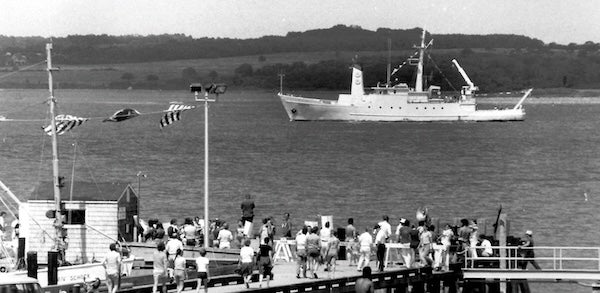
Endeavor replaced Trident, a 180-foot, World War II-era U.S. Army coastal freighter that GSO Dean John Knauss bought for a dollar in 1962. Trident was serviceable, but Endeavor would be intentionally planned for a crew of 12 and a science party of 16, with three deep-sea winches, 1,000 square feet of laboratory space, a cruising range of 6,000 nautical miles and a 17.6-foot draft.
D. Randolph “Randy” Watts, then a new assistant professor at GSO, was one of four faculty working with Boston marine architects John Gilbert Associates to develop Endeavor’s specifications, “leaving room for the most advanced electronics you could put on a vessel and for growth because it was expected to be around for at least 40 years. They did a lot of good research on Trident, but it wasn’t ever conceived of as a research ship. Endeavor was specifically designed to be the most modern research ship that could be built at that time.”
She arrived in Narragansett with a white hull and two smokestacks, one to each side of the main bridge.
“You had to walk around on the bridge in order to see around them. Everybody thought that was a little bit strange,” he says. “But they got used to it and it could be done safely.”
The staterooms were small, and below the waterline—no windows. The diesel engines and the air compressors were noisy. And, recalls retired Capt. Everett “Rhett” McMunn (the longest serving crew member in the ship’s history), “She rolled heavily. The decks were low and we were constantly taking on water.”
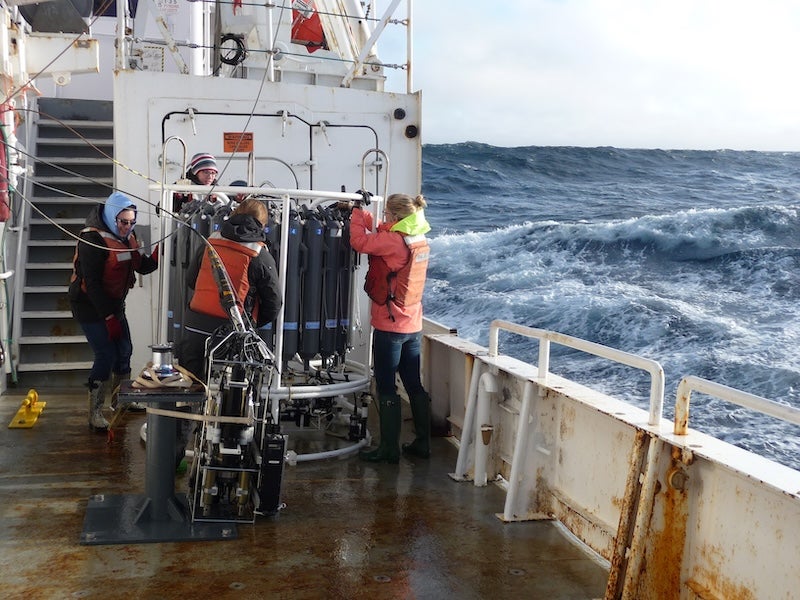
Still, says Watts, who completed 10 science cruises with Endeavor before his studies took him to other UNOLS ships and other regions, “I was real pleased with Endeavor. It was a great ship to work from.”
At a time before laptops and GPS via satellite, communication was once-daily by LORAN radio, data was stored on punch cards, navigation relied on paper charts, sextants and dead reckoning. Watts recalls the challenge of recording scientific observations.
“You ended up writing an awful lot of things by hand and then typing them up. It was tough reading a tiny thermometer on a rolling ship, banging around and then trying to work on a computer screen to enter the data and plot things up,” he says.
In 1993, Endeavor returned to Peterson for a mid-life refit. With design guidance from GSO, she returned with an improved superstructure, a single smokestack aft of the wheelhouse, eight more feet of fantail, and bilge keels that smoothed out her ride.
Life in a Microcosm
There was no typical day on Endeavor, but each was divvied into predictable, busy, 12-hour shifts—collecting samples, keeping watch in the pilot house or chasing rust. The captain might be meeting with the chief scientist and the marine technicians to discuss the daily plan, plotting a course, or doing the paperwork in advance of pulling into a foreign port. The marine technicians would be preparing the equipment, handling last-minute changes, or conferring with a counterpart taking the next watch. The steward would be occupied by checking ship’s stores, figuring out how to minimize food waste and preparing meals that could handle a full complement of food allergies and preferences. The bosun might be herding deck hands, overseeing loading and off-loading at the pier or overboarding and recovery of scientific equipment at sea. Bosun Steve “Oscar” Sisson describes himself “like Gumby, pulled in multiple directions.”
With the exception of the captain and chief engineer, scientists and crew typically bunked two to a stateroom. One’s estimation of the accommodations depended on previous experience. Compared to a commercial fishing boat, Endeavor’s living quarters were a level up. Marine technician Bonny Clarke, who washed her clothes in a bucket in her last job aboard a tall ship, was impressed with the laundromat-worthy washer and dryer. Butler described the staterooms as “cozy.”
The last five decades have seen major technological changes aboard Endeavor. Data acquisition and storage morphed from tapes to DVDs to flash-drives and large computer hard drives. The electric winches became hydraulic. In 1989, Endeavor was fitted out with GPS. Satellite communications replaced ship-to-shore radio; in the last decade, anyone on board with a cell phone could call home via satellite-connected WiFi. Data-presence was installed on Endeavor, so that land-based scientists could view data in real time or request a course based on direct observations of a video feed.
But some operations remained old-school. At times, the crew used paper charts, or Armanetti would take a position using the sextant his mentor McMunn handed down to him. Endeavor was one of a few in the UNOLS fleet without a computer-controlled dynamic positioning system. In the absence of automatically activated propellers and thrusters, holding the ship in place for hours to deploy an ROV or to take a deep coring sample required a deft touch at the helm.
“You’re playing the ship’s propulsion and steering against wind and current, and if you do it right, you can get it down to 0.0, 0.1 knots over the bottom for a good amount of time,” Armanetti says. “It takes a lot of focus and constant, fine-tuned adjustments. But you really get a feel for the way the ship handles. She’s very responsive.”
“It really is just a part of your life,” says McMunn. “It’s still a part of my life. I’m still having people over and I’m still getting the morning report.”
That camaraderie was built during card and board games, movie nights with a 16-millimeter projector, and equator-crossing ceremonies with homemade costumes and silly skits. Watts returned home from cruises with bruised shins from deck hockey games with sticks and crushed soda-can pucks. Alexander recalls gathering on the stern to swap tall tales, or in the wheelhouse trying to decipher the Red Sox games over a squelchy single-side band radio.
Professor Emeritus Tom Rossby, who sometimes reminisces about Endeavor on his blog, wrote about his last swim call (a pleasure abandoned for safety reasons) on Endeavor: “a lovely day, a good gang, and a pestering chief scientist,” he writes. “It was a glassy calm Sunday in April in the middle of the Gulf Stream. Some of us climbed down the rope ladder while others just plain jumped in…Those were the days.”
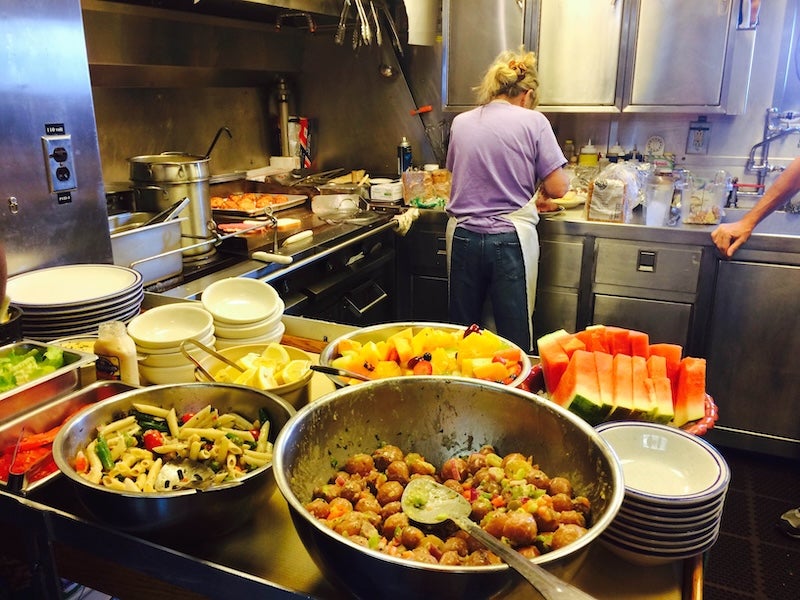
Endeavor’s last steward, Sugeng “Andi” Suwandi, who has fed large crowds on larger UNOLS ships and at Las Vegas hotels and casinos, said that running Endeavor’s galley “was like cooking for friends and family.”
A Million-Nautical-Mile Journey
Endeavor was considered a good sea boat, built to withstand the tantrums of the North Atlantic in winter. Most veterans can recount the sight of waves so steep they topped the bridge. During one Arctic cruise, the waves drove a log into the bridge just below the windows leading McMunn, who was a mate at the time, to quip, “I think we hit the North Pole.”
One November in the late 1990s, Endeavor got caught in a storm on the Grand Banks off Newfoundland, with 80-knot winds and 40-foot seas.
McMunn concedes “that was scary. But you have people aboard whose lives you are responsible for, so you put your nose into it and keep the speed so that you just go up and down and hope she doesn’t turn sideways, and roll or get over-washed—but we never came close to letting that happen.”
And that was one key to her longevity, says Port Engineer Dan Alexander, part of Endeavor’s small, but dedicated team for 27 years. “We ran her easy.” The other was a rigorous maintenance schedule that included annual inspections by the American Bureau of Shipping and dry docking twice every five years, to replace sea valves, probe the hull for spots that needed re-plating, and other repairs. Her GM engines and the Caterpillar generators were stalwarts of the industry. But keeping vintage 1976 machines in good working order was not getting any easier.
“The hydraulics system was very complicated and it was high-pressure so it was dangerous, too. In the end, nobody really wanted to maintain it,” Frain says.
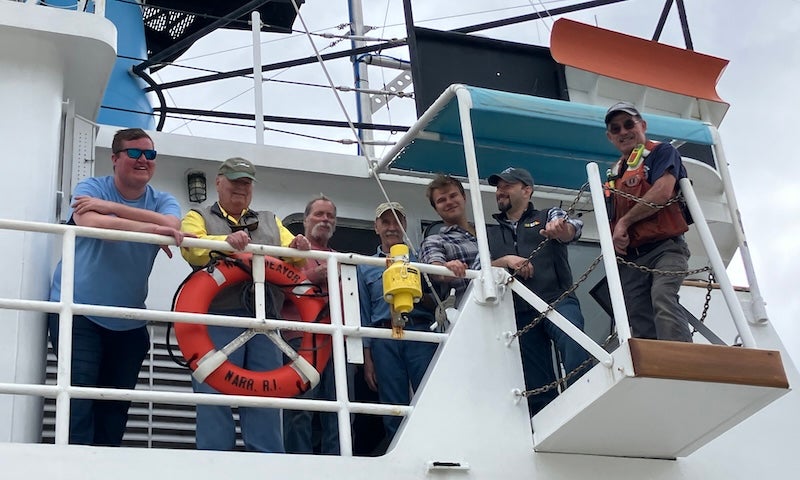
Most of the crew came aboard as relief, then transitioned to a full-time position and moved up the ranks. Sisson came from the commercial fishing industry, and he liked the steady pay check, the health insurance and the 401K retirement account.
Certainly, the crew liked each other.
“It’s hard to come to a new ship because everyone knows each other and it feels like showing up to a TV show in season eight, where so much has happened. Are you going to fit in? But I got to the ship and immediately people were so nice and welcoming that it felt like a home,” says Chief Mate Valmont Reichl. “A lot of people had been there for a really long time and they have been trained by previous people who had been there for a really long time, so it was generational and a really great place to grow and learn.”
Swan Song
On Sept. 20, 2025, Endeavor returned to her home pier for the last time. She’d spent more than three weeks in the Atlantic, off the northeastern coast of Newfoundland, where Canadian and American scientists collected water and sediment samples.
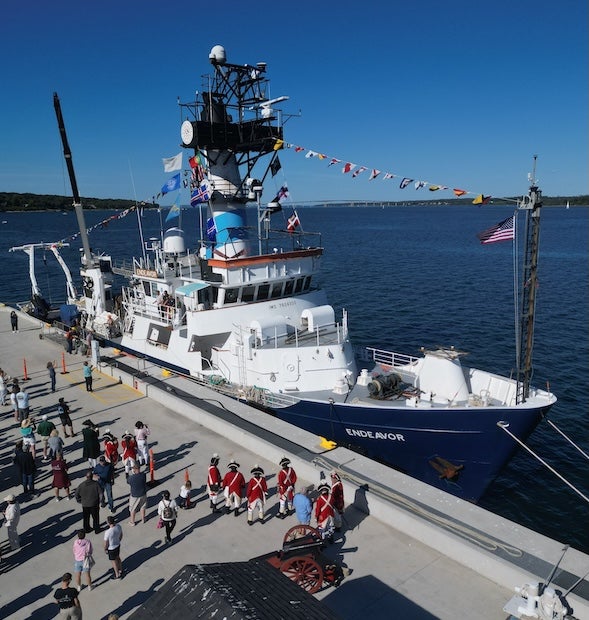
She entered the bay on a warm, sunny day and Armanetti and the crew gave her a paying-off for the books. A U.S. Coast Guard response boat escorted Endeavor, dressed fore and aft with pennants snapping smartly in the breeze, representing all of the countries she had visited.
“The entire crew of the ship came out and scrubbed, de-rusted, and shined her up.” Riechl says. “People put a lot of effort into making the ship look good for her last arrival. And everyone was really proud of how she looked and what it symbolized.”
A lone bagpiper, a fife and drum corps, and the URI Sea Shanty Social Club provided the score to this major-motion-picture ending. Two hundred of her closest friends—including former crew members who reconnected with their old mates for the final good bye—waited on the pier amid members of the Pawtuxet Rangers, dressed in Continental garb and firing their Revolutionary War three-pounder cannon. The Narragansett Fire Department came down and added to the farewell blast.
“It was bittersweet,” says Armanetti. “A sad day in some ways, but also something we’ll never forget.”
Endeavor will be succeeded by Narragansett Dawn, a 61-meter long research vessel funded by the National Science Foundation, operated by the East Coast Oceanographic Consortium, and moored at GSO’s pier. Endeavor’s crew is looking forward to getting to know the new ship. Narragansett Dawn will be equipped with the latest in high-resolution mapping and dynamic positioning, which will “really advance the science,” says Clarke. “It’s going to be a great asset.”
Right now, useful equipment is being stripped out before the crew takes her down to the last port.
“Over the years, we’ve all spent a lot more time on this ship than we have at home,” Armanetti says. “It’s going to be tough to pull that throttle back for the last time.”