
By Veronica M. Berounsky, Ph.D. ’90
“It’s so crazy to think about. We’re in Alvin, a mile and a half deep on the floor of the Pacific Ocean, eating peanut butter and jelly sandwiches for lunch, and we’re looking at a hydrothermal vent.”Sam Katz, M.S. ’21, Ph.D.’24
Growing up on the coast of Maine, being an avid sailor, and interested in science, it’s not surprising that Katz gravitated to a career in oceanography. But how that eventually resulted in deep sea research is a story that might not have happened without the influence of URI’s Graduate School of Oceanography (GSO).
Early Connections
Katz pursued his undergraduate education in land-locked Amherst, Mass. “With its innovative teaching methods, Hampshire College was a great fit for me, but living there convinced me that I really needed to live on the coast,” Katz said.
So Katz sought marine opportunities and, for the summer of 2015, landed a National Science Foundation Research Experience for Undergraduates internship working with Christoph Aeppli, Ph.D., at Bigelow Laboratory for Ocean Sciences. Aeppli and his lab were using passive samplers, which don’t have a pump to collect materials but relies on natural diffusion to detect petroleum compounds in seawater. “This was my first marine science research experience. Working at the Bigelow Lab and interacting with their scientists was amazing,” said Katz.
After college that work turned into a full-time position at Bigelow Lab. They worked with Aeppli’s postdoctoral fellowship mentor at Woods Hole Oceanographic Institution, Christopher Reddy, Ph.D.’98, investigating the aftermath of the Deepwater Horizon Oil Spill in the Gulf of Mexico. After learning of Katz’s interest in passive samplers, Reddy suggested he consider a graduate program where that technology had been used successfully for a number of years: GSO.
Making a Mark at GSO
Professor Rainer Lohmann had been working on passive samplers for a decade on poly- and perfluoroalkyl substances known as PFAS, and with colleagues had established the Sources, Transport, Exposure & Effects of PFAS (STEEP) Research Program. Katz visited GSO, enjoyed meeting members of the Lohmann Lab and found a new home there. “Sam displayed tremendous skill in making and improving a passive sampler for legacy pollutants (dioxins, PCBs), a tool that was integrated into an anchor could be launched from a boat,” said Lohmann.
Katz noted, “For my master’s research, I worked on PFAS in rivers and mudflats in New Jersey because they had a grant involving their Superfund site.”
Heading to Sea
Although Katz was focused on coastal work, he observed that “One of the assets of GSO was having Endeavor moored at the pier. So many people I knew went out on that ship.”
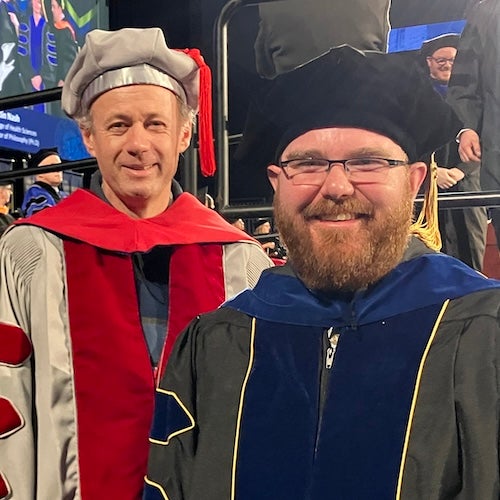
Lohmann wanted to better understand the cycle of long-lived carbon particles, called soot or black carbon, and was awarded a grant that included collecting samples in the Atlantic. Katz jumped at the chance to go to sea and happily worked on the new lab methods. Lohmann was impressed. “This required careful attention to detail in the lab, and Sam was able to perfect a method to analyze these black carbon particles in Atlantic Ocean sediment samples, even though their abundance was small.”
That cruise aboard R/V Endeavor was unlike any other. They departed in Feb., 2020, and all was normal as the scientists retrieved sediment cores and took water samples at 14 locations from Narragansett to Barbados and across the Atlantic. The goal was to establish an age for the black carbon found at the seafloor and determine whether it could be traced to recent African wildfires.
After completing the research, Endeavor arrived at Cape Verde on the day all flights back to the U.S. had been cancelled due to the COVID pandemic. The scientists and crew remained on Endeavor, which was free from coronavirus, and they rode the ship home. During the journey, Lohmann had time to talk to Katz about the funding he had for a Ph.D. student working on black carbon. Katz noted, “I really liked being at GSO, working with Rainer, and I wanted to do more open ocean work.”
The two-week passage qualified as quarantine time. So when the ship arrived (ironically on April Fools’ Day), everyone could go home. But they all wondered what exactly they were going home to. Once back in Narragansett, Katz kept working. “I had the whole lab to myself to finish up the estuarine samples for my master’s degree.”
Despite the extra challenge of defending his thesis virtually due to COVID, in the spring of 2021, Katz received his M.S. degree.
More Sea Time
By now, Katz was already well immersed in his Ph.D. research with Lohmann, with the samples for black carbon they collected on the Endeavor cruise. Because of connections he made on that expedition, Katz was invited to join a Spanish cruise that crossed the Atlantic laterally, from Brazil to Spain, collecting samples for black carbon from areas he had not been to previously. “On a cruise, Sam is fully committed and engaged no matter what time of day or how short the night was,” Lohmann said.
“I’m so happy when I’m out at sea on a cruise,” said Katz. “Although I have to admit I’ve only been on warm-weather cruises!” After processing all those samples and completing his dissertation, Katz received his Ph.D. in May 2024.
Branching Out and Down
In early 2024 Katz met University of Delaware professor and fellow GSO graduate Andrew Wozniak, M.S. ’04, who was looking for a postdoctoral fellow. “The extensive cruise experience Sam accrued and his expertise in the field of refractory black carbon in oceanic systems checked enough of those boxes for me to hire him for this project,” says Wozniak.
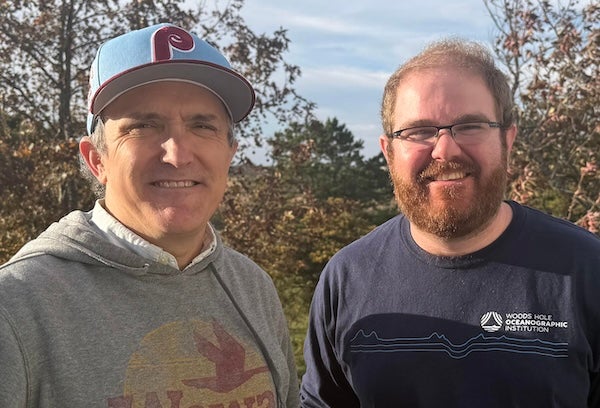
The research team was looking for evidence that black carbon was being released from hydrothermal vents. The project included a 36-day expedition on R/V Atlantis titled: “Vent-uring into the Deep” that left from Costa Rica and followed the East Pacific Rise—where two oceanic plates are spreading—for about 1,300 miles. R/V Atlantis is the support ship for the human-operated submarine Alvin.
In April of 2025, Katz descended in Alvin for his first time. “The images you’ve seen on the screen in the past are suddenly 3-D, and you have a new sense of scale and perspective for the immense topographic features down there,” said Katz. “Though it’s still hard to understand the scale with the hydrothermal vents towering above you.”
Katz traveled down with Alvin two more times. “When going through the trench down there and looking up, you think ‘oh, that’s a continental plate right there, and I’m not on it’—that’s incredible.”
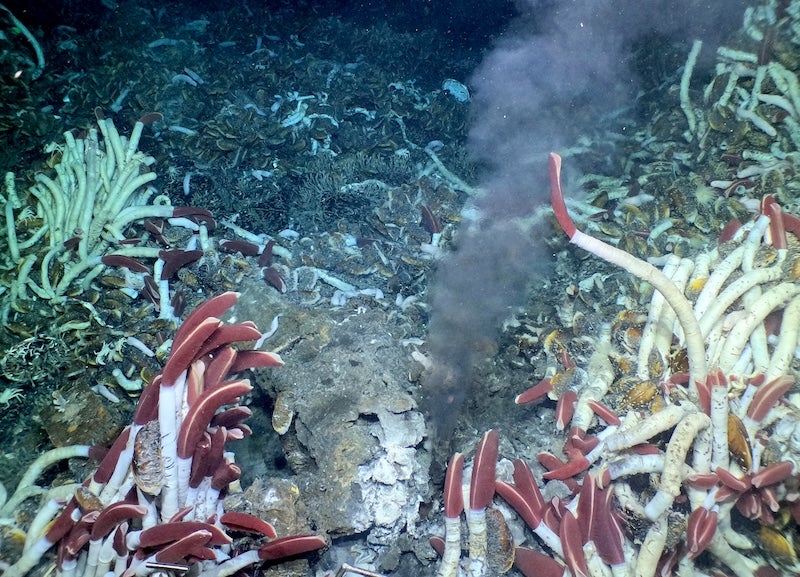
On April 29, while diving in Alvin, Wozniak and his colleagues witnessed the end of an undersea volcanic eruption at the hydrothermal vent site named Tica. The day before, they had seen the same area full of deep-sea life, now it was covered by lava. Katz could barely contain his excitement talking about that part of the cruise. “This was the first time an undersea eruption at a mid-ocean ridge had been witnessed. We have time zero points (time of eruption) at a mid-ocean spreading center!”
They sent cameras to the site a few days later and saw that organisms were recolonizing the area. Life in the deep sea continued.
Katz once simply looked out over the ocean from the Maine coast. Now he is carrying out research on some of the most unique deep-sea ecosystems—an unexpected trajectory shaped profoundly by his GSO experience. “I wouldn’t be at the position I am in today without GSO,” he said.