By Bill Ibelle
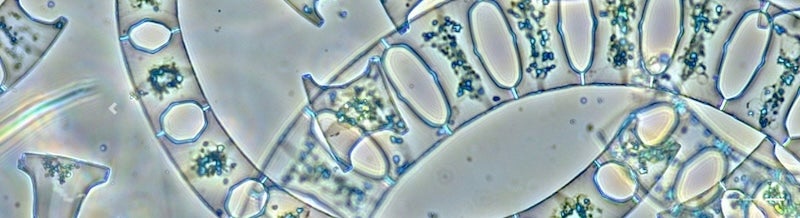
They are stunningly beautiful with intricate patterns as diverse as snowflakes. When seen through a microscope, they look like jewels laid out in a display case.
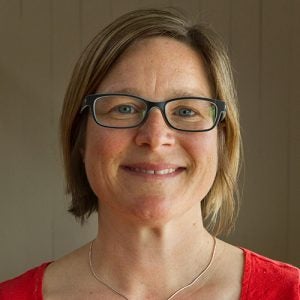
But that’s not why GSO Professor Tatiana Rynearson studies phytoplankton. The reason she’s devoted her career to these microscopic creatures is that they produce 50 percent of the world’s oxygen, pull vast quantities of climate-changing carbon dioxide out of the atmosphere, and—as if this wasn’t already enough—they feed the world.
Phytoplankton serve as the foundation of the marine food chain, feeding the zooplankton that feed the smallest fish and the largest whales. Those smaller fish, in turn, feed the larger fish, which feed even larger fish right up the food chain.
That’s why understanding the world of phytoplankton is critical in the ongoing battle against climate change. In many ways, these tiny creatures serve as the canary in the coalmine for ocean warming, and their decline could have a catastrophic effect on the earth’s food chain.
“Our work is to learn how the ocean food web works. With this understanding, we can figure out which variables cause fish stocks to decline or thrive,” says Rynearson. She notes that the Rhode Island fishing industry makes up a huge part of the state’s economy, supporting more than 3,000 jobs and generating more than $500 million in sales, according to a 2022 URI study.
The Spice of Life
There is a seemingly endless variety of these tiny creatures—tens of thousands
of species in Rynearson’s estimation. Their ability to withstand external pressures will vary greatly between these species. The continued health of the marine ecosystem depends on our ability to develop a better understanding of which factors are most important. “Their enormous variety creates the potential for the system to be extremely resilient,” she says. “We’re working to understand the effects of ocean warming by creating a record of changes over time and devising experiments to develop global models.” The Rynearson lab conducts field research all around the world. In fact, Rynearson’s work has taken her to all seven continents.
Narragansett Bay
One cornerstone of Rynearson’s work is the Narragansett Bay Long-Term Plankton Time Series, which began in 1957 and is one of the oldest plankton studies in the world.
“This study existed before I was born and will continue long after I retire,” she says. “It’s nice to know that I’m part of something that’s bigger than myself and my lab.”
The goal is to track the long-term impact of climate change and other man-made stressors such as human waste, fertilizers, and other types of nutrient runoff. To do this, Rynearson and her students make weekly trips out onto Narraganset Bay to take water samples. These trips occur year-round, rain or shine, on URI’s 53-foot stern trawler, Cap’n Bert.
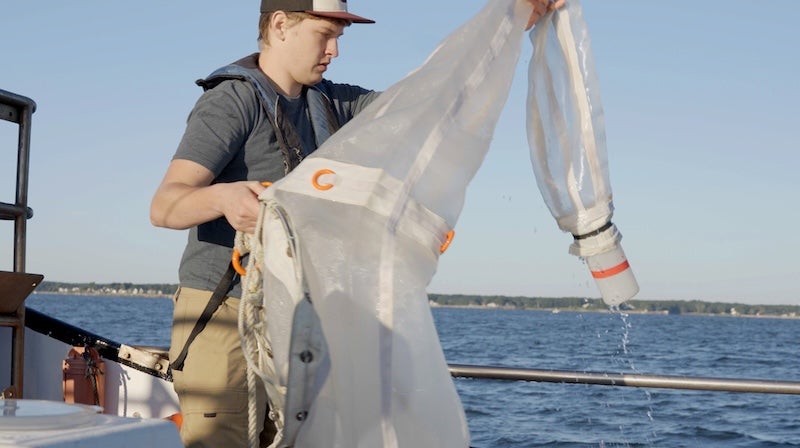
Third year Ph.D. student John Selby conducted those tests every week for the first two years of his graduate studies, collecting samples off Jamestown Island every Monday morning at 7 a.m. The study shows that, over the last several decades, chlorophyl production has been declining in the bay. This decline may be due to rising water temperatures and are likely to have an impact on Rhode Island fisheries. “Rising water temperature leads to an increase in harmful algae blooms which, in turn, cause shellfish closures,” he said.
The Continental Shelf
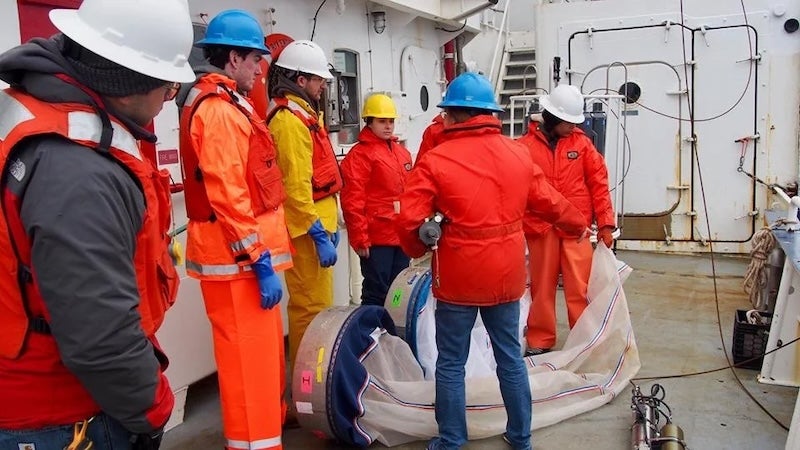
In another long-term study, Rynearson works with Professor Susanne Menden-Deuer who specializes in zooplankton. They serve as co-principal investigators on a project sponsored by the National Science Foundation. Their six-day missions to the waters south of Martha’s Vineyard took place four times a year aboard R/V Endeavor.
“It has been a solid ship that was well-designed for scientific expeditions,” says Rynearson. “We were out in all sorts of weather, flat calm to giant storms. There were times when you couldn’t put anything down without it flying off the lab bench.”
The goal of this fieldwork is to study the 100 miles of ocean between Martha’s Vineyard and the edge of the continental shelf. This relatively shallow region is one of the most productive fisheries in the region.
“We’re studying the area around the wind farms, and because the study existed long before the wind turbines were there, we can track their impact,” says Rynearson.
While Rynearson studies factors that cause various types of phytoplankton to thrive or faulter, Menden-Deuer studies the zooplankton that reside one step higher on the food chain. “I study predation in the food web—who eats whom,” says Menden-Deuer. While phytoplankton transform sunlight into organic matter, zooplankton eat the phytoplankton and then serve as food for larger marine animals. “Zooplankton predation is one of the least known elements of the food chain,” says Menden-Deuer.
As with the Narragansett Bay study, a long-term continental shelf study is needed to understand how climate changes affect this vital fishery. Because the marine ecosystem is so complex, URI collaborates with professors from all over New England.
“Endeavor has been an amazing ship with an incredible captain and crew,” says Menden-Deuer. “It has served as a ship, a dormitory, and a laboratory through every season and all kinds of weather.”
Going to Extremes
Not all of Rynearson’s field work takes place so close to home. In 2016, she served as the chief scientist on a five-week mission to Antarctica aboard the 308-foot icebreaker, Nathaniel B. Palmer. Her team included two URI graduate students, one undergraduate, a former grad student, and a technician.
Their goal was to study variations among the types of phytoplankton in different polar regions and how each species adapts to the pressures of climate change. They worked with another scientist from the University of Edinburgh to determine whether these pressures were forcing rapid evolution in some types of plankton.
“This was a great opportunity for students to learn the fundamentals of experimental evolution,” says Rynearson. “The changes in the species of phytoplankton that thrive could determine the species of fish that thrive or decline.”
But first they had to make the 400-mile journey across the Drake Passage, a legendary stretch of ocean between Cape Horn and Antarctica feared by sailors through the ages for its violent storms that can kick up 40-foot high waves.
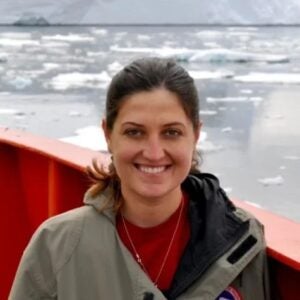
Stephanie Anderson, Ph.D. ’21, who now works for the U.S. Environmental Protection Agency, was one of the URI students on that voyage. She remembers the trip as an “epic” experience. Fortunately, the Drake Passage proved to be relatively calm for their voyage to the southernmost continent and once they got their it was another world.
“We saw penguins, leopard seals, and orcas hunting,” says Anderson. “Because they have no predators on the ice, the ship could come right up to them before they slid into the water.”
One of the most stunning moments was taking samples right off the Ross Ice shelf, an ice cliff that stretches 600 miles and has a vertical drop of more than 100 feet into the ocean.”
Rynearson was an excellent scientific team leader, according to Anderson, and her enthusiasm was infectious. Even their captain, who showed no interest in their science, was drawn in. “She convinced him to come down to our lab and showed him the plankton on the FlowCam, which displays the samples in real time on the big screen,” Anderson recalls.
The crew celebrated both Christmas and New Years onboard the ship, and when they finally reached the McMurdo Station on the last day of their voyage, the ship had to break through the ice to reach the docks.
A Microscopic Partnership
Rynearson is also fascinated by the variety of ways phytoplankton protect themselves. Some are spikey, some have tiny flagella to propel them out of harm’s way, and some develop shells made of glass, silicate or calcium carbonate plates. “They protect themselves in a variety of ways, which leads to a multitude of shapes and designs,” she says. Rynearson is now studying a specific type of phytoplankton that has evolved a highly unusual way of obtaining a limitless source of nutrients.
Very few creatures of any size on earth can utilize nitrogen gas, which makes up 78 percent of the earth’s atmosphere. One exception is the microscopic cyanobacteria, widely considered to be the oldest form of life on earth. Their ability to transform nitrogen into food is a pretty handy trick since it means they have exclusive access to this universally abundant nutrient source.
So imagine Rynearson’s delight when she learned that a particular species of phytoplankton has developed a way to take advantage of this talented companion by allowing cyanobacteria to live inside them.
“It’s quite an accomplishment, since it means this single-celled creature now has a free source of nitrogen for life,” she says. It’s a microscopic quid pro quo—food for protection. “The cyanobacteria get to live in this glass house, which keeps them safe from predators,” says Rynearson. “If you were a predator and had a choice to snack on a Snickers bar or a Snickers bar encased in glass, which would you choose?”
Paying it Forward
In addition to her work as a researcher, Rynearson also serves as teacher, mentor, inspirer and taskmaster, to a steady parade of undergraduate and graduate students. She has a warm, easy style with a talent for putting complex scientific concepts into language that is both entertaining and insightful.
She loves her role as teacher and says one of the things she likes best about her position is that she gets to work with students in so many different settings—in the classroom, in the laboratory, in small groups and one-to-one meetings, and on research vessels conducting fieldwork.
Selby has worked with Rynearson in virtually all of her roles—as teacher, lab supervisor, thesis advisor, and field researcher. In fact, his Ph.D. will expand on Rynearson’s work on the symbiotic relationship between diatoms and the nitrogen-processing cyanobacteria.
“This is an important relationship, because with the cyanobacteria on board, diatoms become a plant that can make its own fertilizer,” he says. “This makes it possible for them to thrive in areas of the ocean where there aren’t enough nutrients.”
Selby says that Rynearson is an incredible communicator. This was particularly important to him because he came into the program from bioengineering, not oceanography, and therefore had a lot of catching up to do. He said Rynearson’s ability to communicate complex material in such a clear fashion helped him develop confidence as an oceanographer.
“The best part is that I get to work with graduate students for five years, so I see them develop as scientists. At the beginning, they’re students, but by the end they’re colleagues.”