
By Michael Blanding
The sun shimmers off the blue surface of Narragansett Bay as URI students line up against the gunwale of a 26-foot work boat. “Maybe a little bit forward,” says mechanical engineering major Emre Barbosa, as the boat slowly maneuvers into position. “Don’t forget to tell ‘em ‘Engines off’ once you get a hook on it,” instructs Brian Caccioppoli, manager of the Small Boats Program at the Graduate School of Oceanography (GSO). Barbosa leans out with a long hook, and snags a bright orange buoy connected to a data logger, which measures temperature, oxygen, salinity, and other parameters in the water. “Engine’s off!” Barbosa yells as he retrieves the sensor and the boat glides to a stop.
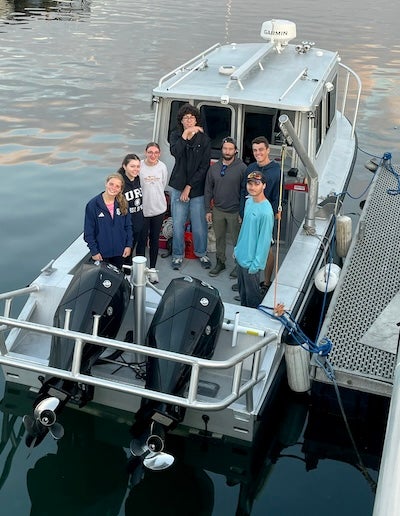
The students are participating in “Applied Coastal Oceanography,” a new hands-on class for first-year honors undergraduates that combines marine science with boat handling skills. Before the class, only one student had ever piloted a boat. Today, they’ve been taking turns at the helm as fellow students practice tying knots and deploying and retrieving sensors. “The students, drive, navigate, tie the knots,” says oceanography professor Chris Kincaid, who co-taught the class with Caccioppoli. “Brian and I did nothing—the students did everything.” One of the students even parked the boat at the dock at the end of the cruise, bringing it around to slide into a berth next to 42-foot research vessel, R/V Shana Rose. “It’s unbelievably tight,” says Kincaid. “You’ve got to do a three-point turn in a boat with $120,000 worth of engines—and one of the students did it. Brian had them doing things I just didn’t think possible.”
The class is just one manifestation of the Small Boats Program, which brings faculty and their students out on the water in a variety of craft to perform coastal marine science. Despite URI’s prominent oceanside location, only 200 or so students get out on the water in a given year. Even GSO graduate students are more likely to embark on a research vessel than to pilot a boat. In recent years, Caccioppoli has made it his mission to increase usage and improve training for faculty and students to promote use of the small boat fleet. With Endeavor’s retirement, and until Narragansett Dawn arrives, URI’s small boats are poised to serve an even more substantial role in research and teaching in Narragansett Bay and nearby coastal areas.
“Our small boats go into any imaginable body of water, in Rhode Island and beyond,” says Caccioppoli. URI’s small boats include everything from a 10-foot inflatable with an outboard motor to a newly acquired 45-foot research vessel, Warfish. (“It sounds a little menacing, but it’s actually a species that lives within the tentacles of a Portuguese Man O’ War,” he says.) In recent years, they’ve been involved in everything from shallow-water mapping in Acadia National Park in Maine to scanning the seafloor in Block Island Sound to prepare for the Block Island Wind Farm. “Our small boats allow us to study oceanographic and environmental problems in estuaries, rivers, ponds, and all sorts of coastal water bodies that aren’t accessible to a large research vessel,” Caccioppoli says.
He got his start in the lab of Emeritus Professor of Oceanography John King, who for many years used Shana Rose to take cores of the ocean floor in the bay. Already, he says, Caccioppoli has been receiving more applications from faculty to use the fleet of small boats as their research continues. Along with his supervisor, Marine Superintendent Ash Hayden, he’s been looking to see how Endeavor’s former crew can assist in operations, engineering and maintenance of small boats. “With Endeavor going away, this could lead to a new boom for small boats and additional interest in using small platforms to achieve similar goals.”
All along, GSO’s small boats have contributed to important science. Associate Professor Mingxi Zhou has used the 14-foot Marlon Jon boat to test autonomous underwater vehicles (AUVs). “The boat is really convenient for emergency purposes, in case we lose communication with the AUV and need to recover it,” says Zhou, who also takes larger small boats out into the bay. “I’ve used all different kinds of small boats,” Zhou says, from the 20-foot maritime skiff that’s useful in warm-weather conditions; to the 23-foot North Wind, a work boat that was formerly the tender for Endeavor; to the Shana Rose, a converted lobster boat with an A-frame that can deploy larger vehicles.
Some of Zhou’s research uses AUVs to map the underside of icebergs in order to better predict their behavior in warming waters. He’s able to simulate that by mapping the underside of Rock Island off Gaspee Point. “There are no icebergs in Rhode Island, so we are using that rock as an environment to test our systems,” Zhou says.
Professor Andrew Davies has also used a range of small boats for EPSCoR, a large-scale project funded by the National Science Foundation, to provide ongoing monitoring of physical conditions in Narragansett Bay. He has employed Shana Rose to deploy the heavy observational platforms, and smaller boats to monitor and service the equipment. “There are a variety of boats across the program, and across the university, so we can choose the platform we need depending on the task at hand,” he says.
Delivered in January, a 26-foot work boat was custom-built last year at Lyman Morse Metal Works in Thomason, Maine, using funds from the G. Unger Vetlesen Foundation, says Caccioppoli. It combines a sturdy aluminum hull with a diesel heater system and enclosed pilot house to keep occupants comfortable in adverse conditions. The boat was designed as an all-purpose research vessel, with a davit to deploy instruments, a towing bit for sonar equipment or nets, and a dive door to get close to the water.
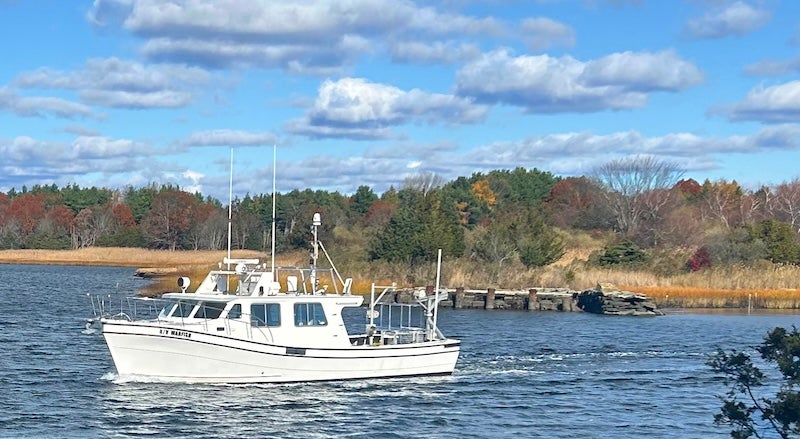
The latest addition to the fleet, Warfish, was donated to GSO and is set to take over for Shana Rose, which is nearing the end of her useable life. Not only is Warfish slightly larger, but it’s faster and carries more fuel, giving it a longer range. In addition, it has a gyroscopic system to keep it stable in high-wave conditions, and a large pilot house with a TV display that could be used to teach. “As is, the boat is ready to do science,” says Caccioppoli, making it a more robust substitute for Endeavor.
Caccioppoli has been spearheading a program to bring training to the next level. Even among the faculty at GSO, he says, there is a great variety in levels of experience. Working on small research boats falls into a gray area between recreational boating and the commercial merchant marine. Some people have learned by doing—that’s not always the safest or most efficient way. Last year, Caccioppoli went to the West Coast to become certified as an instructor by the Scientific Boating Safety Association for its Motorboat Operators Training Course, a four-day training course in boat handling and water safety. “I was floored by the learning that was done, and I thought ‘I want this for URI,’” he says. This past May, he hosted training at URI along with participants from Rutgers and Stockton University in New Jersey, and has heard from other universities who are interested in participating in the next one. “I think the training is going to snowball on the East Coast,” he says. “If I had to pick one thing I am most proud of, it’s developing that.”
Davies, who has taken the training, sees it as an incredibly valuable addition to GSO, not just for working on small boats, but for teaching safety and proper technique. “It’s a higher level of training than recreational boating because there is a scientific requirement, and it includes a lot of things that people don’t practice very much,” he says. “There’s a lot more emphasis on personal safety and safety of others, and really drilling that home—how to do this work, and go out and come back all in one piece.”
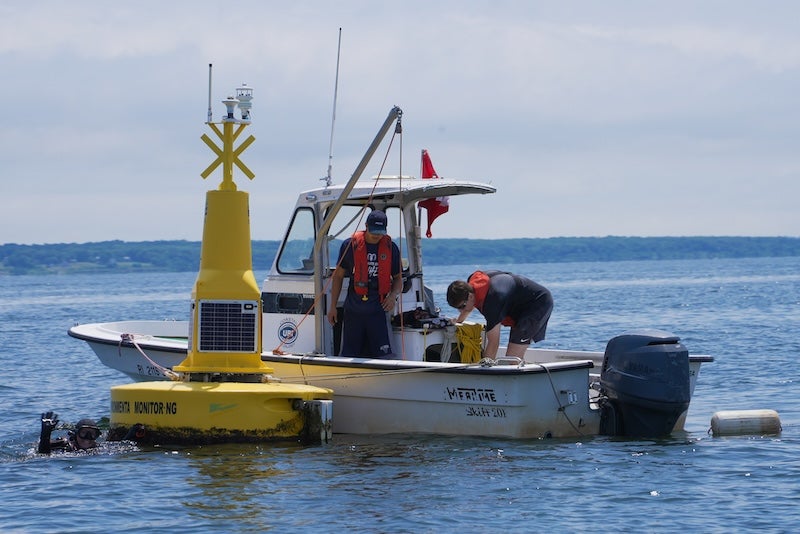
That training is incorporated into the coastal oceanography class, where students are incorporating safety procedures, such as a man-overboard drill in which they recover a heavy, waterlogged dummy named Ruth. The class emphasizes practicality in other ways as well, following a novel hands-on syllabus. Caccioppoli and Kincaid presented students with a real-world problem, a substance being flushed out into the ocean, which is harmless to sea life under 22 degrees Celsius, but otherwise toxic. By gathering data from the moorings in the bay, and analyzing it with MATLAB software, the students must design the optimal location for an outflow pipe. “Half of the time they are gathering and analyzing data, and the other half, they are learning knots and navigation and how to drive the boat,” Kincaid says
When the students first started, Kincaid says, they were nervous about driving the boat. “Now they are all eager to get behind the wheel,” he says. “They’ve developed confidence and skills now they’ll have for the rest of their life.” For marine biology major Phoebe Faucher, the class has been the perfect combination of theory and practice. “It’s been awesome,” she says. “The fact that I can go out and do research in my first semester at URI is such good experience. Instead of sitting at a desk or reading articles, we’re doing hands-on physical work.” She’s particularly excited about one of the finals, a proctored exam to earn a boating license.
“I hope it will enable me to drive boats out on my own, maybe perform my own research in later years.”
For Barbosa, the mechanical engineering major, the experience has been invaluable. The hands-on nature of the class has made the work more tangible, from snagging buoys and gathering data, to coding that data in the lab. “It’s amazing how applicable it is—we can see the whole process firsthand,” he says. “I’m excited to go back out and drive the boat again, and use all the instruments, and keep learning.”