
Data will help support conservation and sustainable management of deep-sea ecosystems
May 26, 2026
Researchers from the University of Rhode Island are contributing to an international effort to document life on Indonesia’s remote tropical seamounts—underwater mountains rising from the ocean floor that can host diverse deep-sea communities.
The expedition is generating some of the first systematic biodiversity data from tropical seamount ecosystems in the region and producing foundational baseline data on what lives on these features and how communities vary across depth and habitat.

The work is part of a collaborative project developed by researchers from Indonesian institutions and URI through a proposal selected under an open call organized by the Indonesian National Research and Innovation Agency (BRIN). The research team includes Drajad Seto, a postdoctoral researcher in URI’s College of the Environment and Life Sciences; URI Graduate School of Oceanography Associate Professor Roxanne Beinart; URI professor and Vice President for Research and Economic Development Bethany Jenkins, and University Gadjah Mada faculty Noer Kasanah.
During the three-week OceanX-BRIN expedition from Jan. 5–24, Seto served as the representative scientist for this research group on board the OceanX vessel, working alongside other scientists contributing to the broader expedition.

Filling a knowledge gap
Seamounts are often described as biodiversity “hotspots” because their topography can alter ocean circulation and enhance productivity. Organic matter produced near the surface can sink to support deep-sea communities far below.
Some seamounts host dense and diverse communities, while others appear comparatively sparse, and scientists still do not fully understand why. Factors such as depth, currents, habitat structure, and food supply may all play a role.
In tropical regions like Indonesia, home to some of the world’s most extensive seamount chains, basic biodiversity data remains scarce. Through collaboration with Indonesian scientists and institutions, the international research team aims to help establish baseline biodiversity observations that future studies can build on.
Mapping seamount biodiversity
The team’s research examines how animal communities change from a seamount’s summit to its deeper slopes and whether those differences track with declining food availability. Working in coordination with a diverse team of Indonesian scientists, the researchers used a remotely operated vehicle (ROV) to collect biological samples across multiple depths.
To assess biodiversity, the team combined environmental DNA (eDNA) metabarcoding with traditional DNA barcoding of organisms collected during dives. The eDNA approach detects genetic traces that animals leave behind in the water, allowing researchers to identify species without directly observing them.

However, interpreting those signals depends on having reliable reference DNA sequences. By collecting organisms with the ROV and generating DNA barcodes for them, the researchers aim to expand the reference databases needed to identify species in future eDNA studies, an important step for studying biodiversity in the deep sea, where many species remain undocumented.
From deep sea to surface
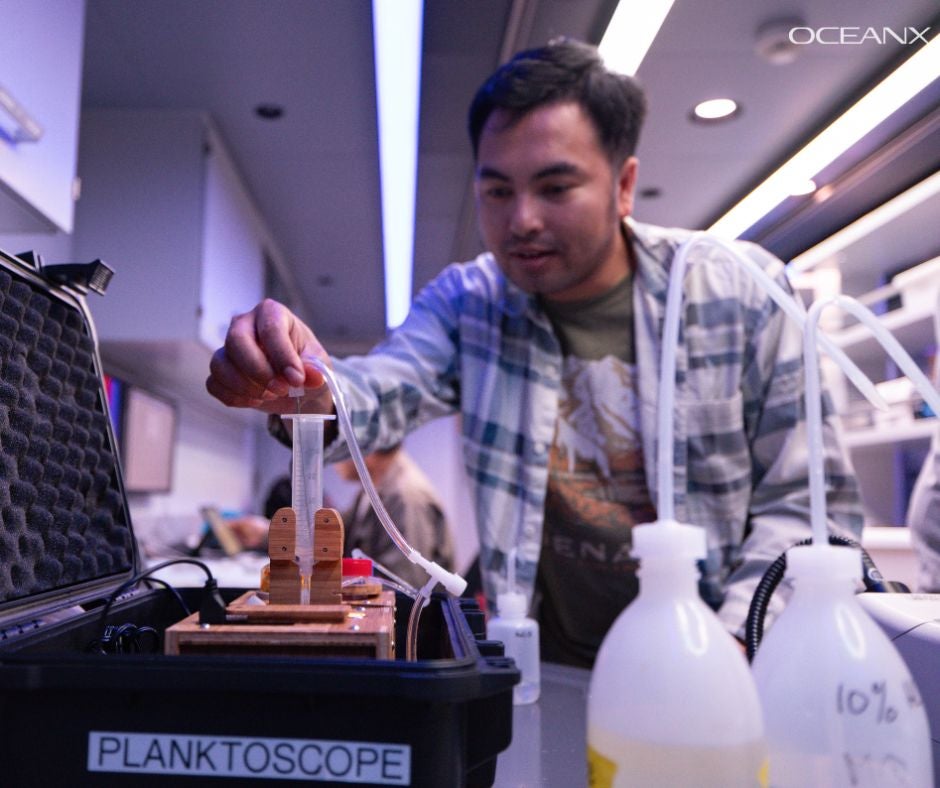
In addition to deep-sea sampling, the expedition documented plankton communities in surface waters above the seamounts. Using the ship’s underway seawater system, Seto worked with BRIN plankton scientists Mariana Intan and Ridho Sianturi to collect samples for imaging and genetic analysis and operated compact plankton imaging known as a PlanktoScope to improve detection of rare or fragile species.
Surface sampling revealed phytoplankton species associated with harmful algal blooms, events that can cause fish kills, shellfish toxicity, and fishery closures. The finding raises the possibility that offshore seamount regions could serve as reservoirs that seed or sustain blooms before they reach coastal waters, a hypothesis the team plans to investigate further.
Collaboration and next steps

The expedition brought together a large and diverse team of Indonesian scientists from BRIN, multiple universities, and NGOs, each contributing expertise ranging from deep-sea ecology and taxonomy to oceanography and plankton science. Because Indonesian regulations require biological samples to remain in-country, Seto will continue the work through ongoing collaboration with BRIN, conducting DNA and RNA extractions, amplification, sequencing, and bioinformatics analysis to integrate the imaging and molecular evidence collected during the expedition. This work will help identify species and build a clearer baseline of biodiversity on Indonesia’s seamounts.
For Seto, who also completed a submersible dive to approximately 950 meters at a seamount summit during the mission, the expedition marked a scientific and personal milestone.
“I learned a tremendous amount from the Indonesian science team and the OceanX crew,” Seto said. “This mission is helping build new baseline knowledge of tropical seamount ecosystems, and that’s essential for understanding and protecting deep-sea biodiversity in Indonesia.”
This story was written by Mackensie duPont Crowley, digital communications coordinator in URI’s Graduate School of Oceanography.