
Rhode Island Network for Excellence in Science and Technology institutions discuss barriers to, opportunities for research collaboration
November 10. 2026
Several University of Rhode Island students joined their counterparts from several partner institutions around the state last week to display their dynamic research projects during the annual meeting of the Rhode Island Network for Excellence in Science and Technology.
Representatives of URI, Brown University, Rhode Island College, Rhode Island School of Design, and Roger Williams University met at RISD to discuss Rhode Island’s collaborative research ecosystem as part of the organization’s efforts to broaden opportunities for research and science education, improve and extend collaboration among local researchers, and strengthen workforce development by creating pathways to high-tech careers.
During a panel discussion, members of RI-NEST and the partner schools discussed the importance of collaboration on research projects among the member institutions, and the barriers to such collaboration, including finding time to build research teams during academic periods at teaching universities, and a need to better promote Science, Technology, Engineering and Math programs at the high school level to build a pipeline of new researchers.
Collaborating on research is in large part welcoming multiple voices who feel welcome included in the conversation, according to Daniel Roxbury, professor of chemical, biomolecular, and materials engineering at URI. Meetings like the RI-NEST annual gathering are opportunities to bring diverse people and ideas together, something researchers should engage in more.
“We have R1 institutions, we have private institutions, public institutions; there are so many different backgrounds and cultures,” said Roxbury, who is principal investigator on microplastics’ socio-ecological impact on coastal ecosystems. “There is very limited time during the academic year for in research. We’ve tried to work around these limitations. It’s about making spaces for people to meet, talk about their interests and differences, and finding those commonalities that will lead to future projects. This culture of inclusion is highly regarded among our projects here.”
U.S. Sens. Jack Reed and Sheldon Whitehouse addressed the contingent of Rhode Island researchers, touting the success of RI-EPSCoR projects and stressing the importance of continuing to foster such important research in Rhode Island, some of which was on display at the meeting as students and professors from member institutions touted their work.
Several URI students from the colleges of Engineering, Environment and Life Sciences, and Pharmacy, as well as the Graduate School of Oceanography displayed their research projects, and discussed their studies with professors, fellow students, and passers-by.
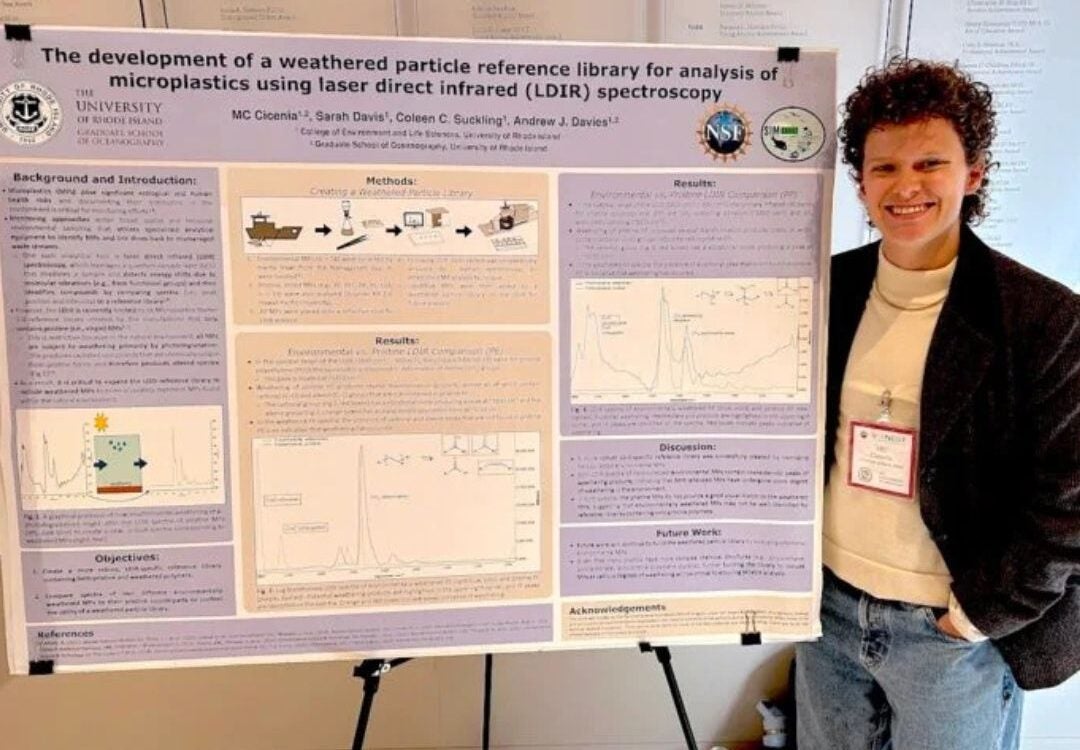
Among the presenters was MC Cicenica, a Ph.D. student at GSO who is studying analytical techniques to identify microplastics in the environment and building a library of “weathered” microplastics that aren’t often recognized and included in such databases.
Scientists typically use laser-direct infrared spectroscopy—the process of directing a laser at a particle and examining the unique spectrum reflected back to identify the particle’s chemical substance—to identify the polymer used in the plastic item, which helps lead to the microplastic’s source. However, when a microplastic is weathered, the chemical structure can change, making it difficult to identify the polymer, or whether the substance is a plastic at all.
Since all plastics that have been in the environment for some time are weathered, they can be misidentified. Consequently, most spectral libraries contain only “pristine” plastics, potentially leading scientists to underestimate the amount of microplastics in the environment.
“It’s important to have a robust understanding of what types of plastics are out there,” Cicencia said. “We know that microplastics are in the environment, but knowing which types are prevalent —whether its polypropylene or polyethylene, for example—can give us a better idea of the sources of microplastics. Maybe it’s a wastewater treatment plant or laundry effluent. It helps us reveal broader patterns that we might not otherwise see.”
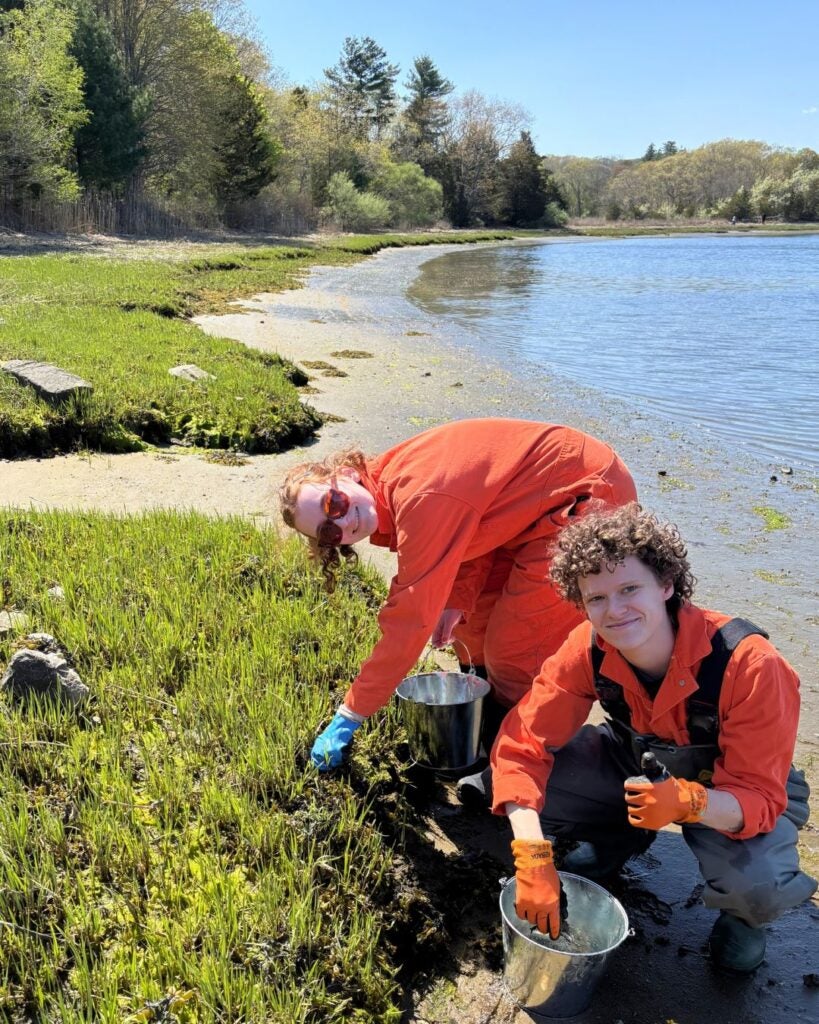
Cicencia and her team are building a reference library of microplastics that includes those weathered microplastics they collected and identified. The database can help researchers better match and identify plastics in the future.
“We’re hoping to get this on paper soon, and it will become a public resource other scientists using this instrument can build upon,” Cicencia said. “It’s a good starting point for other research.”