
The IACR Infrastructure group provides URI researchers access to cutting-edge computing equipment (AI/Data/HPC/Quantum), software and hands-on training, support and consultancy to enable computational research. The IACR’s Infrastructure group is led by Kevin Bryan and includes Cecile Cres, Christian Vye and several PhD students. A quick snapshot of the IACR resources is available here: IACR at-a-glance. For details on the broad topic of Generative AI, and the relevant university-wide efforts and guidelines, please visit the URI Provost’s AI page.
Research Computing Capabilities
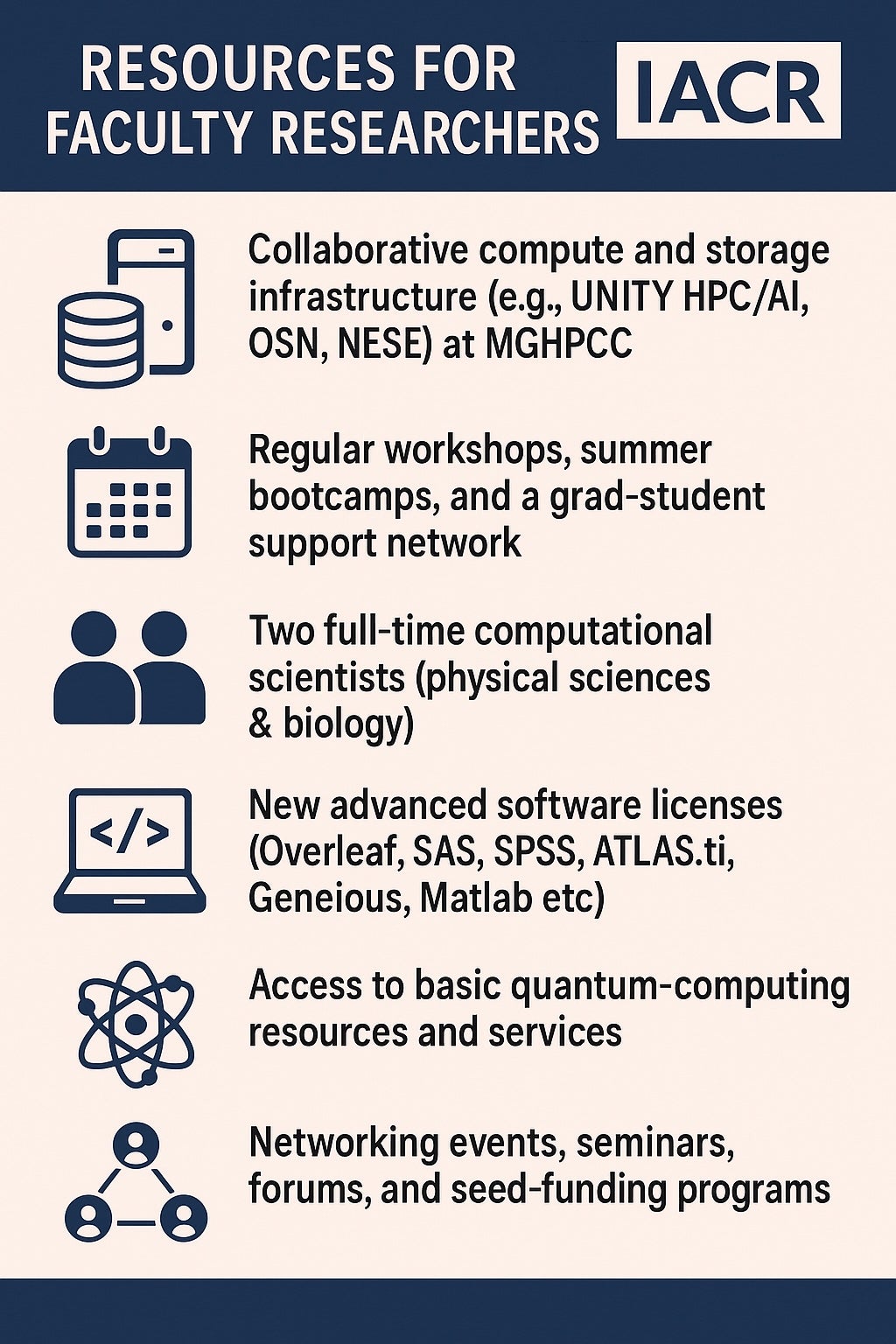
- Partnership with the Massachusetts Green HPC Center (MGHPCC)
- Distributed research computing support through trained GAs in each College
- Replacement of older URI HPC clusters (2021 investment)
- Overleaf Professional subscription for Faculty and PhD student research use
- Research Computing Network (RCN)
- Partnership with the Open Storage Network
- Quantum computing services
Services & Resources
- Multiple HPC clusters: Unity and SeaWulf; Harmony and Sanctuary are in pilot use
- Cloud Computing
- High-performance servers, private servers
- Statistical Software, Services, and Resources (SAS, SPSS, R, JMP, MATLAB, Geneious, Atlas.ti, Qualtrics, Overleaf)
- NIH-STRIDES program
- Sample proposal documents (Facilities, DMP, etc.)
- University-wide software platforms (e.g. R Studio Server, JupyterHub, etc.)
- Training/consultation
- Web/database hosting and resources
- Data storage platforms at URI
Our Team

Kevin Bryan
Manager, High Performance Computing
401.874.5528
bryank@uri.edu

Christian Vye
Advanced Application Specialist
401.874.2966
christianvye@uri.edu

Cecile Cres
Computational Scientist, AI/ML

Leann Biancani
Student Computational Biology Facilitator

Shaghayegh ‘Shay’ Sahraei Joubani
Student Statistical Consultant and Trainer
401.874.2815
s.sahraei@uri.edu

Nikola Bukowiecka
Student Physical Sciences Facilitator

Farhang Naderi
Student HPC Facilitator — GSO
Other Related Resources
Here are some services offered by various other URI departments and organizations, which often are relevant to researchers:
- URI Library AI Guide: Resources related to AI use, tools, etc. for faculty/staff are maintained by the URI Library.
- URI VPN Service: This is often needed for accessing some servers and services from off-campus and abroad. If you’re planning to travel abroad and need this service, it’s especially important to set this up ahead of time, before you leave — it’s quite difficult to set up while abroad.
- Consultation on related IT services (VPN, security, secure data transfers, SSL certificates, etc.)
- Safari (O’Reilly) Online Books and Videos: A great collection of technical reference books and some training videos on a wide variety of technical topics — e.g. programming, data science, artificial intelligence, etc. The URI Library has acquired access for anyone with a URI email address.
- URI ITS Training Courses: Periodically offered introductory courses covering a wide range of topics, including the Google Suite, draw.io, Excel, Video management and caption, and more!
Drop by the IACR at URI Carothers Library 227 or email us at iacr-group@uri.edu with questions, comments, suggestions — anything!
News
 New Spring Course: Applications of AI Methods Across STEM Disciplines - Graduate students (master’s and PhD) in any STEM field can learn applied AI for their research in Spring 2027 in PHY 591 AAI4STEM: Applications of AI Methods Across STEM Disciplines. To enroll, register for PHY 591-0001, listed in the catalog as “Special Problems.” The course meets Tue & Thu 11:00–12:15 in Swan Hall 211 and is capped […]
 URI AI Retreat: AI and Advanced Computing in Research - Faculty and graduate researchers from every discipline are invited to the URI AI Retreat on November 6 at the Mosby Center to connect, exchange ideas, and explore AI and advanced computing in research.
 URI Faculty and Students Offered Free Access to AWS Kiro - AWS is offering URI students free access to Kiro, an AI-powered development platform, with complimentary access also available for participating faculty.
- URI Releases 2026 AI Task Force Report and Campus AI Resources - URI’s new 2026 AI Task Force report highlights progress and recommendations for thoughtful, responsible AI across teaching, research, and University operations, with links to campus guidance, workshops, and research support.
 NSF Opens New AI Infrastructure and AI-Ready Dataset Opportunities - Two new NSF solicitations may interest URI teams working with AI, scientific data, research computing, and cyberinfrastructure. Full proposals are due November 4, 2026.